Warmer water, stressed ecosystems: Climate change is warming the oceans, lakes and rivers. Each species can live only within a range of temperatures, so warming moves fish, changes food webs and can make some populations collapse.
The points to remember
- Tropical waters: warmer water cuts fish stocks and raises deaths; cold waters may gain fish for a while.
- Fish shift to cooler water, nearer the poles or deeper, changing migration routes.
- Warmth lowers young fish survival and breeding success.
- Warm water holds less oxygen, which kills animals that cannot move away, on the sea bed.
- Coral bleaching destroys reef habitat and the food webs on it.
- Melting ice lowers salinity; currents, upwelling and storms change, moving nutrients and plankton.
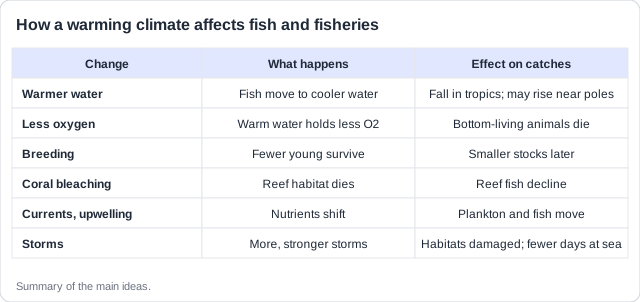
Example (SL): the North Sea. The North Sea has warmed by about 1 °C since the 1980s. Cod, a cold-water fish, have moved north and into deeper water, while warm-water fish such as anchovy and red mullet have become more common.
Name the change: Not 'climate change affects fish' or 'global warming changes migration' alone: say what changes (temperature, oxygen, CO2) and what it does to the catch.
Free preview
This is the free notes preview
You're reading the free notes. Aimnova Pro unlocks the full study experience — and you can try it with your first topic free to keep:
- FlashcardsLock in vocabulary and key terms with spaced repetition.
- Practice questionsAnswer exam-style questions and get instant AI marking.
- Mock exams & past-paper vaultSit full mocks and see exactly how examiners award marks.
- Personalised study planA daily plan built around your exam date and weak areas.
Corals get most of their food from tiny algae that live inside them. When the water stays too warm for weeks, corals push the algae out and turn white: coral bleaching.
The points to remember
- About 1 °C above the usual summer maximum, for several weeks, causes bleaching.
- If the heat ends soon, corals can recover; if it lasts, they starve and die.
- Dead coral is covered by seaweed and slowly breaks down, so reef fish lose food and shelter.
- About a quarter of all marine species depend on reefs: biodiversity falls.
- People lose fish, tourism income and coastal protection from storms.
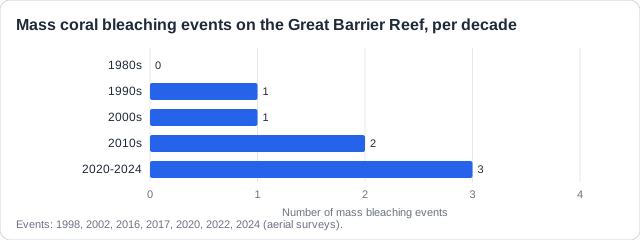
Example (SL): the Great Barrier Reef, 2016-2017. Two marine heatwaves in a row bleached most of the reef. About half of the shallow-water coral died, worst in the north, and the reef had little time to recover before the next events in 2020, 2022 and 2024.
Study smarter, not longer
Most students waste 40% of study time on topics they already know. Our AI tracks your progress and optimizes every minute.
The ocean absorbs about a quarter of the CO2 that people release, and this makes seawater more acidic: ocean acidification.
The points to remember
- CO2 dissolves in seawater and forms carbonic acid, which releases hydrogen ions: the pH falls.
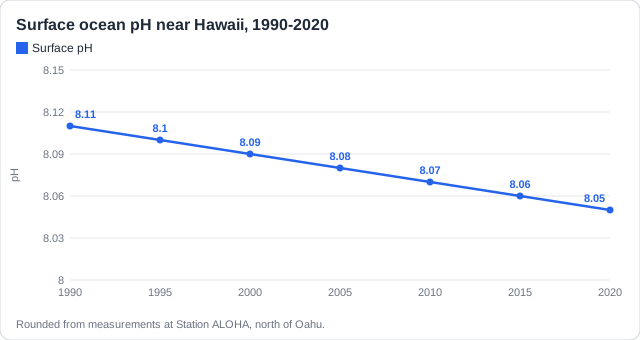
- Surface pH has fallen from about 8.2 to 8.1: about 30% more acidic, because the pH scale is logarithmic.
- Fewer carbonate ions are left, so molluscs, corals and some plankton struggle to build calcium carbonate shells.
- Shells grow thinner or even dissolve; larvae die; weaker coral adds to bleaching damage.
- Losses spread up the food web to fish, and to shellfish farms and fisheries.
Example (SL): oyster hatcheries in Oregon, USA. From 2007 billions of oyster larvae died at hatcheries on the Pacific coast. The cause was corrosive, CO2-rich water welling up from the deep. Hatcheries now monitor the water and add chemicals to raise its pH.
Not acid rain: Ocean acidification comes from dissolved CO2. Acid rain, sulfur dioxide and nitrogen oxides are a different problem. The only lasting fix is to cut CO2 emissions worldwide.
When warming, low oxygen and acidification hit a population at once, it may collapse: fall so far that it cannot recover quickly, and fisheries must close.
The points to remember
- A marine heatwave can kill adults and young, and remove their food.
- Hungry fish need more food in warm water, just when there is less.
- With few young surviving, the stock is not replaced for years.
- People lose fisheries, jobs and food security: about 3 billion people rely on seafood for protein.
Remember it as: Too hot, too little food, too few young.
Example (SL): Pacific cod in the Gulf of Alaska. A marine heatwave called 'the Blob' warmed the water from 2014 to 2016. Cod needed more food but found less, and their numbers fell by about 70%. In 2020 the cod fishery was closed for the first time.
Practice with exam-style questions
Answer exam-style questions and get AI feedback that shows you exactly what examiners want to see in a full-marks response.
You may be asked to plan an experiment on how acidification affects shelled organisms. Change one thing, measure one thing, keep everything else the same.
The points to remember
- Question: does lower pH reduce the mass of shells?
- Independent variable: pH of the water, for example 8.2, 7.8, 7.4 and 7.0 (CO2 bubbled in or dilute acid added).
- Dependent variable: % change in dry mass of each shell after 7 days.
- Control: temperature, water volume, shell species and size, time; seawater at pH 8.2 as the control group.
- Repeat: at least 3 shells at each pH; calculate the mean.
- Ethics: use empty shells, not live animals; wear eye protection with acid.
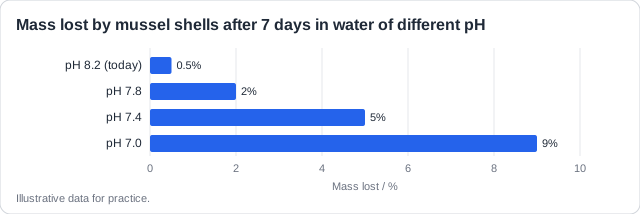
Example (SL): empty mussel shells. A class collects empty mussel shells from a fish market, dries and weighs them, and puts three in each of four beakers of seawater at different pH. After a week the shells at pH 7.0 have lost the most mass.
How this comes up: Paper 2 asks for four impacts of climate change on wild fisheries [4], or the impacts of ocean acidification on systems and society [7]; a method question can ask you to plan an experiment.
Fishers in Peru, Norway and the Pacific islands all report that their catches are changing.
Outline four impacts of climate change on wild fisheries.
Model answer plan
See the mark-by-mark plan — for / against / judgement, with marking guidance — in study mode.