Enough, safe, near, always: Water security is having access to sufficient amounts of safe drinking water. The best level is safely managed water.
The points to remember
- Water security = access to sufficient amounts of safe drinking water.
- Enough: water for drinking, cooking and washing, every day.
- Safe: free from germs and harmful chemicals.
- Accessible: at home or close by, at a price people can afford.
- Reliable: there whenever it is needed, in the dry season too.
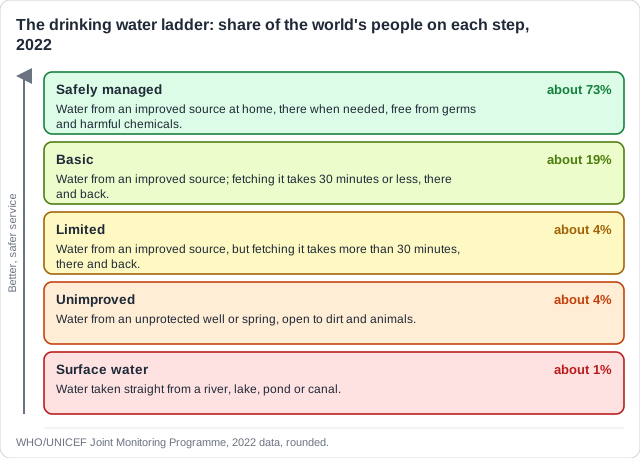
- In 2022 about 2.2 billion people lacked safely managed drinking water; 115 million drank from rivers and ponds.
Remember it as: Enough, safe, near, always: miss one and you are not water secure.
Only the top step counts as safely managed. The next two steps use an improved source, but the water is not at home, so people must carry it.
Real example, Cape Town, South Africa, 2018: after three dry years the city's dams fell very low. From February 2018 each person was asked to use no more than 50 litres a day, and the city planned a Day Zero. People saved water, the winter rains came, and Day Zero was avoided.
Not just 'having water': A definition needs both halves: enough water AND safe drinking water. 'Having water' alone is not water security.
Free preview
This is the free notes preview
You're reading the free notes. Aimnova Pro unlocks the full study experience — and you can try it with your first topic free to keep:
- FlashcardsLock in vocabulary and key terms with spaced repetition.
- Practice questionsAnswer exam-style questions and get instant AI marking.
- Mock exams & past-paper vaultSit full mocks and see exactly how examiners award marks.
- Personalised study planA daily plan built around your exam date and weak areas.
A place can have plenty of water and still lack water security, because the water is not safe. Contamination can come from sewage, old pipes or the rocks themselves.
The points to remember
- Water security needs quantity (enough) and quality (safe).
- Germs from sewage cause diarrhoea, cholera and typhoid.
- Chemicals poison people slowly: lead from old pipes, arsenic from some rocks.
- Water scarcity is about the amount of water available to people.
- Water security adds safety and access: enough safe water that people can reach.
- So a place can have plenty of water and still no water security.
Water scarcity
- How much water is available
- Too little water for people's needs
- Example: Cape Town's dams in 2018
Water security
- Access to enough SAFE water
- Enough, safe, near and reliable
- Example: Flint had plenty of water, but it was unsafe
Remember it as: Scarcity counts the litres. Security also asks: is it safe, and can you reach it?
Real example, Flint, Michigan, USA, 2014: to save money, the city switched its tap water to the Flint River in April 2014. The water was not treated to stop it corroding the pipes, so lead from old pipes got into people's tap water. The city switched back in October 2015.
Do not mix them up: Scarcity is about the amount of water. Security is about access to enough safe water. Say which one the question asks about.
Practice with exam-style questions
Answer exam-style questions and get AI feedback that shows you exactly what examiners want to see in a full-marks response.
Water security is a significant part of a sustainable society. Without safe water, health, learning and work all suffer.
The points to remember
- Health: unsafe water spreads disease; dirty water causes about half a million deaths from diarrhoea a year.
- Time: with no tap at home, women and girls spend hours fetching water instead of school or work.
- Food and jobs: farms, factories and power stations need a reliable supply.
- Peace: when water runs short, people and countries compete for it.
- SDG 6: the UN goal of clean water and sanitation for all by 2030.
- So water security is a significant component of a sustainable society.
Remember it as: Safe water: healthy people, girls in school, farms and firms at work.
Real example: UNICEF estimates that women and girls around the world spend about 200 million hours every day collecting water. That is time taken from school, work and rest.
Link it to the whole society: Say what goes wrong for the society, not only the person: 'girls miss school, so fewer adults can earn a living later'.
Water security can be lost when the supply falls, the water becomes unsafe, or people can no longer reach or pay for it. Later micros look at each cause in more detail.
The points to remember
- Drought: less rain, so rivers and reservoirs run low.
- Pollution: sewage, farm chemicals and factory waste make water unsafe.
- Broken infrastructure: pipes leak and treatment plants fail, so water is lost or not cleaned.
- Rising demand: more people, farms and factories share the same supply.
- Cost: poor homes cannot pay for a tap and buy from vendors at high prices.
Remember it as: Too little, too dirty, too far, too costly.
Real example, Jackson, Mississippi, USA, 2022: floods damaged the city's main water treatment plant. About 150,000 people were left without safe running water for weeks.
Name what is lost: In a data question, link each problem to the part of water security it removes: enough, safe, near or reliable.
Feeling unprepared for exams?
Get a clear study plan, practice with real questions, and know exactly where you stand before exam day. No more guessing.
How this comes up: Paper 2, Section A: a figure about drinking water, then a short Outline question about one household [2].
Figure 1 shows the drinking water ladder. A family in a rural village collects all its water from a protected well that is a 45-minute walk away, there and back.
Outline why this family does not have water security.
Model answer plan
See the mark-by-mark plan — for / against / judgement, with marking guidance — in study mode.