Concrete changes the flows: Cities replace soil and plants with hard surfaces. Rain that once soaked in now runs straight into drains and rivers, so rivers rise faster and higher, and a flash flood becomes more likely.
What urbanisation does to the flows
- Roofs and roads are impermeable: less infiltration, so more surface run-off.
- Drains rush run-off to rivers: higher, faster peaks and flash floods.
- Less infiltration means less groundwater recharge: the water table falls.
- Fewer plants means less evapotranspiration, so less water vapour.
- City heat raises evaporation and can bring heavier rain downwind.
- Cities pump water from rivers and aquifers; exhaust gases make acid rain.
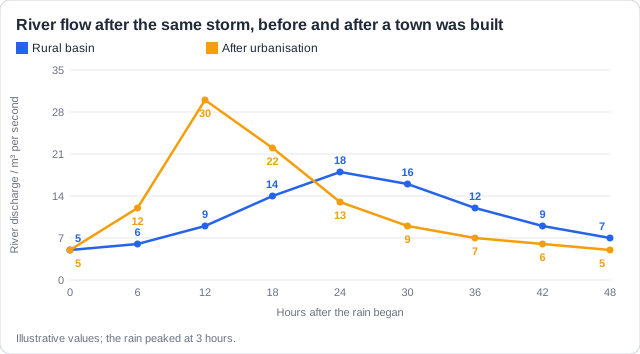
Real example: Houston, Texas, spread over prairie and wetland that once soaked up rain. When Hurricane Harvey stalled over the city in 2017, over 1,000 mm of rain fell in a few days; with so much concrete, it ran off and flooded well over 100,000 homes.
Free preview
This is the free notes preview
You're reading the free notes. Aimnova Pro unlocks the full study experience — and you can try it with your first topic free to keep:
- FlashcardsLock in vocabulary and key terms with spaced repetition.
- Practice questionsAnswer exam-style questions and get instant AI marking.
- Mock exams & past-paper vaultSit full mocks and see exactly how examiners award marks.
- Personalised study planA daily plan built around your exam date and weak areas.
Trees catch rain, hold the soil and return water to the air. Cutting them down changes each of these flows.
The points to remember
- Fewer leaves: less interception, so more rain reaches the ground at once: more run-off.
- Fewer roots and less leaf litter: less infiltration, less groundwater storage.
- Fewer trees: less transpiration, drier air and less rain locally.
- Bare soil is eroded: more sediment and nutrients wash into rivers.
- Bare soil also loses water by evaporation and dries out.
Remember it as: No trees: less caught, less soaked, less breathed out, more run off.
Goes down
- Interception
- Infiltration
- Transpiration
- Groundwater storage
- Local rainfall
Goes up
- Surface run-off
- Flood risk
- Soil erosion
- Sediment in rivers
- Evaporation from bare soil
Real example: before people arrived, about 80% of New Zealand was forest; today only about a quarter is native forest. On cleared hill country, heavy rain runs off quickly, washing soil into rivers and raising flood peaks downstream.
Say up or down: Every point needs a direction: 'less transpiration', 'more run-off'. 'It affects run-off' is not enough.
Memorize terms 3x faster
Smart flashcards show you cards right before you forget them. Perfect for definitions and key concepts.
Farming changes the water cycle through what it takes out (irrigation) and how it treats the soil.
The points to remember
- Irrigation abstracts water: rivers, lakes and aquifers shrink.
- Ploughed, bare fields: more run-off and soil erosion, muddier rivers.
- Machines and overgrazing compact the soil: less infiltration.
- Fertiliser run-off causes eutrophication; pesticides poison aquatic life.
- Draining wetlands removes a natural water store.
Taking water
- Irrigation lowers rivers, lakes and aquifers.
- Fish and wetlands lose their water.
Bare soil
- Ploughing and compaction raise run-off.
- Eroded soil clouds the rivers.
Chemicals
- Fertilisers wash in: algal blooms.
- Pesticides kill non-target species.
Real example: from the 1960s the Soviet Union diverted the Amu Darya and Syr Darya rivers to irrigate cotton. So little water reached the Aral Sea that it shrank to about a tenth of its former volume, and its fishing industry collapsed.
Cause, then effect: Link each farming practice to what it does to the water: 'fertiliser washes into the lake and causes algal blooms', not just 'fertiliser'.
A dam does not change how much rain falls, but it changes where water is stored and when it flows.
The points to remember
- A dam creates a new store: the reservoir.
- Flow downstream becomes smaller and steadier: fewer floods, but less water for wetlands.
- Sediment is trapped behind the dam, so deltas and coasts downstream erode.
- A big reservoir loses a lot of water by evaporation.
- Water seeping from the reservoir can raise groundwater nearby.
Above the dam
- A new reservoir store
- Evaporation from its surface
- Sediment settles out
Below the dam
- Smaller, steadier flow
- Fewer floods
- Less sediment: deltas erode
Real example: Egypt's Aswan High Dam, finished in 1970, created Lake Nasser and ended the Nile's yearly floods. The lake loses over 10 km³ of water a year to evaporation, and with the river's silt trapped behind the dam, the Nile Delta coast is now eroding.
Know your predicted grade
Take timed mock exams and get detailed feedback on every answer. See exactly where you're losing marks.
Questions often give a figure of where rain goes in a forest and in a town, and ask you to calculate or explain a change.
Reading the figure
- Read each flow as a percentage of the rain.
- Infiltration = shallow + deep: add them before comparing.
- Give the units (%) in every calculated answer.
- Flash-flood factors: paving, poor drains, steep slopes, thin soils, heavy rain or melt, felled slopes, dam failure.
- A storage question wants a store (groundwater, biomass), not a flow.
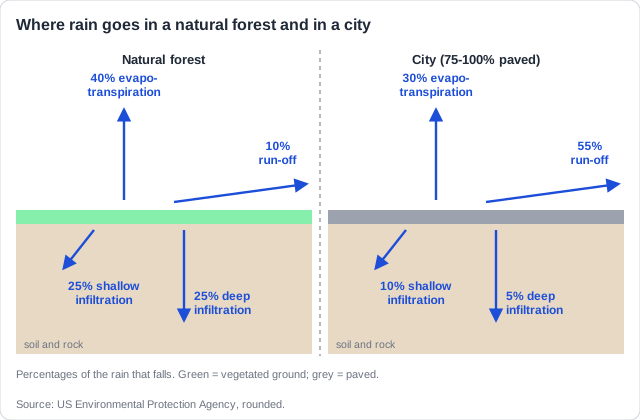
Worked example: the difference in infiltration: Formula: difference = forest infiltration - city infiltration.
Forest: 25% + 25% = 50%. City: 10% + 5% = 15%. Difference = 50% - 15% = 35%.
Real example: in October 2024 more than 400 mm of rain fell in a few hours in parts of Valencia, Spain. Water rushed down the paved ravine suburbs south of the city as a flash flood, and over 200 people died.
How this comes up: Paper 2, Section B (a): outline four ways urbanisation changes the water cycle [4]. Each point = a change in the city linked to a flow.
Dhaka, the capital of Bangladesh, has grown from about 3 million people in 1980 to over 20 million, building over its wetlands and ponds.
Outline four ways in which urbanisation may influence processes in the hydrological cycle.
Model answer plan
See the mark-by-mark plan — for / against / judgement, with marking guidance — in study mode.