Save the home, save the species: Habitat conservation protects species by protecting the place they live. It is in situ conservation: every species in that habitat is protected at once.
The points to remember
- Habitat conservation protects the natural environment, so all its species are protected together.
- It keeps food webs, pollination, nutrient cycling and natural behaviour working.
- Large wild populations keep genetic diversity high, and natural selection goes on.
- Two ways: protect wild areas (laws, parks, reserves, marine protected areas) or actively manage them.
- Harder when habitat is already destroyed or fragmented, or threats (poaching, invasives, climate, farming) go on.
Remember it as: Save the home, save the family.
National parks
- Large areas protected by law.
- People visit, but cannot farm, build or hunt.
Nature reserves
- Often smaller, for particular habitats or species.
- Access may be limited.
Marine protected areas
- Areas of sea and coast.
- Fishing limited, or banned in no-take zones.
Example (SL): Kaziranga National Park, India. About 12 greater one-horned rhinos were left there in 1905. Protecting the whole floodplain grassland, with armed rangers against poaching, raised the number to about 2600, roughly two thirds of all that are left. Tigers, elephants and wild water buffalo share the same protected habitat.
Better than captivity in the long run: Keeping a species in its habitat keeps its natural behaviour, its food web and a large gene pool; a zoo keeps only a few animals. This is the usual advantage asked of in situ over ex situ conservation.
Free preview
This is the free notes preview
You're reading the free notes. Aimnova Pro unlocks the full study experience — and you can try it with your first topic free to keep:
- FlashcardsLock in vocabulary and key terms with spaced repetition.
- Practice questionsAnswer exam-style questions and get instant AI marking.
- Mock exams & past-paper vaultSit full mocks and see exactly how examiners award marks.
- Personalised study planA daily plan built around your exam date and weak areas.
Some habitats disappear even when they are protected by law. They survive only if people keep working on them. This is active management.
What active management does
- Stop succession: grazing, cutting scrub and controlled burning keep open habitats open.
- Remove invasive species and predators that people brought in.
- Restore damage: bring back the water flow, replant native plants, clean up pollution.
- Guard it: anti-poaching patrols, and quotas, closed seasons and size limits for harvesting.
- Close roads: less fragmented habitat, fewer road deaths, less noise, and harder for poachers to get in.
Remember it as: Graze, burn, weed, water, guard.
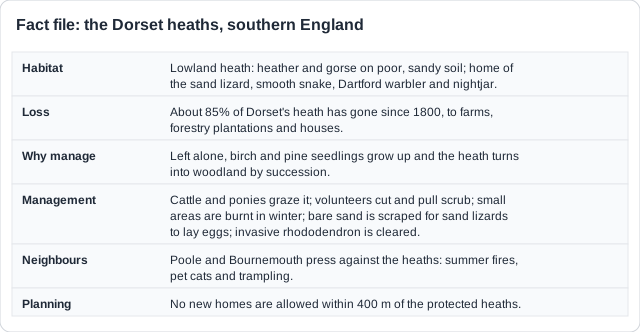
Example (SL): the Dorset heaths, England. Heather heath is home to the sand lizard and the Dartford warbler. Left alone, birch and pine grow up and the heath becomes woodland by succession. So cattle and ponies graze it, volunteers pull scrub, small patches are burnt in winter, and bare sand is scraped for lizards to lay eggs.
Why removing invasive plants can be controversial: People may use the plants for timber, jobs, fuel or shade, or enjoy them; some species feed or nest in them; cutting them releases carbon and can leave soil to erode; it is costly, may harm native plants, and some say every species has a right to exist.
Why closing roads helps
- Habitat is less fragmented; animals reach food and water.
- Populations are less isolated, so the gene pool mixes.
- Less noise and disturbance; fewer road deaths.
- Poachers can no longer drive in.
Example: Amur tigers, Russia
- In 2015, logging roads in tiger forest in the Russian Far East were closed.
- Poachers had used them to reach tigers and their deer prey.
Say how, not just 'bigger': 'The habitat gets larger' or 'poaching is harder' is not enough. Give the mechanism: less fragmented, fewer road deaths, no vehicle access for poachers.
Stop wasting time on topics you know
Our AI identifies your weak areas and focuses your study time where it matters. No more overstudying easy topics.
Fence the pests out: An ecosanctuary protects native species from the predators people brought in. Inside a pest-exclusion fence, every pest is removed, then native species are reintroduced.
The points to remember
- The fence stops introduced predators (rats, stoats, cats, possums) climbing over or digging under.
- Inside, pests are removed; then native species are reintroduced and breed safely.
- Birds bred inside spill over into the land around.
- It suits places where the main threat is introduced predators, as in New Zealand.
- Limits: costly to build and check; a fallen tree or flood can breach it; mice often get back in.
- Limits: a small area holds a small gene pool; animals that leave meet predators again.
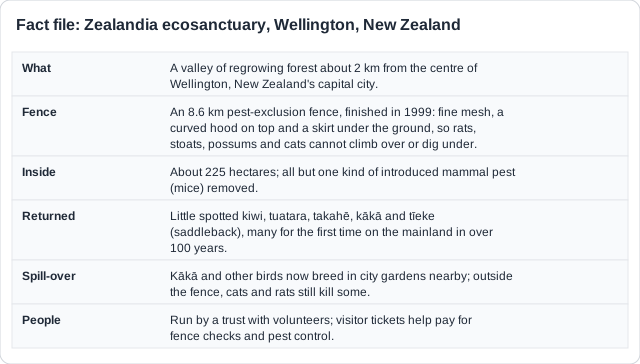
Example (SL): Zealandia, Wellington, New Zealand. New Zealand's birds evolved with no land mammals to hunt them, so rats and stoats wiped many out. In 1999 an 8.6 km fence closed off a city valley. Little spotted kiwi, tuatara and kākā were returned, and kākā now nest in Wellington's gardens.
Numbers in a sanctuary: percentage change: Percentage change = (new - old) ÷ old x 100. A count that rises from 40 birds to 110 birds is (110 - 40) ÷ 40 x 100 = +175%. A fall gives a minus sign: 29 800 to 24 850 is a 16.6% decrease.
Where a reserve is placed matters as much as what happens inside it. Look at its neighbours and how far it is from a town.
The points to remember
- Surrounding land use: farms bring fertiliser, pesticides and livestock; plantations bring invasive trees.
- Near a city: pet cats, fires, trampling, pollution, roads and poachers are close.
- Near a city also brings visitors, volunteers, money and support.
- Far from towns: less disturbance, but harder to patrol and fewer paying visitors.
- Few villages nearby means less conflict over land when the reserve is set up.
- Planning rules can control the neighbours, such as no new homes close to the reserve.
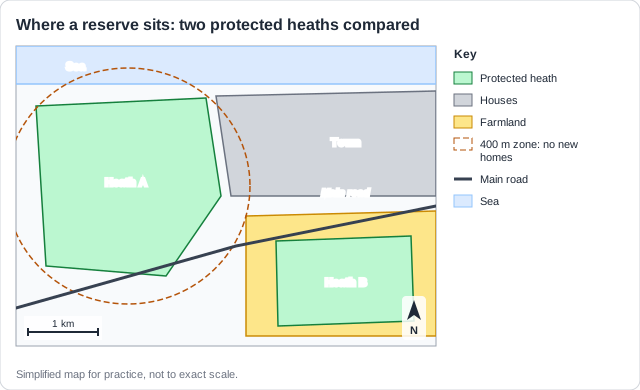
Example (SL): the Dorset heaths again. Poole and Bournemouth press right up against the heaths: summer fires started by people, pet cats and heavy trampling. So the councils allow no new homes within 400 m of the protected heaths, and developers further out pay for new green spaces that draw dog walkers away.
Asked why a park was put in a place?: Use the figures: high biodiversity or endemic species there, a threat such as fast deforestation, a link to another park, few villages to object, and a chance for ecotourism.
See how examiners mark answers
Answer exam-style questions with model answers. Learn exactly what earns marks and what doesn't.
Some protected areas are run by the people who live beside them and use them. At sea these are called locally managed marine areas (LMMAs).
The points to remember
- The local community manages it: the people whose fishing or farming affects it.
- People feel ownership, so they take responsibility and keep the rules.
- It raises local awareness and changes behaviour; more people get involved.
- It uses local knowledge of the area.
- Flexible and fast: less bureaucracy, a quick response to local threats, closer monitoring.
- Policing by the community, in a way that fits local custom.
Remember it as: Our sea, our rules, our eyes.
Example (SL): Fiji. In 1997 the village of Ucunivanua closed part of its own reef flat to collecting clams. The villagers chose the area, counted the clams themselves and watched for outsiders. Clams inside the closed area soon became far more common, and over 400 villages across the Pacific have since set up their own LMMAs.
The advantage of community management itself: When asked why community management works, do not list no-take zones, bigger fish, more jobs or tourism. Say what the community brings: ownership, local knowledge, fast and flexible decisions, policing.
Community-based
- Local support, so rules are kept.
- Cheaper: the community patrols.
- People still earn a living.
Strict protection
- Best for the most sensitive species.
- No-take zones give full recovery.
- Needs rangers, money and a strong law.
When a country's protected areas grow, from a few small parks to a large network, species gain in several ways.
The points to remember
- Protected areas ban damaging activities (building, hunting, logging): a safe place to live and breed.
- More and bigger areas protect more habitats, and so more species.
- They give room for top predators, which need large areas.
- Core habitat lies further from people, so edge effects are smaller.
- Areas that join up allow genetic mixing, like corridors.
- More ecotourism, funding and community involvement keep conservation going.
Example (SL): Costa Rica. Its first national parks came in the 1970s; today about a quarter of the country is protected. Forest cover roughly doubled, from about a fifth of the land in the 1980s to over half. The country holds about 5% of the world's species, and ecotourism in its parks is now a major source of income.
Three separate ways, not one: In an Explain [3], give three different mechanisms from the list, each linked to species. Avoid vague phrases such as 'it reduces limiting factors'.
Study smarter, not longer
Most students waste 40% of study time on topics they already know. Our AI tracks your progress and optimizes every minute.
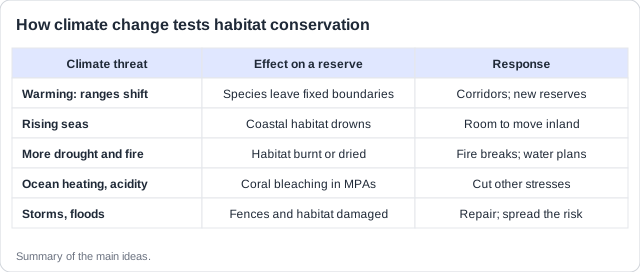
Climate change is the biggest test for habitat conservation, because a reserve cannot move but the climate its species need can.
The points to remember
- Strength: large, connected reserves let species move as climate zones shift.
- Strength: healthy, diverse ecosystems are more resilient; forests, peat and mangroves store carbon.
- Limit: boundaries are fixed while species' ranges move uphill or towards the poles.
- Limit: rising seas, drought, fire, storms and coral bleaching reach inside reserves.
- Responses: corridors, buffer zones, new reserves where species are moving to; cut other stresses.
- Judgement: it helps but cannot work alone; emissions must be cut by international action.
Example (SL): the golden toad, Costa Rica. It lived only in the protected Monteverde cloud forest. After very dry, warm years in the late 1980s it was never seen again, and it was declared extinct in 2004: a reserve cannot protect a species from a climate that changes around it.
It can also slow climate change: Protecting sea otters in their kelp forests keeps sea urchins in check, so the kelp grows, photosynthesises more and takes in more carbon dioxide.
How this comes up: Paper 1 gives a fact file on a threatened species and asks how an in situ strategy could improve its IUCN category [3]; Paper 2 Section B asks how effective habitat conservation is [9].
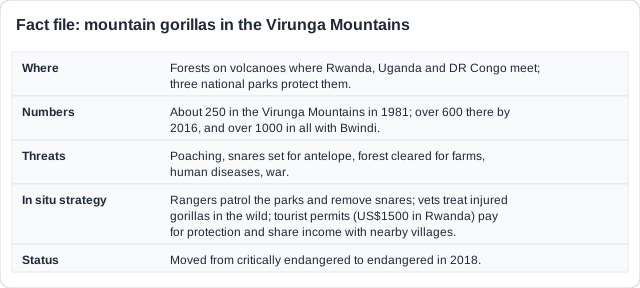
The fact file shows the mountain gorillas of the Virunga Mountains.
Explain how a specific in situ conservation strategy could improve the IUCN category of the mountain gorilla.
Model answer plan
See the mark-by-mark plan — for / against / judgement, with marking guidance — in study mode.