Starting again, on soil: In secondary succession the community is removed but the soil stays. Life returns on that soil, so the process starts well ahead of a primary succession.
The points to remember
- Secondary succession starts on bare soil where a community lived before.
- A disturbance removes the community, but the soil stays.
- The guide's two cases: a field where farming stops and a forest after an intense fire.
- Floods, storms and logging can start it too, and so can ending grazing or mowing.
- It follows the same pattern as primary: pioneers, grasses, shrubs, trees, climax.
Remember it as: Soil stays, so life comes back faster.
Real example: in 1882, scientists at Rothamsted in England fenced off part of the Broadbalk wheat field and left it alone. That patch, the Broadbalk Wilderness, is now woodland.
Name the process in full: Grassland turning into forest once grazing stops is secondary succession. 'Succession' alone is not enough, and it is not primary: the soil was there all along.
Free preview
This is the free notes preview
You're reading the free notes. Aimnova Pro unlocks the full study experience — and you can try it with your first topic free to keep:
- FlashcardsLock in vocabulary and key terms with spaced repetition.
- Practice questionsAnswer exam-style questions and get instant AI marking.
- Mock exams & past-paper vaultSit full mocks and see exactly how examiners award marks.
- Personalised study planA daily plan built around your exam date and weak areas.
When a farmer stops ploughing, the field does not stay bare for long. The soil holds a seed bank, and each seral stage replaces the last.
When farming stops
- First year or two: annual weeds and grasses grow fast from the seed bank and from seeds blown in.
- Next: perennial grasses and herbs outcompete the short-lived annuals.
- Then shrubs (bramble, hawthorn) grow above them and shade them out.
- Trees grow up through the shrubs; their seeds come on the wind or with animals.
- Each stage changes the light and the soil, so the next stage outcompetes it.
- After decades to a century or more, the climax forest returns.
Remember it as: Weeds, grasses, shrubs, trees.
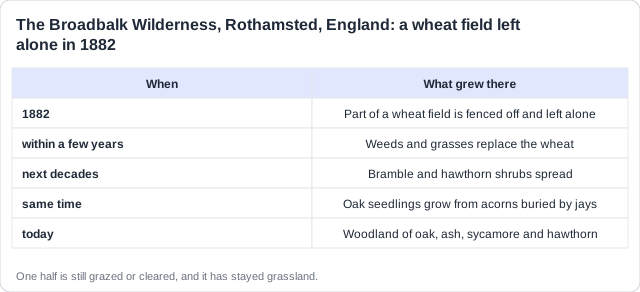
Real example: at Broadbalk the wheat was gone within a few years. Jays buried acorns in the grass, and oaks grew up through the hawthorn. Half of the plot is still grazed or cleared, and it has stayed grassland: grazing holds the succession back.
Say what each stage changes: Shrubs shade the grasses; trees shade the shrubs. Linking each change to competition shows why the community is replaced, not just that it is.
Never wonder what to study next
Get a personalized daily plan based on your exam date, progress, and weak areas. We'll tell you exactly what to review each day.
An intense fire can kill most plants, but it leaves the soil, and often seeds and roots in it. The forest then rebuilds itself in seral stages.
Succession after a fire
- The fire opens the canopy, so sunlight reaches the forest floor.
- Ash releases nutrients, so the soil is fertile.
- Plants grow from seeds that survived, seeds released by the heat, or seeds blown in from unburnt forest.
- Pioneers such as fireweed and fast-growing annuals cover the ground first.
- Over time, slower-growing trees replace them, as each stage changes conditions and is outcompeted.
- The climax forest returns only after many years, because trees grow slowly.
Remember it as: Light, ash, seeds, pioneers, slow trees, climax.
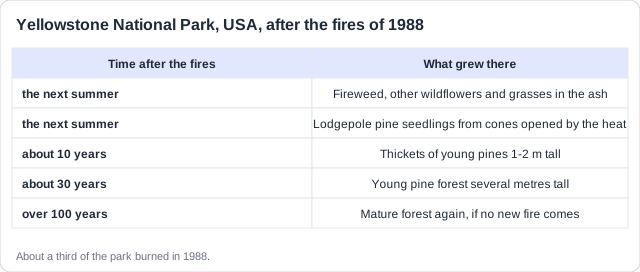
Real example: in 1988 fires burned about a third of Yellowstone National Park, USA. Many lodgepole pine cones are sealed with resin and open only in the heat of a fire, so the next summer the ash was carpeted with pine seedlings among the fireweed.
Put the stages in order: Start with what the fire changed (light, ash), then where new plants come from, then pioneers, then their replacement, then the climax. One stage per sentence.
Both successions pass through seral stages to a climax, but secondary succession starts far ahead, because the hardest step, making soil, is already done.
Why secondary is faster
- The soil is already there: no waiting for rock to weather.
- The soil holds nutrients and organic matter (and ash after a fire).
- It holds a seed bank, plus roots and stumps that resprout.
- Soil organisms (decomposers, fungi, worms) are already there.
- Seeds arrive quickly from nearby land that was not disturbed.
- So secondary succession takes decades to a century or two; primary takes hundreds to thousands of years.
Primary succession
- Starts on bare rock, sand or silt
- No soil, no seeds, no life
- Pioneers: lichens, mosses, algae
- Very slow: hundreds of years or more
- New lava, moraine, fresh dunes
Secondary succession
- Starts on bare soil
- Soil, seed bank and roots remain
- Pioneers: grasses, dandelions, fireweed
- Faster: decades to a century or two
- Abandoned farmland, a burnt forest
In one line: Primary = from scratch, on bare rock. Secondary = the soil is already there, only the community was removed.
Real example: in 1980 the eruption of Mount St Helens, USA, buried some slopes under deep new rock: primary succession, and they stayed nearly bare for years. Where trees were only blown down and the soil survived, plants regrew from roots within months: secondary succession.
Stop wasting time on topics you know
Our AI identifies your weak areas and focuses your study time where it matters. No more overstudying easy topics.
How this comes up: Paper 1, from a case study about a forest: describe the process of succession after a wildfire [3].
In the summer of 2018, wildfires burned large areas of pine forest in central Sweden.
Describe the process of succession after a wildfire has occurred in the forest.
Model answer plan
See the mark-by-mark plan — for / against / judgement, with marking guidance — in study mode.