Starting from nothing: Primary succession begins on a newly formed substratum. There is no soil and no living community yet, so everything must arrive and build up from scratch.
The points to remember
- Primary succession starts on new ground with no soil and no community living there before.
- New volcanic rock: lava and ash from an eruption.
- Moraines: rock and gravel left behind as a glacier retreats.
- Wind-blown sand (new dunes) and waterborne silt (new mudflats where rivers meet the sea).
- It is very slow: soil must be built first, so it takes hundreds to thousands of years.
Remember it as: New ground, no soil, no seeds: start from zero.
Real example: in November 1963 an eruption under the sea off the south coast of Iceland began to build a new island, Surtsey. Its lava and ash had no soil and no life. Only scientists may land there, so it is a natural experiment in primary succession.
Primary or secondary?: Ask one question: was there soil? New lava, fresh moraine or new dunes: primary succession. A burnt forest or an old field keeps its soil: that is secondary succession.
Free preview
This is the free notes preview
You're reading the free notes. Aimnova Pro unlocks the full study experience — and you can try it with your first topic free to keep:
- FlashcardsLock in vocabulary and key terms with spaced repetition.
- Practice questionsAnswer exam-style questions and get instant AI marking.
- Mock exams & past-paper vaultSit full mocks and see exactly how examiners award marks.
- Personalised study planA daily plan built around your exam date and weak areas.
The first colonisers are pioneer species. Together they form the pioneer community.
What makes a pioneer
- Pioneer species are the first to colonise bare ground: lichens, mosses, algae, hardy grasses.
- They tolerate harsh conditions: heat, cold, drought, wind and almost no nutrients.
- Their tiny spores and seeds are carried in by wind, birds or the sea.
- They grow and spread fast and make many offspring.
- Some fix nitrogen (mountain avens, clover), adding nutrients to the poor ground.
- Lichens release acids that slowly break down the rock.
Remember it as: Tough, tiny seeds, fast, first.
Real example: on Surtsey, the first flowering plant was sea rocket, in 1965, from seeds washed onto the beach. The first mosses grew on the lava in 1967, from spores blown in by the wind.
Arrive, survive, spread: Say how pioneers arrive (wind, birds, sea), why they survive (they tolerate harsh conditions) and how they spread (fast, many seeds).
Study smarter, not longer
Most students waste 40% of study time on topics they already know. Our AI tracks your progress and optimizes every minute.
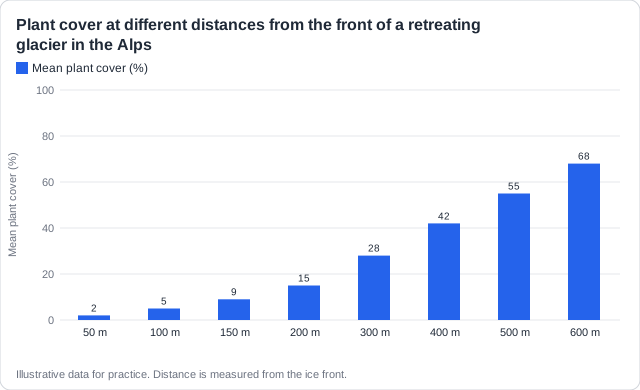
On bare rock, the first job is making soil. A primary succession on rock is called a lithosere. The ground in front of a retreating glacier shows every step.
How the pioneer community develops
- Weathering: frost (freeze-thaw), heat and rain break the bare rock into small mineral grains.
- Pioneers arrive: wind, birds and animals bring in spores and seeds.
- The pioneers establish and spread fast over the bare ground.
- When they die they decompose, adding organic matter and nutrients: a thin soil forms.
- Their roots bind the soil, so less is washed or blown away (less erosion).
- As the soil gets deeper, more plants can survive, so plant cover rises.
Remember it as: Break the rock, bring the seeds, rot the dead, hold the soil.
Real example: on Surtsey, soil formed fastest where gulls began nesting in 1986: their droppings added nutrients, and a green patch of grass grew there while the rest of the lava stayed bare.
Pioneer community means the first stages: A question on how the pioneer community develops wants weathering, arrival, decomposition and roots. Writing about the climax forest does not answer it and gets no credit.
A succession is a chain of communities. Each one is a seral stage. The last is the climax community.
The seral stages
- The sequence: pioneers, then grasses and herbs, then shrubs, then trees, then the climax community.
- Each seral stage changes the conditions (deeper soil, more shade), so the next stage outcompetes it.
- The climax community is stable: it stays unless it is disturbed.
- It has the most biodiversity and the most complex food webs, and is in equilibrium (inputs about equal outputs).
- Long-lived, slow-growing trees and animals dominate it.
- The climax depends on the climate: rainforest in the tropics, oak woodland where it is temperate, grassland where it is dry.
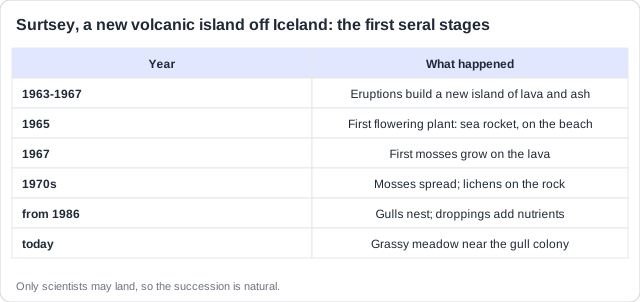
Real example: Surtsey is only about 60 years old, so it has reached the grass and herb stage. On older lava in Iceland the sere goes on to heath, then birch woodland, the climax of Iceland's cool climate.
Use the words: Name the stages with the right terms: pioneer community, seral stages, climax community. Then say what each stage changes that lets the next one in.
Practice with exam-style questions
Answer exam-style questions and get AI feedback that shows you exactly what examiners want to see in a full-marks response.
How this comes up: Paper 1: photos of a retreating glacier and a chart of plant cover. Describe how the pioneer community develops [2].
Figure 1 shows the mean plant cover at different distances from the front of a retreating glacier in the Alps.
Describe the processes leading to the development of a pioneer community as the glacier retreats.
Model answer plan
See the mark-by-mark plan — for / against / judgement, with marking guidance — in study mode.