The Earth's hot-water tank: The oceans absorb most of the sunlight that reaches the Earth and store it as heat. Because of their low albedo and high specific heat capacity, they hold far more heat than the land and change temperature slowly.
The points to remember
- The oceans cover about 71% of the Earth's surface, so they receive most of the Sun's energy.
- Water has a low albedo: it reflects little sunlight and absorbs most of it.
- Water has a high specific heat capacity: it stores a lot of heat and warms and cools slowly.
- Most energy is absorbed in the tropics, where the Sun is high all year.
- So the oceans are a huge heat store, and the sea's temperature is more stable than the land's or fresh water's.
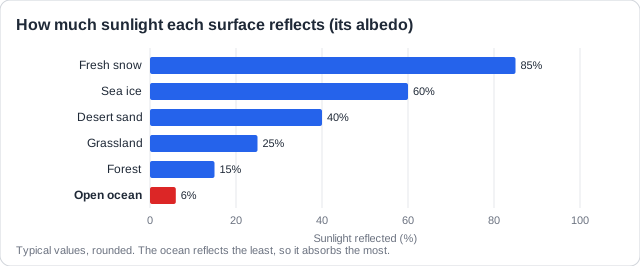
Real example: on a hot summer day at a beach, the sand burns your feet by noon, but the sea is still cool; at night the sand is cold and the sea feels warm. Water heats and cools far more slowly than land.
Say why water absorbs so much: Name the property and its effect: 'low albedo, so it absorbs most sunlight'; 'high specific heat capacity, so it stores heat and changes temperature slowly'.
Free preview
This is the free notes preview
You're reading the free notes. Aimnova Pro unlocks the full study experience — and you can try it with your first topic free to keep:
- FlashcardsLock in vocabulary and key terms with spaced repetition.
- Practice questionsAnswer exam-style questions and get instant AI marking.
- Mock exams & past-paper vaultSit full mocks and see exactly how examiners award marks.
- Personalised study planA daily plan built around your exam date and weak areas.
The heat absorbed in the tropics does not stay there. An ocean current carries it across the world, so the oceans act like the Earth's central heating.
The points to remember
- The oceans are joined into one connected circulation.
- Warm currents carry heat (and moist air) from the tropics towards the poles.
- Cold currents carry cold water from the poles back towards the equator.
- Surface currents are driven mainly by wind, turned by the Earth's rotation; tides help too.
- Deep currents are driven by density differences: cold, salty water sinks.
- Without currents, the tropics would be hotter and high latitudes far colder.
Remember it as: Warm water goes out to the poles; cold water comes back.
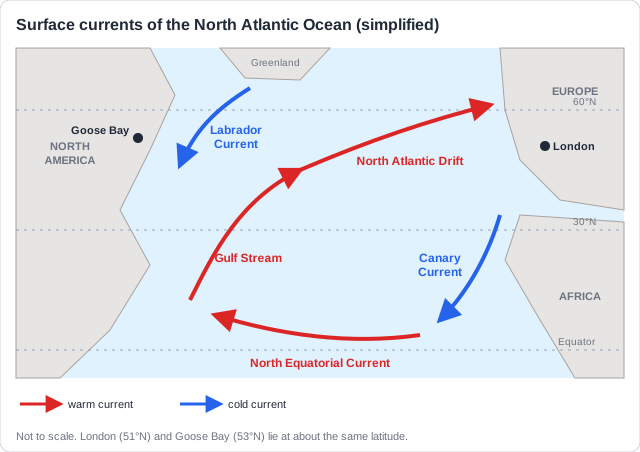
Real example: the Gulf Stream carries more water than all the world's rivers together, and its heat reaches Europe as the North Atlantic Drift.
Get feedback like a real examiner
Submit your answers and get instant feedback — what you did well, what's missing, and exactly what to write to score full marks.
A current changes the climate of the coast it passes. The heat moves in steps: water, then air, then land.
The points to remember
- A warm current warms the air above it; winds carry that air over the coast, so winters are milder.
- A cold current carries cold water; it cools the air above; winds carry the cool air inland.
- So the average annual temperature of the coast is lowered.
- Warm currents raise evaporation, so the air is moist and brings rain.
- Cold currents limit evaporation, so the air is dry: coasts can be deserts (the Atacama).
- Coasts have a smaller yearly temperature range than places far inland.
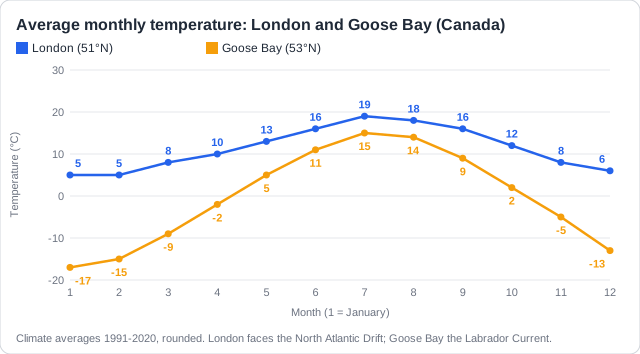
Real examples: London's January average is about 5 °C, but Goose Bay in Canada, at the same latitude beside the cold Labrador Current, averages about -17 °C. On the other side of the world, the cold Humboldt Current keeps Lima, Peru, cool for the tropics and so dry that it gets only about 15 mm of rain a year.
Water, then air: The current carries cold water, not cold air. The water cools the air above it, and the winds carry the cool air inland. Mixing these up loses the mark.
Water helps keep the Earth's average temperature steady in several ways: as liquid, as vapour and as ice.
The points to remember
- Water absorbs more solar energy than land: high specific heat capacity, low albedo.
- Evaporation takes in heat, cooling the sea surface.
- Water vapour carries that heat to higher latitudes, in rising air and in tropical storms.
- Condensation into clouds releases the heat in colder places.
- Currents move heat from the equator to the poles; cold currents flow back.
- Oceans absorb CO₂; water vapour warms (a greenhouse gas); ice, snow and white clouds reflect sunlight and cool.
Absorb
- The Caribbean Sea absorbs strong tropical sunlight and warms to over 27 °C.
Evaporate
- Huge amounts of water evaporate; this takes heat out of the sea surface.
Carry
- A hurricane carries the warm, moist air north towards the USA.
Condense
- The vapour condenses into towering clouds and releases its heat further north.
Water that warms
- Water vapour: a greenhouse gas
- Oceans store absorbed heat
- Warm currents heat cold coasts
Water that cools
- Evaporation takes in heat
- Ice, snow, white clouds reflect sunlight
- Oceans absorb CO₂
Four different roles: For 'the role of water', give four different processes, each with its effect: absorbing, evaporating, carrying and condensing, currents, reflecting. Four points about currents alone repeat one idea.
Learn what examiners really want
See exactly what to write to score full marks. Our AI shows you model answers and the key phrases examiners look for.
Below the surface, water moves slowly in deep currents. What drives them is density, not wind.
The points to remember
- Deep water moves because of density: cold water and salty water are denser.
- Dense water sinks, so the ocean is mixed from top to bottom.
- Sinking and rising water carry nutrients, so some coasts have rich fisheries.
- Melting Greenland ice adds fresh, light water to the North Atlantic.
- That could weaken the Gulf Stream, making north-west Europe colder.
Real example: the Greenland ice sheet is losing about 270 billion tonnes of ice a year. Scientists warn that the fresh meltwater could slow the circulation that feeds the Gulf Stream, so north-west Europe could become colder even as the world warms.
More detail at HL: Higher Level studies the full loop, the ocean conveyor belt. At SL, remember: cold and salty water is dense and sinks, and that sinking helps move heat and nutrients.
How this comes up: Paper 2, Section B (a): outline how ocean circulation affects climate [4].
Ocean currents flow through every ocean, from the Caribbean to the Arctic.
Outline how ocean circulation systems affect climate.
Model answer plan
See the mark-by-mark plan — for / against / judgement, with marking guidance — in study mode.