The carbon cycle is out of balance: People release carbon much faster than natural sinks can absorb it, and we damage the sinks themselves. Measures are needed to put the balance back.
The points to remember
- Burning fossil fuels releases carbon stored for millions of years in just decades.
- Sinks (oceans, forests, soils) absorb only about half; the rest builds up in the atmosphere.
- CO₂ has risen from 280 ppm before industry to over 420 ppm today.
- We also damage the sinks: cutting forests and draining peat release their carbon.
- So measures must cut what goes in, keep the stores and capture more.
Remember it as: Cut it, keep it, capture it.
Cut what goes in
- Low-carbon technologies
- Burn less fossil fuel: taxes, trading, laws
Keep and capture
- Protect forests, peat and soils
- Reforestation and artificial sequestration
Real example: at Mauna Loa, Hawaii, CO₂ in the air averaged 421 ppm in 2023, about 50% more than before industry began.
Free preview
This is the free notes preview
You're reading the free notes. Aimnova Pro unlocks the full study experience — and you can try it with your first topic free to keep:
- FlashcardsLock in vocabulary and key terms with spaced repetition.
- Practice questionsAnswer exam-style questions and get instant AI marking.
- Mock exams & past-paper vaultSit full mocks and see exactly how examiners award marks.
- Personalised study planA daily plan built around your exam date and weak areas.
The first measure is to make energy without burning coal, oil and gas: low-carbon technologies.
The points to remember
- Renewable energy (wind, solar, hydro, geothermal) makes electricity without burning fossil fuels.
- Nuclear power makes electricity with very low carbon emissions.
- Electric vehicles and public transport cut oil burned for travel.
- Energy efficiency (insulation, LED lights) means less energy, so less fuel is burned.
- Each works because less fossil fuel is burned, so less carbon moves from the lithosphere to the air.
Say how it works: In an outline, give the measure AND why it helps: 'wind turbines make electricity without burning coal, so less CO₂ is released', not just 'renewable energy'.
Real example: in 2012 about 40% of the UK's electricity came from coal. When the last coal power station, Ratcliffe-on-Soar, closed on 30 September 2024, the share fell to zero, replaced mainly by wind, gas and solar.
Never wonder what to study next
Get a personalized daily plan based on your exam date, progress, and weak areas. We'll tell you exactly what to review each day.
Governments can make burning fossil fuels cost more, or cap it by law: a carbon tax, carbon trading, and international agreements.
The points to remember
- A carbon tax makes fossil fuels cost more, so people and firms use less or switch.
- Carbon trading caps total emissions; firms that cut emissions can sell permits.
- The Paris Agreement (2015): countries aim to keep warming well below 2 °C, ideally 1.5 °C.
- Each country sets its own pledge (NDC) and updates it every five years.
- People can help: less meat, less food waste, less travel by car and plane.
Carbon tax
- A fixed price per tonne
- Emissions fall as fuel costs more
- Money raised can fund green energy
Carbon trading
- A cap on total emissions
- Firms buy and sell permits
- The cap is lowered each year
Real example: under the Paris Agreement (2015), almost every country set a nationally determined contribution. The EU Emissions Trading System, running since 2005, has helped cut emissions from its power stations and factories by about 47% below 2005 levels by 2023.
Forests, soils and peatland already hold huge amounts of carbon. Keeping it there is often cheaper than capturing it again later.
The points to remember
- Stop deforestation: standing forests keep their carbon out of the air.
- Protect and restore peatlands and wetlands: never drain them.
- Reduce soil disruption: less ploughing (no-till), cover crops, compost (see 2.3.8).
- Protected forests, peat and soils also keep absorbing CO₂: they stay sinks.
- These need laws, enforcement and money for the people who own the land.
Link it to the carbon cycle: Say which store keeps its carbon: 'protecting the forest keeps carbon in the trees and soil, so it is not released as CO₂ by burning or decomposition'.
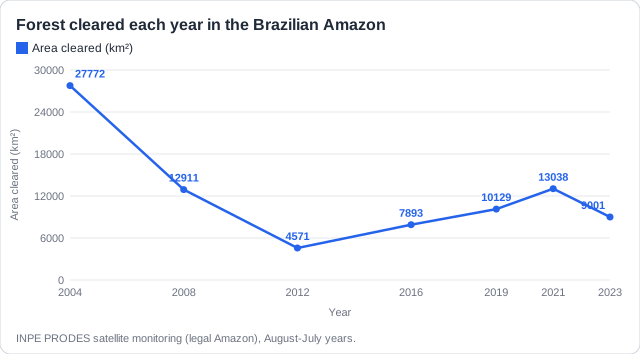
Real example: in the Brazilian Amazon, satellite monitoring, new protected areas and fines cut forest clearing from 27 772 km² in 2004 to 4571 km² in 2012. When enforcement weakened, clearing rose again, then fell after 2022.
Stop wasting time on topics you know
Our AI identifies your weak areas and focuses your study time where it matters. No more overstudying easy topics.
The third group takes carbon back out of the air: reforestation, and artificial sequestration such as carbon capture and storage and direct air capture.
The points to remember
- Reforestation and afforestation: growing trees absorb CO₂ by photosynthesis and store it in wood.
- Carbon capture and storage (CCS): CO₂ from chimneys is buried in rock deep underground.
- Direct air capture ('artificial trees') pulls CO₂ from the air to store it.
- Pros: CO₂ in the air falls, and CCS lets fossil fuels be used during the switch.
- Cons: high cost and energy, few storage sites, and it does not tackle the root cause.
- Trees can burn or be cut down, releasing the carbon again.
- Revegetating bare land and cities (parks, green roofs) also absorbs CO₂.
Reforestation
- Cheap and natural
- Also gives habitat and stops erosion
- Slow: trees take decades to grow
- Carbon lost again if the forest burns
Carbon capture (CCS)
- Traps CO₂ at the chimney
- Lets fossil fuels be used for now
- Expensive, uses extra energy
- Does not fix the root cause
Real example: Costa Rica paid landowners to protect and replant forest; cover rose from about a fifth of the country in the 1980s to over half today. At Sleipner in the North Sea, Norway has pumped about 1 million tonnes of CO₂ a year into rock under the sea bed since 1996.
How this comes up: Paper 2, Section A, after a carbon-cycle figure: outline one or two measures that can reduce the effects of human activities on the carbon cycle [1] or [2].
Kenya plans to generate all its electricity from renewable sources and to restore 10.6 million hectares of degraded land by 2030.
Outline two measures that can alleviate the effects of human activities on the carbon cycle.
Model answer plan
See the mark-by-mark plan — for / against / judgement, with marking guidance — in study mode.