The ocean pays a price for being a sink: The CO₂ the ocean absorbs does not just sit there: it makes seawater more acidic. This is ocean acidification, measured on the pH scale.
The points to remember
- More CO₂ in the air means more CO₂ dissolves in the ocean.
- CO₂ reacts with water to form carbonic acid, so the water becomes more acidic.
- Surface pH has fallen from about 8.2 to 8.1 since before the industrial age.
- That small fall means about 30% more acidity: the pH scale is not a straight line.
- Seawater is still alkaline (above 7): 'acidification' means moving towards acid.
The chemistry, in one line: CO₂ + H₂O → H₂CO₃ (carbonic acid). More CO₂ in, more acid, lower pH.
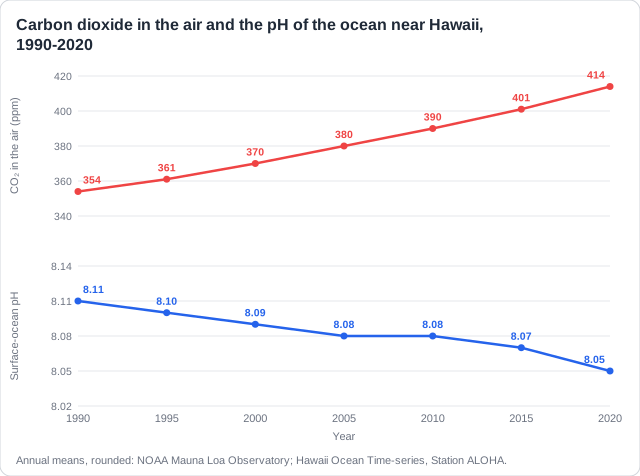
Real example: at Station ALOHA, north of Hawaii, scientists have measured the ocean every month since 1988. As CO₂ at nearby Mauna Loa rose from 354 to 414 ppm (1990-2020), surface pH fell from about 8.11 to 8.05.
Free preview
This is the free notes preview
You're reading the free notes. Aimnova Pro unlocks the full study experience — and you can try it with your first topic free to keep:
- FlashcardsLock in vocabulary and key terms with spaced repetition.
- Practice questionsAnswer exam-style questions and get instant AI marking.
- Mock exams & past-paper vaultSit full mocks and see exactly how examiners award marks.
- Personalised study planA daily plan built around your exam date and weak areas.
Shells and coral skeletons are made of calcium carbonate. To build them, animals take carbonate ions from the water. Acid uses up those carbonate ions.
The points to remember
- Lower pH means fewer carbonate ions in the water.
- Molluscs and corals need them to build calcium carbonate shells and skeletons.
- So shells and skeletons grow more slowly, are thinner, or even dissolve.
- Young animals (larvae) are hit hardest: many die before their shells form.
- Animals affected: corals, oysters, mussels, sea snails, some plankton.
Remember it as: More CO₂, more acid, fewer building blocks, weaker shells.
Normal seawater
- pH about 8.2
- Plenty of carbonate ions
- Shells and skeletons grow
More acidic seawater
- pH about 8.1 or lower
- Fewer carbonate ions
- Shells thin, grow slowly or dissolve
Real example: sea butterflies are molluscs. In 2012 scientists found sea butterflies in the Southern Ocean with shells already dissolving in the more acidic water. Fish and whales eat them, so the damage can spread.
Feeling unprepared for exams?
Get a clear study plan, practice with real questions, and know exactly where you stand before exam day. No more guessing.
The harm does not stop at shells. It passes through food webs and whole ecosystems.
The points to remember
- Many species are adapted to a narrow pH range, so a small change harms them.
- Producers such as phytoplankton and corals are sensitive: less food at the base of the food web.
- Corals bleach more easily and recover less well in more acidic water.
- Low pH can reduce reproduction in fish and shellfish and change fish behaviour and senses.
- Fewer producers and habitats: lower biodiversity and resilience; a possible tipping point.
- Some seagrasses and seaweeds may benefit from the extra CO₂.
A double threat for corals: Warmer water causes coral bleaching; acidification slows the growth of coral skeletons. Together they make it much harder for a reef to recover.
Real example: on the Great Barrier Reef, the growth of coral skeletons slowed by about 14% between 1990 and 2005, the sharpest fall in the 400-year record. Warming and acidification are the main suspects.
Ocean acidification is a problem for societies too, especially for people who live from the sea.
The points to remember
- Fisheries and aquaculture (oysters, mussels) can collapse, costing jobs and income.
- Coastal and indigenous communities lose food and may have to import it.
- Coral reefs support tourism, which declines as reefs die.
- Dead reefs protect coasts less from storm waves.
- There is an aesthetic loss, and the species' own right to exist (bio-rights) is harmed.
Environmental systems
- Shells and skeletons
- Food webs, biodiversity
- Resilience of reefs
Societies
- Fisheries and aquaculture
- Food, jobs, income
- Tourism, coastal protection
Three traps: This is not acid rain: do not write about acid deposition, sulfur dioxide or NOx. Describing the chemistry earns only two marks in an essay. And a question on 'systems and societies' needs both sides.
Real example: the Great Barrier Reef supports about 64 000 jobs and is worth about 6.4 billion Australian dollars a year to Australia's economy, mostly through tourism.
Memorize terms 3x faster
Smart flashcards show you cards right before you forget them. Perfect for definitions and key concepts.
Burning fossil fuels, and cutting down forests, change far more of the ocean than its pH. These are the ocean's abiotic conditions.
The points to remember
- Greenhouse gases warm the atmosphere and the oceans.
- More CO₂ dissolves: acidification, lower pH.
- Warmer water expands and ice melts: sea level rises.
- Melting ice dilutes the sea: salinity falls; more evaporation can raise it locally.
- Warmer water holds less oxygen; changes in temperature and salinity alter currents.
- Oil spills block light, so phytoplankton die and oxygen falls.
- Warmth can boost algal growth locally; dead sea life decomposes, adding CO₂ (or methane deep down).
When the cause is deforestation: Link each step: trees cleared, less CO₂ absorbed, more CO₂ in the air; thawing permafrost adds CO₂ and methane; so global warming and acidification. Bare soil also erodes and sends sediment into rivers and the sea.
Real example: since satellites began measuring in 1993, global sea level has risen by about 10 cm, partly because warmer seawater expands.
What does not count: Acid rain, NOx or sulfur dioxide changing ocean pH; timber ships polluting the sea; nutrient runoff from taiga soils (they are poor in nutrients). Write 'global warming', not just 'climate change', and say how warming raises sea level.
How this comes up: Paper 2, Section A: a carbon-cycle figure or graph, then describe the impacts on marine ecosystems of more CO₂ dissolving in the ocean [3].
Figure 1 shows carbon dioxide in the air at Mauna Loa and the pH of the ocean at Station ALOHA, Hawaii, from 1990 to 2020.
Describe the impacts on marine ecosystems of more carbon dioxide dissolving in the ocean.
Model answer plan
See the mark-by-mark plan — for / against / judgement, with marking guidance — in study mode.