Plastic that never goes away: Plastic does not rot. It breaks into smaller and smaller pieces until it becomes microplastics, which now reach every sea on Earth.
The points to remember
- Microplastics are pieces of plastic smaller than 5 mm.
- Some are made small: microbeads in cosmetics, fibres shed when synthetic clothes are washed, factory pellets.
- Most are broken off bigger plastic by UV light, waves and currents.
- Plastic is non-biodegradable: it breaks into smaller pieces but does not rot away.
- Plastic reaches the sea from rivers, landfills near the coast, ships and lost fishing gear.
- Microplastics now travel far in ocean currents and are found in water, air, soil and living things everywhere.
Remember it as: Plastic does not rot, it just gets smaller.
Real example: the Great Pacific Garbage Patch holds an estimated 1.8 trillion pieces of plastic, most of them microplastics.
Free preview
This is the free notes preview
You're reading the free notes. Aimnova Pro unlocks the full study experience — and you can try it with your first topic free to keep:
- FlashcardsLock in vocabulary and key terms with spaced repetition.
- Practice questionsAnswer exam-style questions and get instant AI marking.
- Mock exams & past-paper vaultSit full mocks and see exactly how examiners award marks.
- Personalised study planA daily plan built around your exam date and weak areas.
Microplastics are a problem even when an animal passes them out again, because they do not travel alone. Persistent pollutants in the water stick to them, in the same way that oil sticks to a plastic tub.
The points to remember
- Persistent pollutants such as PCBs and DDT dissolve poorly in water but well in oily substances.
- Plastic is oily, so these pollutants are absorbed into its surface.
- On a plastic pellet they can be up to a million times more concentrated than in the water around it.
- The longer a piece floats, the more pollutant it soaks up.
- So microplastics act as carriers (vectors) for toxins.
Remember it as: Oily plastic soaks up oily poisons.
Real example: plastic pellets collected in Tokyo Bay, Japan, carried PCBs at up to a million times the concentration in the seawater around them.
Say what the plastic carries: 'Microplastics are eaten' alone is only half the story. Say that toxins are absorbed onto the microplastics, so eating the plastic passes the toxins on.
Stop wasting time on topics you know
Our AI identifies your weak areas and focuses your study time where it matters. No more overstudying easy topics.
Now the plastic enters the food chain, and the pollutants it carries go with it. From here, bioaccumulation and biomagnification take over (the ideas of the previous page).
The points to remember
- Small animals at low trophic levels (zooplankton, filter feeders such as mussels, small fish) mistake microplastics for food.
- In the gut, the toxins pass into the animal's tissues.
- The toxins bioaccumulate in the prey and biomagnify up the food chain.
- So microplastics increase the transmission of pollutants along the food chain.
- Top predators, including people who eat seafood, get the highest dose.
- More microplastic, and a longer time in the sea, means more toxin in the fish.
Remember it as: Mistaken for food, toxins in, up the chain.
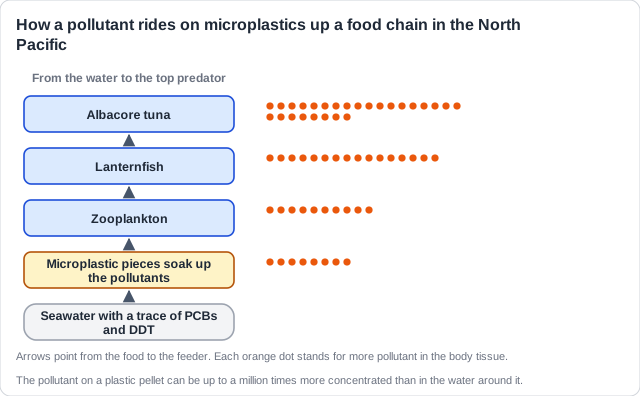
Real example: in the North Pacific, about 35% of the small lanternfish sampled had eaten plastic. Lanternfish are eaten by tuna, squid, dolphins and seabirds, so the toxins move up the chain.
Reading a trend graph: If a graph shows microplastics rising over time, fish caught later hold more toxins for two reasons: more microplastic to eat, and a longer time for the toxins to build up.
Bigger pieces of plastic harm sea life directly, before they ever break down. Learn these too: a question about plastic and a food chain credits them alongside the toxins.
The points to remember
- Large items look like food: a floating bag looks like a jellyfish to a turtle.
- Swallowed plastic fills the stomach, so the animal feels full and starves.
- Animals get entangled in lost fishing nets and six-pack rings, and drown or are injured.
- Plastic floating over the water blocks sunlight, so there is less photosynthesis; it can smother corals.
- Hard plastic scrapes corals, and the wounds become infected.
Remember it as: Mistaken for food, tangled, starved, smothered, scratched.
Real example: on Midway Atoll, Laysan albatross parents pick up floating plastic by mistake and feed it to their chicks; many chicks die with stomachs full of plastic.
See how examiners mark answers
Access past paper questions with model answers. Learn exactly what earns marks and what doesn't.
How this comes up: Paper 2, Section A: why microplastics may hit species at higher trophic levels hardest [2].
Microplastic concentrations in the Great Pacific Garbage Patch have risen quickly since the 1970s.
Outline reasons why microplastics in the Great Pacific Garbage Patch may have the greatest impact on species at higher trophic levels.
Model answer plan
See the mark-by-mark plan — for / against / judgement, with marking guidance — in study mode.