Some pollutants never go away: A non-biodegradable pollutant stays in water, soil and living things for years, and reaches food webs through water, soil and air. PCBs, DDT and mercury are the best-known examples, and they change whole ecosystems.
The points to remember
- Non-biodegradable pollutants, such as POPs (persistent organic pollutants), are not broken down by decomposers or the body.
- DDT is an insecticide, sprayed on crops and to kill the mosquitoes that spread malaria.
- PCBs are chemicals once used in electrical equipment, paints and coolants.
- Mercury comes from burning coal and from gold mining; in water it turns into methylmercury.
- They dissolve in fat, not water, so they are stored in fatty tissue instead of being excreted.
- They change ecosystems: top predators are poisoned, breed less and can die out locally.
Remember it as: Won't break down, won't wash out, so it builds up.
| Pollutant | Where it comes from | Stored in |
|---|---|---|
| DDT | Insecticide on crops and against malaria mosquitoes | Body fat |
| PCBs | Old electrical equipment, paints, coolants | Body fat, blubber |
| Mercury | Burning coal, gold mining, factory waste | Muscle and organs |
Real example: DDT was sprayed on farms and marshes across the United States from 1945 until it was banned there in 1972.
Free preview
This is the free notes preview
You're reading the free notes. Aimnova Pro unlocks the full study experience — and you can try it with your first topic free to keep:
- FlashcardsLock in vocabulary and key terms with spaced repetition.
- Practice questionsAnswer exam-style questions and get instant AI marking.
- Mock exams & past-paper vaultSit full mocks and see exactly how examiners award marks.
- Personalised study planA daily plan built around your exam date and weak areas.
A pollutant that cannot be broken down or excreted builds up in the body, a little more with every meal. This is bioaccumulation: it happens inside one organism, over time.
The points to remember
- Taken in with food or water, but not broken down (metabolized) or excreted.
- Taken in faster than it is lost, so it stays in the body.
- Stored in fatty tissue.
- The concentration rises over time: older animals hold the most.
- Animals that live long and carry lots of fat are hit hardest: whales, seals, birds of prey.
Remember it as: Bioaccumulation: one body, over time.
Real example: in the United States, pregnant women are told not to eat swordfish, shark or king mackerel. These fish live long, so they hold the most mercury.
Know your predicted grade
Take timed mock exams and get detailed feedback on every answer. See exactly where you're losing marks.
Now follow the pollutant from one feeder to the next. Its concentration rises at every step: biomagnification. It happens along a food chain.
The points to remember
- The pollutant is passed on when an organism is eaten.
- At each level most ordinary biomass is lost in respiration and waste; the pollutant is kept.
- Each predator eats many prey over its life and keeps the pollutant from all of them.
- So the concentration rises at each trophic level, often millions of times from water to the top.
- Top predators carry the highest concentration.
Remember it as: Biomass burned, pollutant kept: up the chain, up the dose.
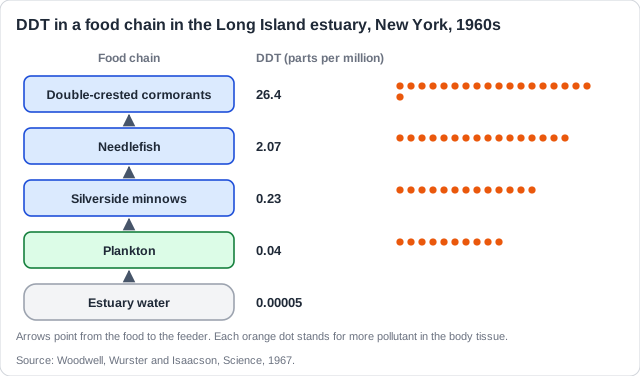
Percentage change between two levels: Formula first: percentage change = (higher value - lower value) / lower value x 100.
Needlefish to cormorants: (26.4 - 2.07) / 2.07 x 100 = 1,175%.
Real example: in the 1960s, DDT in the Long Island estuary, New York, rose from 0.04 parts per million in plankton to 26.4 in cormorants: about 660 times higher. Quote numbers like these when you read a figure.
Not 'they eat more': Never give 'animals higher up eat more food' as the reason: they do not eat more biomass in a given time. The reason is that the biomass is used up in respiration while the pollutant stays.
The two words are easy to mix up. Both mean a rising concentration of a non-biodegradable pollutant; the difference is where it rises.
Bioaccumulation
- Inside one organism
- Rises over time, with age
- More taken in than is lost
Biomagnification
- Along a food chain
- Rises at each trophic level
- Biomass lost in respiration, pollutant kept
Remember it as: Accumulate: in me, over time. Magnify: up the chain.
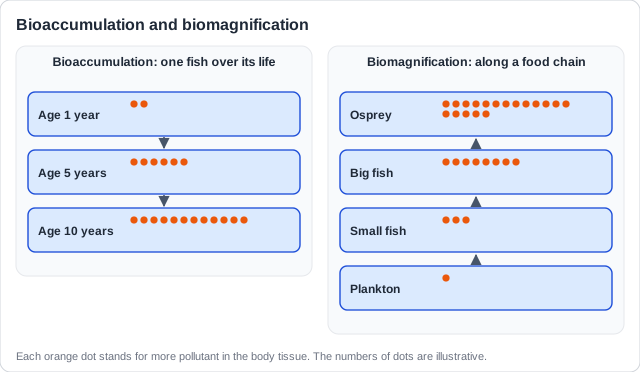
Real example: in the Long Island estuary, needlefish held 2.07 ppm of DDT and the cormorants that ate them 26.4 ppm: biomagnification.
Two traps: Asked for the difference, give both halves in one answer: one half alone scores nothing.
Asked only to 'state the relationship' in a table, write 'the higher the trophic level, the higher the concentration'. Naming the process there is not enough.
Get feedback like a real examiner
Submit your answers and get instant feedback — what you did well, what's missing, and exactly what to write to score full marks.
The top of the food chain gets the highest dose, so that is where the damage shows first, and from there it spreads through the whole ecosystem.
The points to remember
- DDT makes birds of prey lay thin eggshells that break, so fewer chicks hatch.
- PCBs disturb hormones, the immune system and reproduction, for example in orcas and seals.
- Mercury damages the nervous system: the brain and nerves.
- Top predators decline or die out locally, so their prey are no longer controlled: the food web changes.
- Humans eat top predators such as tuna and swordfish, so people can get high doses too.
- Mothers pass pollutants stored in fat to their young through eggs and milk.
Remember it as: Top of the chain, top of the dose.
Real example: DDT thinned the eggshells of US bald eagles; by 1963 only 417 nesting pairs were left in the lower 48 states. After DDT was banned in 1972 they recovered, to 9,789 pairs by 2007.
DDT shows why these chemicals are hard to judge: it saves human lives, but it also harms wildlife. That makes its use controversial.
For using DDT
- A very effective, cheap insecticide
- Controls malaria and other diseases spread by insects
- Kills crop pests, so harvests are bigger
Against using DDT
- A persistent pollutant of soil and water
- It bioaccumulates and biomagnifies
- Kills non-target species such as birds of prey
- Harms human health; lowers biodiversity
Factors from both sides: When asked to identify factors that make DDT controversial, give short points from both sides: one idea per line, one mark each.
Real example: the United States banned DDT in 1972, but the World Health Organization still allows it to be sprayed inside homes where malaria is common.
Learn what examiners really want
See exactly what to write to score full marks. Our AI shows you model answers and the key phrases examiners look for.
How this comes up: Paper 2, Section B (b): explain how bioaccumulation and biomagnification of toxins may occur in food chains [7].
Persistent toxins such as DDT have been found in birds of prey far from where they were used.
Explain how bioaccumulation and biomagnification of toxins may occur in food chains.
Model answer plan
See the mark-by-mark plan — for / against / judgement, with marking guidance — in study mode.