Weigh it dry: Biomass is the mass of the organic matter in living things. Water is most of the rest, so we dry samples and weigh what is left.
The points to remember
- Biomass is the mass of organic matter in an organism or a trophic level.
- Most of an organism's inorganic mass is water, and the amount of water changes from hour to hour.
- Drying removes the water, so dry mass ≈ biomass (the organic matter).
- Water holds no usable food energy, so dry mass also shows the energy stored.
- Give it per unit area, e.g. g per m², so different places can be compared.
Remember it as: Take out the water; what is left is the biomass.
Real example: a lettuce is about 95% water. 100 g of fresh lettuce leaves dries down to about 5 g: only that 5 g is biomass.
Fresh mass misleads: Fresh mass depends on how much water an organism happens to hold, for example after rain. Always compare biomass as dry mass per m².
Free preview
This is the free notes preview
You're reading the free notes. Aimnova Pro unlocks the full study experience — and you can try it with your first topic free to keep:
- FlashcardsLock in vocabulary and key terms with spaced repetition.
- Practice questionsAnswer exam-style questions and get instant AI marking.
- Mock exams & past-paper vaultSit full mocks and see exactly how examiners award marks.
- Personalised study planA daily plan built around your exam date and weak areas.
Collect
Take all the organisms in a measured area.
Dry
Oven at about 60-80 °C.
Weigh
Reweigh until the mass stays the same.
Scale up
Mean per m² × total area.
The method, step by step
- Collect a sample: e.g. all the plants in random quadrats.
- Dry it in an oven at about 60-80 °C: hot enough to drive off water, not so hot that it burns.
- Weigh, dry again and reweigh until the mass stays the same: constant mass.
- Work out the mean dry mass per m².
- Extrapolate: multiply by the total area to estimate the whole trophic level.
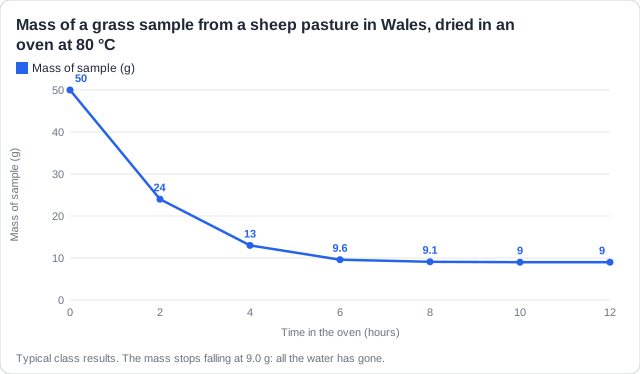
Real example: on a sheep pasture in Wales, a student cuts all the grass in a 0.25 m² quadrat. It dries from 50 g to a constant 9.0 g, so the grass biomass is 9.0 ÷ 0.25 = 36 g per m².
Why 'constant mass'?: A sample can look dry and still hold water. Only when two weighings give the same mass has all the water gone.
See how examiners mark answers
Access past paper questions with model answers. Learn exactly what earns marks and what doesn't.
To build a pyramid of energy (2.2.17) we need the energy in the biomass, not just its mass. The energy is found by burning a small dried sample and scaling up.
Energy from biomass
- Burn a dried sample completely in a calorimeter.
- The heat released warms the water; the temperature rise gives the energy per gram.
- Energy per m² = energy per gram × dry mass per m².
- Scale up (extrapolate) to the whole area or trophic level.
The calculation: Energy per m² = energy released per gram of dry mass × dry mass per m²
Worked example: dry grass releases 17 kJ per gram when burned. The pasture holds 36 g of dry grass per m², so it stores 17 × 36 = 612 kJ per m².
Plant material in class: In school, burn only small dried samples of plant material, such as leaves or seeds, in a simple calorimeter; the energy from a whole field is then an estimate.
Drying also lets us measure what an animal gains from its food. Its gross productivity is the food it eats minus the faeces it passes out (GP and NP are explained in 2.2.13).
Gross productivity of animals, in the laboratory
- Dry and weigh the food given at the start.
- After a set number of days, dry and weigh the food left: food eaten = given - left.
- Collect, dry and weigh the faeces produced over the same days.
- Gross productivity = food eaten - faeces (the food absorbed).
- Divide by the number of days to give biomass per day.
- Do not weigh the animals themselves: their gain in mass is net productivity.
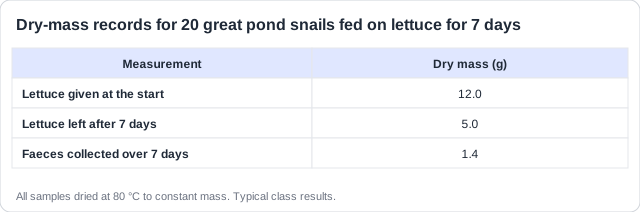
Worked example: food eaten = 12.0 - 5.0 = 7.0 g. Gross productivity = 7.0 - 1.4 = 5.6 g in 7 days, so 5.6 ÷ 7 = 0.8 g per day for the 20 snails.
A common slip: Weighing the animals at the start and the end measures their net productivity, not their gross productivity. For gross productivity, weigh the food and the faeces.
Study smarter, not longer
Most students waste 40% of study time on topics they already know. Our AI tracks your progress and optimizes every minute.
Drying is simple and accurate for small plants, but it has real drawbacks.
Limits of the method
- It is destructive: the organisms are killed, which may be unethical, especially for animals.
- Large organisms such as trees cannot be dried whole: only parts are sampled and scaled up.
- Each sample is a snapshot at one time; biomass changes with the seasons.
- Samples may not represent the whole area, and roots or mobile animals are easily missed.
Remember it as: It kills, it cannot take a tree, it is one moment.
Real example: to estimate the biomass of an oak woodland, ecologists cannot dry whole trees. They measure the trunk width of every tree and use tables made by drying a few felled trees.
How this comes up: Paper 2, Section B (a): outline a laboratory method to find the gross productivity of a named aquatic animal population [4]. Section A may ask why dry mass is used [1-2].
A class keeps a population of freshwater crayfish in a laboratory tank and feeds them on pond weed.
Outline the procedures the class could use to find the gross productivity of the crayfish population in terms of biomass per day.
Model answer plan
See the mark-by-mark plan — for / against / judgement, with marking guidance — in study mode.