One boundary, looked at closely: The planetary boundaries model shows that biosphere integrity has passed a critical threshold. It is one of the boundaries furthest beyond its safe limit.
The points to remember
- Biosphere integrity is the health of the living world: all its species and ecosystems.
- It has two parts: genetic diversity (the variety of genes and species) and functional diversity (the jobs species do).
- Ecosystems and species depend on each other: ecosystems support species, and species keep ecosystems working.
- So when an ecosystem is disturbed, species are lost; and when species are lost, the ecosystem works less well.
Remember it as: Species hold up ecosystems; ecosystems hold up species.
Real example: bees and other pollinators do a job many food crops need: about three-quarters of the world's main food crops depend at least partly on animals to pollinate them. Lose the pollinators, and the job stops.
Genetic diversity
- The variety of genes and species
- Measured by the extinction rate
- Lost when species die out
Functional diversity
- The jobs species do
- Pollinating, decomposing, grazing
- Lost when those jobs stop
Free preview
This is the free notes preview
You're reading the free notes. Aimnova Pro unlocks the full study experience — and you can try it with your first topic free to keep:
- FlashcardsLock in vocabulary and key terms with spaced repetition.
- Practice questionsAnswer exam-style questions and get instant AI marking.
- Mock exams & past-paper vaultSit full mocks and see exactly how examiners award marks.
- Personalised study planA daily plan built around your exam date and weak areas.
Human activity has disturbed ecosystems on every continent and in every ocean, and this is what has worn down biosphere integrity.
How human activity erodes it
- Habitat loss: forests, wetlands and grasslands turned into farms, cities and roads (the biggest cause).
- Overexploitation: overfishing, hunting and logging faster than species can recover.
- Climate change: species cannot move or adapt fast enough.
- Pollution: pesticides, fertiliser and plastics.
- Invasive species: rats, cats and other species brought in by people.
Remember it as: Habitat, harvest, heat, poison, invaders.

Real example: the Yangtze river dolphin of China was declared probably extinct in 2006, after dams, pollution, boat traffic and fishing nets wrecked its river habitat.
An average fall, not a count: A 73% fall means monitored populations are, on average, about a quarter of their 1970 size. It does not mean 73% of all animals, or 73% of species, have gone.
Stop wasting time on topics you know
Our AI identifies your weak areas and focuses your study time where it matters. No more overstudying easy topics.
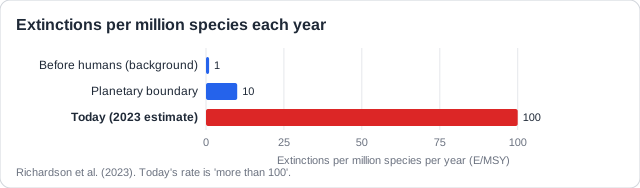
How do we know the boundary has been crossed? The clearest evidence is the extinction rate.
The points to remember
- Before humans, about 1 extinction per million species per year (the background rate).
- The planetary boundary is 10 extinctions per million species per year.
- Today's rate is over 100: more than ten times the boundary.
- So the boundary for biosphere integrity has been crossed, and it is in the high-risk zone.
Remember it as: Background 1, boundary 10, today over 100.
Real example: about 1 million of the world's plant and animal species are now threatened with extinction, according to a major United Nations report in 2019.
A rate, not a total: Quote the extinction rate with its unit, 'per million species per year', and compare it with the boundary of 10.
How this comes up: Paper 2, Section B (a): outline how human activity has led to loss of biosphere integrity [4].
The planetary boundaries model shows that biosphere integrity is one of the boundaries furthest beyond its safe limit.
Outline four ways in which human activity has led to loss of biosphere integrity.
Model answer plan
See the mark-by-mark plan — for / against / judgement, with marking guidance — in study mode.