Turn it round before it tips: Biosphere integrity is already past its safe limit. To avoid ecosystems passing a tipping point, the loss must be reversed, not just slowed.
The points to remember
- Losing species and habitat lowers an ecosystem's resilience.
- A less resilient ecosystem can be pushed past a tipping point into a new state.
- The change can be sudden, and hard or impossible to reverse.
- So slowing the loss is not enough: the loss of biosphere integrity must be reversed.
Remember it as: Slow the loss, then turn it round, before the system flips.
Real example: in the Caribbean, disease killed most of the sea urchins in 1983 and parrotfish were overfished. With few grazers left, seaweed smothered many coral reefs, and coral cover fell by about half between 1970 and 2012. Many reefs have stayed covered in seaweed.
Link loss to tipping points: In an answer, go step by step: species lost, then resilience down, then a tipping point is closer.
Free preview
This is the free notes preview
You're reading the free notes. Aimnova Pro unlocks the full study experience — and you can try it with your first topic free to keep:
- FlashcardsLock in vocabulary and key terms with spaced repetition.
- Practice questionsAnswer exam-style questions and get instant AI marking.
- Mock exams & past-paper vaultSit full mocks and see exactly how examiners award marks.
- Personalised study planA daily plan built around your exam date and weak areas.
Why protect a whole ecosystem rather than one species? Because every species needs its niche.
The points to remember
- A species' niche is everything it needs: food, shelter, breeding sites and the right conditions.
- These needs are met only in an intact ecosystem.
- Protecting the ecosystem protects the niches of all the species in it, not just one.
- It also keeps the interactions species rely on: their prey, pollinators and partners.
- Saving a species without its habitat rarely works: it cannot survive in the wild.
Remember it as: Save the home and you save the species.
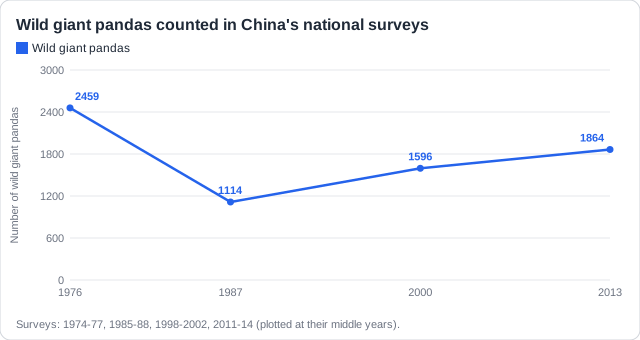
Real example: giant pandas eat almost only bamboo and give birth in hollow old trees. After China protected their mountain forests in dozens of reserves, wild numbers rose from about 1 114 in the 1980s to 1 864 in 2014, and in 2016 pandas were moved from Endangered to Vulnerable.
Practice with real exam questions
Answer exam-style questions and get AI feedback that shows you exactly what examiners want to see in a full-marks response.
Protecting the integrity of ecosystems slows the damage. Restoring what has been lost turns it round.
How the loss can be slowed and reversed
- Protected areas keep whole ecosystems intact, which slows the loss.
- Wildlife corridors link habitats, so species can move, find mates and breed.
- Reduce the pressures: less clearing, overfishing, pollution and fewer invasive species.
- Restoration, such as replanting forest or bringing back missing species, reverses the loss.
- Goal: protect 30% of land and sea by 2030 (a world agreement made in 2022).
Slows the loss
- Protected areas
- Corridors
- Fewer pressures
Reverses the loss
- Replanting habitat
- Removing invasive species
- Bringing back missing species
Real example: in 2009 Belize banned catching parrotfish, the grazers that keep seaweed off its coral reefs, to help the reefs recover.
Protecting is not yet reversing: A protected area stops more damage; only restoration, with fewer pressures, brings the lost species and habitat back. Say which one you mean.
How this comes up: Paper 1 ends with a [6]: To what extent, using the case study. Four points each way at most, then a verdict.
Figure 1 shows the number of wild giant pandas in China's four national surveys. From the 1990s China protected most of the pandas' mountain forests in reserves and linked some of them with bamboo corridors.
To what extent has protecting the pandas' forest ecosystem been the reason for their recovery?
Model answer plan
See the mark-by-mark plan — for / against / judgement, with marking guidance — in study mode.