Small numbers, big effect: A keystone species has a disproportionate effect on community structure. If it is removed, the whole ecosystem can collapse.
The points to remember
- A keystone species has a disproportionate effect on its community.
- It shapes community structure: which species live there, and how many.
- Remove it and the food web can collapse: some species boom, others vanish.
- Keystones can be predators, ecosystem engineers or mutualists such as pollinators.
Remember it as: Pull out the keystone and the arch falls.
Real example: in the 1960s the ecologist Robert Paine removed purple sea stars from a rocky shore in Washington, USA. Mussels took over the rock, and the number of species fell from 15 to 8.
Say why it is a keystone: Link the species to the whole community: 'without it, the food web collapses', not just 'it eats other animals'.
Free preview
This is the free notes preview
You're reading the free notes. Aimnova Pro unlocks the full study experience — and you can try it with your first topic free to keep:
- FlashcardsLock in vocabulary and key terms with spaced repetition.
- Practice questionsAnswer exam-style questions and get instant AI marking.
- Mock exams & past-paper vaultSit full mocks and see exactly how examiners award marks.
- Personalised study planA daily plan built around your exam date and weak areas.
When a keystone predator disappears, the effect passes down the food web like falling dominoes: a trophic cascade.
The chain reaction, step by step
- A keystone predator controls herbivores, so no one species dominates.
- Remove it: prey numbers rise and they overgraze the producers.
- Fewer producers: less primary productivity, so less energy for higher levels.
- Habitat and niches are lost, so species die out locally: biodiversity falls.
- A small population that is left can lose genetic diversity.
Remember it as: Predator down, grazers up, plants down, species out.
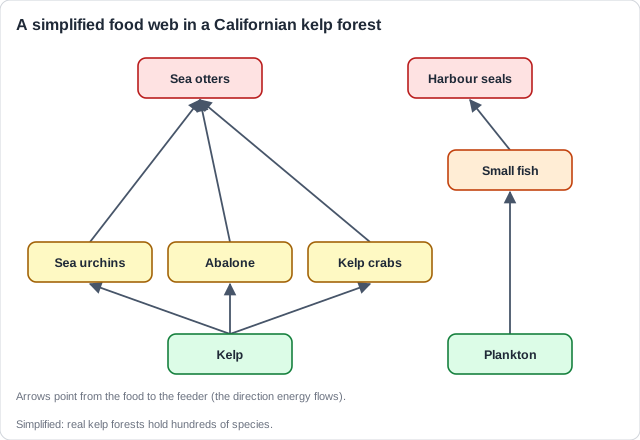
Real example: by 1911 fur hunters had killed almost all the sea otters off California. Sea urchins boomed and ate the kelp down to bare rock, called an urchin barren. Where otters were protected and returned, the kelp grew back.
Use only the links in the figure: Follow the arrows you are given. A change the food web does not show, such as 'sea lions increase because there is less competition', does not count.
Get feedback like a real examiner
Submit your answers and get instant feedback — what you did well, what's missing, and exactly what to write to score full marks.
Some keystones work by building, not eating. An ecosystem engineer creates new places for other species to live.
The points to remember
- An ecosystem engineer changes the physical habitat and makes homes for others.
- Beaver dams slow the water: ponds, marsh and wet meadow form, so habitat diversity rises.
- Still water suits pond plants, frogs and dragonflies: more species.
- Flooded trees die and give birds nest holes.
- But the pond has less oxygen, so stream fish such as trout decline.
- When a dam breaks, a beaver meadow grows on the nutrient-rich silt.
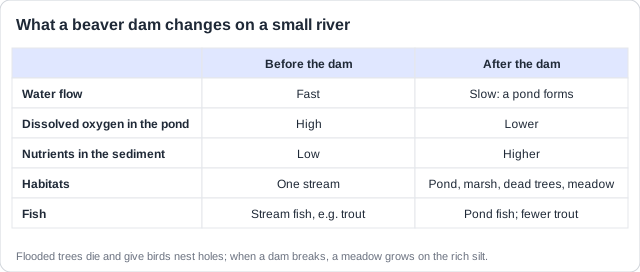
Reading pond and stream data: Quote a number for each place: 'oxygen is 4 mg per litre in the pond but 11 in the stream'. A change with no numbers is not enough.
Real example: wild beavers appeared on the River Otter in Devon, England. After a five-year trial (2015-2020) found that their dams held back floodwater and created ponds full of wildlife, they were allowed to stay.
This is why keystones matter for sustainability: they help an ecosystem stay stable and bounce back. That ability is its resilience.
The points to remember
- Keystones keep the food web complex: many species, many links.
- More biodiversity means more ways to recover after a disturbance: higher resilience.
- Healthy producers mean bigger storages of biomass and more nutrient cycling.
- So the ecosystem can keep itself going for a long time: keystones support sustainability.
Remember it as: Keystone in place: more species, bigger stores, faster recovery.
Real example: off California, kelp forests with sea otters recover after winter storms, because young kelp can regrow while otters keep the urchins in check.
Say the word 'resilience': Link each point to resilience in so many words. An answer that explains the food web but never says why that makes the ecosystem resilient cannot get full marks.
Learn what examiners really want
See exactly what to write to score full marks. Our AI shows you model answers and the key phrases examiners look for.
Many conservation projects bring keystone species back, a part of rewilding. The return can raise biodiversity, or lower it.
The points to remember
- An apex predator is at the top of a food chain, with no natural predators.
- Gain: predators cut herbivore numbers and change where they feed, so plants recover.
- Gain: engineers create habitat, and keystones stop one species dominating.
- Risk: a returning species may eat rare native species.
- Risk: in a small, fenced or island habitat it may overpopulate or upset predator-prey balance.
Remember it as: Bringing one back can add species or take them away.
Can raise biodiversity
- Wolves: elk browse less, willow and songbirds return.
- Beavers: new ponds and wetlands.
- Sea stars: mussels cannot crowd out other species.
Can lower biodiversity
- Sea otters eat abalone.
- Dingoes in a fenced reserve ate the rare bettongs they were meant to help.
Real example: on the River Otter in Devon, the beavers' ponds brought back frogs and wetland insects.
Name a species for every point: Tie each gain or risk to a named species and place. An answer with no named example cannot get full marks.
Keystone and flagship species are easy to mix up. They describe different things: what a species does, and how people see it.
The points to remember
- Keystone: chosen for its ecological role, found by scientific study.
- Flagship: a charismatic, popular species used to win support and raise funds.
- Protecting a flagship protects its whole habitat and the species in it.
- A keystone may be unpopular: seen as a pest or a threat.
- One species can be both: the jaguar is a keystone top predator and a flagship.
Keystone species
- Its role in the ecosystem
- Found by scientific study
- May be feared or disliked
Flagship species
- Its appeal to people
- Chosen for publicity and funds
- Protects the habitat it lives in
Two traps: 'It controls its prey' alone does not show a keystone: say it is integral to the food web or the ecosystem's structure. And a point made twice in reverse ('flagships are popular, keystones are not') counts once.
Real example: the giant panda, the logo of the conservation charity WWF, is a flagship; the purple sea star, which few people have heard of, is a keystone.
Never wonder what to study next
Get a personalized daily plan based on your exam date, progress, and weak areas. We'll tell you exactly what to review each day.
How this comes up: Paper 2, Section A: a food web with a keystone predator. Explain what happens to biodiversity if it declines [3].
Figure 1 shows a simplified food web in a Californian kelp forest.
Explain how a reduction in sea otter numbers may impact the biodiversity of the kelp forest ecosystem.
Model answer plan
See the mark-by-mark plan — for / against / judgement, with marking guidance — in study mode.