The brakes came off: The numbers of other species are held in check by limiting factors. Humans have removed most of theirs, so the human population has grown for over 200 years.
The points to remember
- Natural predators were removed: weapons, farming and living in towns keep people safe.
- Medicine, vaccines and clean water cut deaths from disease, so the death rate fell.
- Technology raised the food supply: fertilisers, irrigation and new crop varieties.
- Trade and transport move food and resources to where people need them.
- With fewer limits, the population grew exponentially: 1 billion in 1800, 8 billion in 2022.
Remember it as: No predators, less disease, more food: the brakes came off.
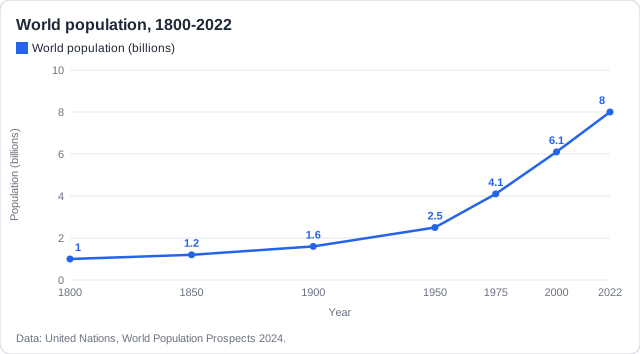
Real example: after the 1960s Green Revolution, India's grain harvest more than tripled, and famine stopped limiting its population.
Free preview
This is the free notes preview
You're reading the free notes. Aimnova Pro unlocks the full study experience — and you can try it with your first topic free to keep:
- FlashcardsLock in vocabulary and key terms with spaced repetition.
- Practice questionsAnswer exam-style questions and get instant AI marking.
- Mock exams & past-paper vaultSit full mocks and see exactly how examiners award marks.
- Personalised study planA daily plan built around your exam date and weak areas.
More people, each using more resources, put pressure on ecosystems. Removing the natural limits has a cost.
What happens to ecosystems
- Habitat loss: forests and wetlands are cleared for farms, towns and roads.
- Overharvesting: fish, timber and wild animals are taken faster than they renew.
- Pollution and climate change from farming, industry and fossil fuels.
- Invasive species spread with trade and travel.
- Biodiversity loss: extinctions run far above the background extinction rate.
- Degradation of soil, water and fish stocks can become a new limiting factor on people.
Remember it as: More people, more pressure: habitats, harvests, pollution, climate, invasives.
Growth harms ecosystems
- Forests are cleared for farms and towns.
- Extinctions run far above the natural rate.
But the harm can be reduced
- Protected areas and breeding programmes.
- Mountain gorillas rose to over 1000 by 2018.
Weigh both sides: Growth usually reduces biodiversity, and conservation can slow the loss, but overall the loss is still rising.
Real example: in Borneo, forest has been cleared for oil palm plantations, and orangutan numbers have fallen by about half since 1999.
Practice with real exam questions
Answer exam-style questions and get AI feedback that shows you exactly what examiners want to see in a full-marks response.
Two old views disagree about whether people can keep outgrowing their limits.
Malthus
- Population grows faster than food.
- Famine, disease and war will limit it.
Boserup
- Need drives new ideas.
- Technology raises the food supply.
What technology can and cannot do
- Food: GM crops, vertical farms and fertilisers raise yields.
- Water: desalination, water treatment and reuse.
- Energy and pollution: renewable energy, catalytic converters, scrubbers and carbon capture.
- Births: contraception lets families choose to have fewer children.
- But: it is costly, poorer countries may not afford it, and it can create new problems.
Remember it as: Malthus: food runs out. Boserup: need drives new ideas.
Real example: Israel gets most of its household water from desalination plants on its Mediterranean coast.
Technology can move a problem: Fertilisers raise yields, but they wash into rivers and harm the wildlife there.
Nature's brakes or people's choices?: Future growth may be limited by natural factors returning, or by people choosing to have fewer children, as the demographic transition model predicts.
The points to remember
- Natural limiting factors could return: water shortages, poor harvests, disease and a changing climate.
- Population policies act directly: family planning, or limits on the number of children.
- Development acts indirectly: education for girls and better health care lower birth rates.
- Birth rates are already falling in most countries as they develop.
- The UN projects the world population will peak at about 10.3 billion in the 2080s.
Remember it as: Nature's brakes or people's choices?
Real example: China's one-child policy (1980-2015) limited most families to one child, and China's population began to fall in 2022.
Feeling unprepared for exams?
Get a clear study plan, practice with real questions, and know exactly where you stand before exam day. No more guessing.
How this comes up: Paper 2, Section B (c) [9]: a 'to what extent' or 'discuss' essay on human population growth and its limits.
Many countries face water shortages, polluted air and rising demand for food as their populations grow.
To what extent can technology address the impacts of overpopulation?
Model answer plan
See the mark-by-mark plan — for / against / judgement, with marking guidance — in study mode.