Does crowding matter?: A density-dependent factor gets stronger as a population gets more crowded. A density-independent factor does not care how crowded it is.
The points to remember
- Density-dependent factors grow stronger as a population gets denser: competition, predation, disease, parasites.
- In a crowded population, predators find prey more easily and pathogens pass from one to another faster.
- Density-independent factors hit a population whatever its density: storms, floods, fires, droughts, hard frosts.
- Density-independent factors can kill many, but they do not hold a population near its carrying capacity.
- It is the density-dependent factors that regulate a population around its carrying capacity.
Remember it as: Crowding makes it worse? Density-dependent. Weather that hits everyone? Density-independent.
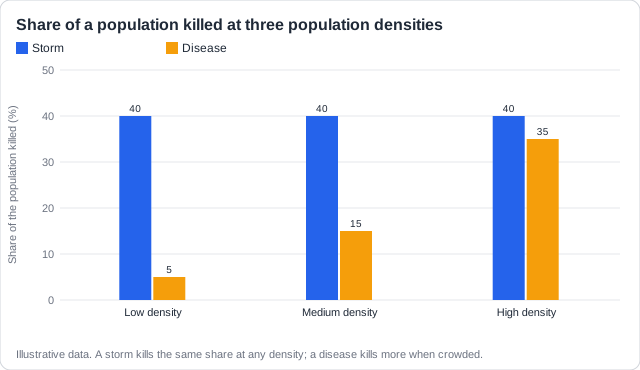
Real example: the very cold winter of 2010 killed many of Britain's wrens, however many there were: density-independent.
Free preview
This is the free notes preview
You're reading the free notes. Aimnova Pro unlocks the full study experience — and you can try it with your first topic free to keep:
- FlashcardsLock in vocabulary and key terms with spaced repetition.
- Practice questionsAnswer exam-style questions and get instant AI marking.
- Mock exams & past-paper vaultSit full mocks and see exactly how examiners award marks.
- Personalised study planA daily plan built around your exam date and weak areas.
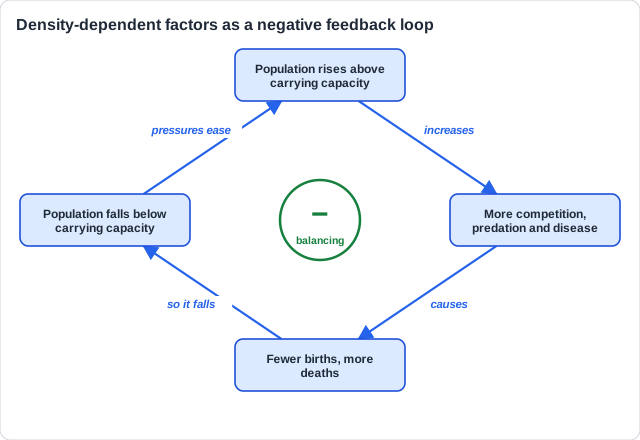
Back to balance: Density-dependent factors work as negative feedback: they push a population back towards its carrying capacity whenever it moves away.
The points to remember
- The population rises above its carrying capacity.
- Competition, predation and disease all increase.
- Fewer births and more deaths, so the population falls back.
- Below the carrying capacity these pressures ease, so the population rises again.
- This is negative feedback: it returns the population to equilibrium around the carrying capacity.
Remember it as: Too many: more squeeze, fewer survive. Too few: less squeeze, more survive.
Real example: on the Isle of Rum, Scotland, scientists have followed red deer since 1972; in years with more deer, fewer calves survive their first winter.
Study smarter, not longer
Most students waste 40% of study time on topics they already know. Our AI tracks your progress and optimizes every minute.
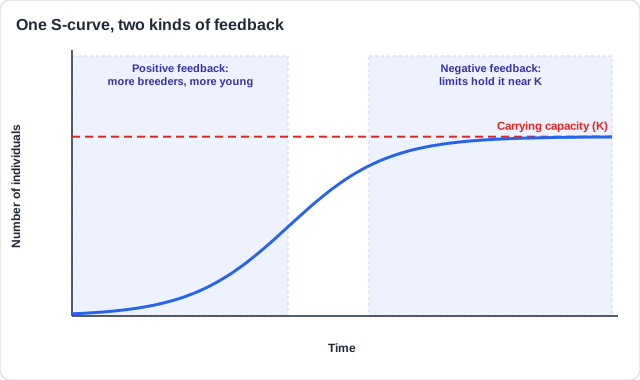
Two loops, one curve: An S-shaped growth curve shows both kinds of feedback: positive feedback drives the early growth, and negative feedback slows it and holds it at the carrying capacity.
The points to remember
- At the start, more individuals breed, making more young, who breed in turn: positive feedback.
- Positive feedback is a change that leads to more of the same change: fast, exponential growth.
- Near the carrying capacity, density-dependent factors (food, water, predation, disease) grow stronger.
- They slow the growth rate and hold numbers near the carrying capacity: negative feedback.
- Negative feedback is a change that leads to less of that change: it stabilises the population.
Remember it as: Positive: more makes more. Negative: more makes less.
Real example: after the cattle disease rinderpest was wiped out in the 1960s, Serengeti wildebeest rose from about 250 000 to over a million by the late 1970s, then levelled off as grass ran short.
Name both loops: Write 'positive feedback' and 'negative feedback' by name, each with its part of the curve. Describing the curve without naming the loops scores far fewer marks.
How this comes up: Paper 2, Section B (b): explain how positive and negative feedback produce an S-curve [7]. Short questions ask you to tell density-dependent factors from density-independent ones [2].
Grey seals began breeding on a new, empty beach in Norfolk, England, in the 1980s. Their numbers grew slowly, then very fast, and are now levelling off.
Explain how both positive and negative feedback mechanisms may play a role in producing a typical S population growth curve for a species.
Model answer plan
See the mark-by-mark plan — for / against / judgement, with marking guidance — in study mode.