The most an area can support: The carrying capacity is the largest population of one species that the resources of an area can support.
The points to remember
- Carrying capacity is the maximum number of individuals of one species an area can support sustainably.
- It is set by competition for limited resources: food, water, space, light, nest sites.
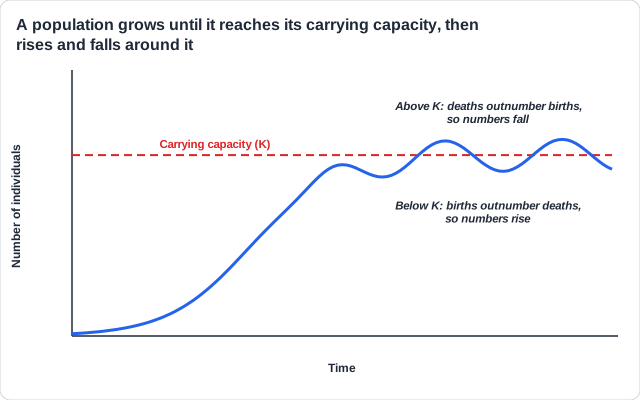
- Below it, births outnumber deaths, so the population grows.
- Above it, deaths outnumber births, so the population falls back.
- Most populations rise and fall around their carrying capacity (K).
Remember it as: Carrying capacity: one species, most individuals, for the long term.
One species, not many: Write 'the maximum number of individuals of a species'. 'The maximum number of species' describes something else and is wrong.
Real example: in South Africa's Kruger National Park, managers once culled elephants to keep them near 7000, the number they judged the park's trees and grass could support.
Free preview
This is the free notes preview
You're reading the free notes. Aimnova Pro unlocks the full study experience — and you can try it with your first topic free to keep:
- FlashcardsLock in vocabulary and key terms with spaced repetition.
- Practice questionsAnswer exam-style questions and get instant AI marking.
- Mock exams & past-paper vaultSit full mocks and see exactly how examiners award marks.
- Personalised study planA daily plan built around your exam date and weak areas.
Every species needs some resources from the non-living world and some from other living things.
The points to remember
- Abiotic resources: water, light, space, nest sites, soil nutrients, oxygen, a suitable temperature.
- Biotic resources and factors: food or prey, partners in mutualism, and fewer predators, competitors or pathogens.
- The resource in shortest supply sets the limit: it is the limiting factor.
- Improve the limiting resource and the carrying capacity rises; reduce it and the carrying capacity falls.
- Farmers raise it for crops with fertiliser and irrigation.
Remember it as: Shortest supply sets the limit: fix it and the limit rises.
Abiotic: the non-living world
- Water
- Light
- Space and nest sites
- Soil nutrients and oxygen
- Temperature
Biotic: other living things
- Food or prey
- Mutualist partners, such as pollinators
- Predators
- Competitors
- Pathogens
Real example: puffins on Shetland need cliff-top soil to dig burrows (abiotic) and sand eels to feed their chicks (biotic); when sand eels ran short, far fewer chicks survived.
Study smarter, not longer
Most students waste 40% of study time on topics they already know. Our AI tracks your progress and optimizes every minute.
Too many for the land: When nothing keeps a population in check, it can overshoot its carrying capacity and damage its own habitat.
The points to remember
- With no predators and no culling, a population can grow beyond its carrying capacity.
- It overgrazes: plants are eaten faster than they regrow, and plant diversity falls.
- Bare ground erodes; young trees die when animals eat them or strip their bark.
- Food runs out, so animals starve or catch disease, and the population crashes.
- Managers cull (kill a set number) to keep the population at its carrying capacity.
Remember it as: Overshoot, overgraze, erode, starve, crash.
Real example: Scotland has no wolves, and about 400 000 wild red deer; where they are not culled they eat young trees, so native woodland cannot regrow.
Say what actually happens: 'The ecosystem becomes unstable', 'it collapses' or 'resources are used up' are too vague. Name the change: overgrazing, soil erosion, bark stripping, starvation, a crash.
Carrying capacity is easy to define and hard to measure. Scientists can only estimate it, and it keeps changing.
Why it is hard to estimate
- There are many limiting factors, and they act together.
- Conditions change: weather, climate change, new diseases, introduced species.
- Species' needs can change as they evolve; finding them takes long-term study.
- Counts are estimates with a large error; a large range is hard to sample.
- Future prey, competitors and policies (such as a hunting ban) are hard to predict.
- Humans use many resources, substitute one for another, import resources and export wastes.
Remember it as: Many limits, always changing, hard to count.
Real example: puffin numbers are counted from burrows on cliffs, and the counts have a large error.
Humans are a special case: A city can live beyond its local carrying capacity by importing food and energy and exporting its wastes, or by using new resources, such as turning sea water into drinking water.
Practice with real exam questions
Answer exam-style questions and get AI feedback that shows you exactly what examiners want to see in a full-marks response.
Warming can move the limit: Global warming changes the resources a species depends on, so it can raise or lower its carrying capacity.
The points to remember
- Warmer weather means more plant growth: more food, so carrying capacity rises.
- But more plant growth can also feed more competitors, so it can fall.
- Glaciers retreat, exposing new habitat: carrying capacity rises.
- Droughts and wildfires destroy food and habitat: carrying capacity falls.
- Less rain means less plant growth and less food: carrying capacity falls.
Remember it as: Warming, then the resource, then the carrying capacity: three links.
Real example: in Hudson Bay, Canada, the sea ice now melts weeks earlier, so polar bears have less time to hunt seals from the ice, lowering the number the bay can support.
Start from warming: 'Less food lowers carrying capacity' is not enough: first say how warming causes the change in food or habitat.
How this comes up: Paper 2: define carrying capacity [1], give reasons it is hard to estimate [3], explain the S-curve [7]. Paper 1: predict what happens to an unmanaged population [2].
Sheep were first brought to the island of Tasmania, Australia, in the early 1800s. Their numbers grew slowly, then quickly, and by the 1850s they had levelled off at under two million.
Explain how the interactions between a species and its environment give rise to the S-shape of its population curve.
Model answer plan
See the mark-by-mark plan — for / against / judgement, with marking guidance — in study mode.