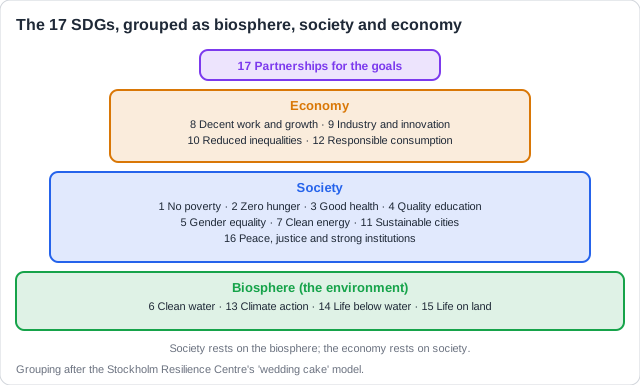
One to-do list for the world: The SDGs are social and environmental goals and targets. They guide action on sustainability and environmental justice.
The points to remember
- 17 goals, agreed by all UN member countries in 2015, to reach by 2030.
- Each goal has targets; indicators measure progress towards each target.
- They are social and environmental goals: poverty, inequality, climate, nature, prosperity, peace and justice.
- They apply to every country, rich and poor.
- They guide action on sustainability and environmental justice.
Remember it as: 17 goals, 169 targets, one deadline: 2030.
A target says what to reach; an indicator shows how far a country has got.
Real example, SDG 15 (Life on land): Costa Rica pays landowners to protect and replant forest, and forest now covers about half the country again.
Free preview
This is the free notes preview
You're reading the free notes. Aimnova Pro unlocks the full study experience — and you can try it with your first topic free to keep:
- FlashcardsLock in vocabulary and key terms with spaced repetition.
- Practice questionsAnswer exam-style questions and get instant AI marking.
- Mock exams & past-paper vaultSit full mocks and see exactly how examiners award marks.
- Personalised study planA daily plan built around your exam date and weak areas.
The SDGs are a model: a simplified plan for a complex world. So they have uses and limitations.
The points to remember
- Use: a common ground for policymaking: every government works to the same goals.
- Use: they relate to both developed and developing countries, not only poorer ones.
- Use: they galvanise the world into tackling economic and social inequality.
- Limitation: the goals do not go far enough: SDG 8 still aims for economic growth.
- Limitation: top down and bureaucratic: set by governments, with little say for local people.
- Limitation: they tend to ignore local contexts: one target does not fit every country.
- Limitation: lacking in supportive data: many countries cannot measure their indicators.
Remember it as: Uses: same goals, every country, a fairer world. Limits: too little, top down, one size, no data.
Real example: SDG 13 asks every country to act on climate, but it sets no emissions cut for any one country, so critics say it does not go far enough.
Goals can pull against each other: Faster growth (SDG 8) can mean more emissions (SDG 13). Say which goal gains and which loses.
Never wonder what to study next
Get a personalized daily plan based on your exam date, progress, and weak areas. We'll tell you exactly what to review each day.
How this comes up: Paper 1: a fact file on a place and the words of one SDG. Outline the evidence of progress towards the goal [1].
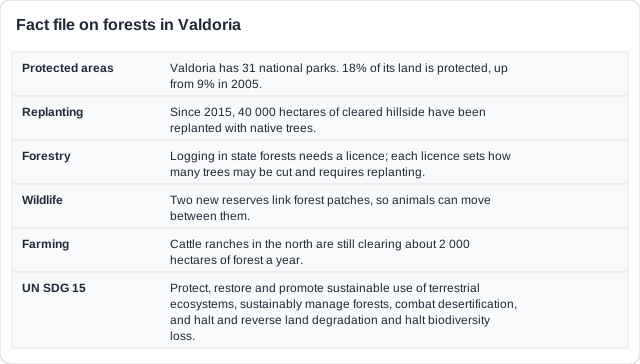
Figure 1 is a fact file on forests in Valdoria and gives the text of UN SDG 15.
Using the information in Figure 1, outline the evidence that Valdoria is making progress towards SDG 15.
Model answer plan
See the mark-by-mark plan — for / against / judgement, with marking guidance — in study mode.