The Montreal Protocol at Higher Level: The same treaty as SL, read as a lesson in environmental law: universal ratification, China's early phase-out, the Kigali groups, Greenfreeze and the gases the treaty still leaves out. At HL, practise evaluating the strategies, four points a side and a judgement.
Practise this as you read
- Explain why the Protocol worked when most treaties fail.
- Evaluate what it has not solved, and what it teaches for climate.
Free preview
This is the free notes preview
You're reading the free notes. Aimnova Pro unlocks the full study experience — and you can try it with your first topic free to keep:
- FlashcardsLock in vocabulary and key terms with spaced repetition.
- Practice questionsAnswer exam-style questions and get instant AI marking.
- Mock exams & past-paper vaultSit full mocks and see exactly how examiners award marks.
- Personalised study planA daily plan built around your exam date and weak areas.
The world agrees to stop: The Montreal Protocol is a treaty on the substances that deplete the ozone layer. It sets the rules for making, trading and using CFCs and other ODSs, and the dates to stop.
The points to remember
- An international treaty signed in 1987, in force in 1989, under the Vienna Convention (1985).
- It regulates the production, trade and use of CFCs and other ODSs.
- Countries must cut and then stop making and using ODSs by fixed dates.
- Trade controls: countries that signed may not buy ODSs from, or sell them to, countries that did not.
- Every UN country has ratified it (198 parties): the first treaty ever to reach that.
- It is called the most successful international environmental agreement yet.
Remember it as: Make, trade, use: the Protocol controls all three.
Real example: on 16 September 2009 Timor-Leste joined, and the Montreal Protocol became the first treaty in the history of the United Nations to be ratified by every country. Kofi Annan, the UN Secretary-General, had called it 'perhaps the single most successful international agreement to date'.
Practice with exam-style questions
Answer exam-style questions and get AI feedback that shows you exactly what examiners want to see in a full-marks response.
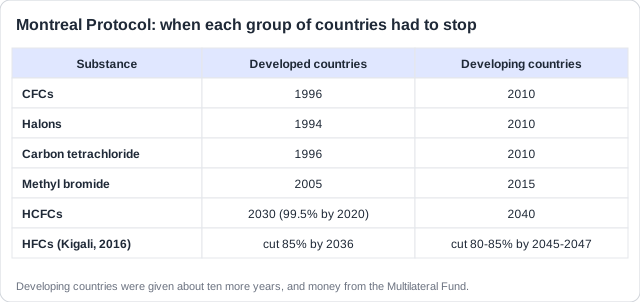
Not every country had to stop at once. Developing countries were given about ten years longer, and help from the Multilateral Fund.
The points to remember
- Developed countries stopped CFCs and halons by 1994-1996; developing countries by 2010.
- These staggered dates follow differentiated responsibility: rich countries caused most of the harm.
- Advantage: poorer countries get time to find money and technology, so more countries sign.
- Disadvantage: the global phase-out takes longer, and companies may move to countries with later dates.
- The Multilateral Fund pays developing countries to switch: over US$4 billion since 1991.
Staggered dates: for
- Time to raise money and get new technology
- More countries willing to sign
- Rich countries start at once
Staggered dates: against
- The world phase-out takes longer
- Companies may move to late countries
- Late countries may profit from trade
Real example: China was the world's largest producer of CFCs and halons. With money from the Multilateral Fund through the World Bank, it shut five of its last six plants on 1 July 2007, two and a half years before its 2010 deadline. Its CFC output fell from about 55,000 tonnes at its 1998 peak to about 550 tonnes.
A treaty that keeps getting stronger: Each time the science improved, the parties added gases or brought dates forward. Replacing CFCs led first to HCFCs and then to HFCs, which the Kigali Amendment now controls.
The points to remember
- The treaty is strengthened as the science improves: London 1990, Copenhagen 1992 and others.
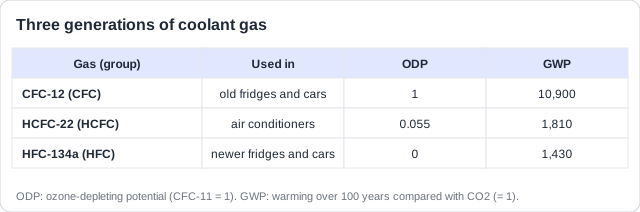
- CFCs were first replaced by HCFCs, then by HFCs, which do not destroy ozone at all.
- But HFCs are powerful greenhouse gases: HFC-134a warms about 1,430 times as much as CO2.
- The Kigali Amendment (Rwanda, 2016) cuts HFCs by 80-85% by the late 2040s.
- Why governments agreed: HFCs harm the climate, alternatives existed, and rich countries pay poorer ones.
- It could avoid 0.3-0.5 °C of warming by 2100: a climate co-benefit.
Real example: the Kigali Amendment came into force on 1 January 2019. A second group of countries with hot climates and fast-growing demand for cooling, including India, Pakistan and the Gulf states, freeze HFC use in 2028 and cut it by 85% by 2047.
Read the table: ODP shows harm to ozone; GWP shows harm to the climate. HFCs score 0 for ozone but high for warming.
Feeling unprepared for exams?
Get a clear study plan, practice with real questions, and know exactly where you stand before exam day. No more guessing.
Most environmental treaties fail to solve the problem they target. The Montreal Protocol worked, and the reasons explain when international cooperation can succeed.
The points to remember
- Clear science, widely accepted: scientists, the public and politicians understood what CFCs did.
- Alternatives were ready, so CFCs could be phased out smoothly.
- Few producers: a small number of chemical companies made most CFCs, so costs fell on few industries.
- Money: the Multilateral Fund paid for the switch in developing countries (technology transfer).
- Binding legal commitments, trade controls and monitoring; very few countries broke the rules.
- Flexible: tightened again and again as new science came in. ODS use fell by about 99%.
Science
- Molina and Rowland, 1974; the ozone hole, 1985.
- The public saw the risk: skin cancer.
Business
- A few big producers.
- Substitutes ready to sell.
Politics
- Binding dates and trade controls.
- Money for poorer countries.
Real example: in 1992 Greenpeace and an East German company built the 'Greenfreeze' fridge, cooled with hydrocarbons instead of CFCs or HFCs. Hydrocarbon fridges are now sold around the world, showing that cheap alternatives made the phase-out possible.
Not just 'CFCs were banned': Say why it worked: alternatives, funding, binding rules, near-universal support, clear evidence.
The Protocol is a success, but not a complete one. A strong answer weighs its limits too, and asks whether its lessons work for climate change.
The points to remember
- Slow recovery: CFCs last decades, so the Antarctic recovers only around 2066.
- Black market and illegal production: e.g. CFC-11 in eastern China until about 2018.
- Replacement gases have problems: HCFCs still destroy some ozone; HCFCs and HFCs are greenhouse gases.
- Not every ODS is covered: nitrous oxide and dichloromethane are not controlled.
- Hard to copy for climate: CO2 comes from every part of every economy, with no easy substitute.
- Yet it shows countries can cooperate: a model for other global problems.
Montreal Protocol (1987)
- A few gases, a few industries
- Cheap substitutes ready
- Every country signed
- ODS use down about 99%
Kyoto Protocol (1997)
- CO2 from the whole economy
- Few cheap substitutes then
- The US never ratified it
- Global emissions kept rising
Real example: nitrous oxide from fertilizers and fossil fuels is now the largest ozone-depleting emission, but the Montreal Protocol does not control it, because it was never listed as a controlled substance.
A lesson for other problems: The Protocol shows that binding targets, money for poorer countries and ready alternatives can make global cooperation work.
Memorize terms 3x faster
Smart flashcards show you cards right before you forget them. Perfect for definitions and key concepts.
How this comes up: Paper 2, Section B (b) [7]: evaluate the strategies used to protect stratospheric ozone: up to [4] for strengths, up to [4] for limitations, and [1] for a supported conclusion.
Since 1987, countries have banned CFCs, switched to replacement gases and controlled the trade in ozone-depleting substances.
Evaluate the strategies that have been used to protect stratospheric ozone.
Model answer plan
See the mark-by-mark plan — for / against / judgement, with marking guidance — in study mode.