Perspectives on climate change at Higher Level: Different examples from SL: the 2024 Peoples' Climate Vote, the 2021 youth survey, Norway, China and Laudato Si'. At HL, link perspectives to who leads the response (6.3.6), stakeholders (6.3.12) and the urgency of action (6.3.13).
Practise this as you read
- Explain what shapes a view, person by person.
- Weigh individuals against economies and power.
Free preview
This is the free notes preview
You're reading the free notes. Aimnova Pro unlocks the full study experience — and you can try it with your first topic free to keep:
- FlashcardsLock in vocabulary and key terms with spaced repetition.
- Practice questionsAnswer exam-style questions and get instant AI marking.
- Mock exams & past-paper vaultSit full mocks and see exactly how examiners award marks.
- Personalised study planA daily plan built around your exam date and weak areas.
Same science, different views: People and societies look at the same evidence on climate change and reach different perspectives. Many factors shape them.
The points to remember
- Views differ on whether it is happening, why, and how serious it is.
- They differ most on what to do, how fast, and who should pay.
- Personal perspectives belong to one person; societal ones are shared by a group or country.
- Perspectives change over time, with new information and new experiences.
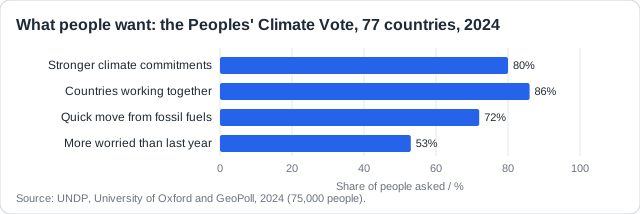
Real example (HL): the Peoples' Climate Vote. In 2024 the UN asked 75,000 people in 77 countries. Four in five wanted their government to do more, even in big oil and coal producing countries.
Get feedback like a real examiner
Submit your answers and get instant feedback — what you did well, what's missing, and exactly what to write to score full marks.
An individual's perspective depends on who they are, where they live and what they value. Vulnerability, how much a person could lose, matters a lot.
The points to remember
- Age: the young will live longer with the effects; many older people worry for their grandchildren.
- Income and job: a coal miner may fear losing work; an engineer in solar power sees jobs.
- Where you live: people on low coasts or in drylands feel the effects; others may not yet.
- Experience: living through a flood, fire or heatwave often makes people more concerned.
- Health: people with lung or heart disease suffer more in heat and smog.
- Values, culture, religion, politics and the media shape what people believe and trust.
Remember it as: Age, job, place, experience, health, values.
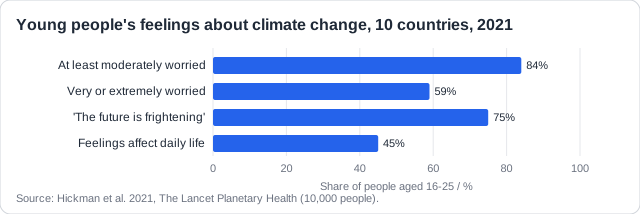
Real example (HL): in this 2021 survey, published in The Lancet Planetary Health, three in four young people said the future is frightening, and many felt their governments were failing them.
Show both sides: Vulnerability does not decide everything: people far from any danger can still care, through empathy, education or their values.
A society's perspective is the view its government and people share, shown in what the country says and does at climate talks.
The points to remember
- Level of development: richer countries can afford new technology; poorer ones need help.
- Fossil fuels: countries that earn money from coal, oil or gas often want slower change.
- Vulnerability: small islands and low coasts want the fastest, deepest cuts.
- Responsibility: countries that emitted most in the past are expected to do more.
- Politics and culture: leaders, elections and indigenous or religious views shape the response.
Real examples (HL): Norway earns a fortune from oil and gas, yet almost 90% of new cars sold there in 2024 were fully electric. China is now the biggest emitter, but it also installs more solar power than any other country and still calls itself a developing country.
Learn what examiners really want
See exactly what to write to score full marks. Our AI shows you model answers and the key phrases examiners look for.
Perspectives show most clearly in how a society chooses to respond: cut emissions (mitigation), cope with the effects (adaptation), or both.
A rich society often
- Builds hard defences, such as sea walls
- Invests in new technology
- Prefers gradual change that protects its economy
A poorer, vulnerable society often
- Asks for fast global cuts in emissions
- Uses cheaper, local ways to adapt
- Asks rich countries to pay for the harm
The points to remember
- Urgent or gradual? Act now at any cost, or move slowly to protect jobs.
- Technology or lifestyle? Invent our way out, or consume less.
- Who pays? Those who emitted most, or everyone equally?
Real example (HL): the small island states argue '1.5 to stay alive': above 1.5 °C of warming, some islands may become unlivable. Large fossil fuel producers have pushed for slower targets.
The guide asks for your own perspective too. A good personal view is stated clearly, explained by what shapes it, and backed with evidence.
The points to remember
- State your view: how serious, and what should be done.
- Explain what shapes it: your age, place, values and what you have seen.
- Support it with evidence, such as data or a named case.
- Recognize other views, and why people hold them.
Real example (HL): in 2015, Pope Francis's letter Laudato Si' called caring for the climate a moral duty for over a billion Catholics. A personal view can draw on such values, as long as it also weighs the evidence.
Never wonder what to study next
Get a personalized daily plan based on your exam date, progress, and weak areas. We'll tell you exactly what to review each day.
How this comes up: Paper 2 Section B (c) [9] asks how factors such as development shape a society's response to climate change, marked on bands. Use contrasting named countries and end with a judgement.
In 2024, four out of five people asked in 77 countries wanted their governments to do more on climate change.
To what extent do the perspectives of individuals shape a society's response to climate change?
Model answer plan
See the mark-by-mark plan — for / against / judgement, with marking guidance — in study mode.