Transformations in soil at Higher Level: The same ideas as SL with different examples: thawing permafrost in Siberia, Tollund Man, the Burren, Azolla and the Aral Sea basin. At HL, expect a seven-mark answer on how transformations change the whole soil system.
Practise this as you read
- Name what changes into what in every transformation.
- Separate changes to one component from changes to the whole soil.
Free preview
This is the free notes preview
You're reading the free notes. Aimnova Pro unlocks the full study experience — and you can try it with your first topic free to keep:
- FlashcardsLock in vocabulary and key terms with spaced repetition.
- Practice questionsAnswer exam-style questions and get instant AI marking.
- Mock exams & past-paper vaultSit full mocks and see exactly how examiners award marks.
- Personalised study planA daily plan built around your exam date and weak areas.
Same place, new matter: A transfer moves matter. A transformation changes it into something else, inside the soil. Transformations can change one part of the soil, or the whole soil system.
The points to remember
- A transformation changes what the matter is: its chemistry, its form or its state.
- Rock becomes clay, leaves become humus, ammonium becomes nitrate, dissolved salt becomes a crust.
- Some change one component (leaves into humus); some change the whole soil (salinization).
- Others: respiration by soil life, freeze-thaw of soil water, compaction of the pores.
- In the exam, name it, say what changes into what, and keep it within the soil.
Remember it as: Transfer = moves. Transformation = changes.
Changes one component
- Leaves decomposed into humus
- Rock weathered into clay
- Ammonium turned into nitrate
Changes the whole soil
- Salinization of a field
- Compaction of the pores
- Thawing of frozen ground
Real example: across Siberia, permafrost is thawing as the climate warms. Ice in the soil turns to water, the ground sinks and turns to mud, and frozen dead plants start to rot: the whole soil system is being transformed.
Memorize terms 3x faster
Smart flashcards show you cards right before you forget them. Perfect for definitions and key concepts.
Dead leaves, roots and animals are the soil's food. Detritivores and decomposers break them down into humus and simple nutrients that plants can use again.
The points to remember
- Detritivores such as earthworms break dead leaves into small pieces.
- Decomposers (fungi, bacteria) break them down into humus and inorganic nutrients.
- Their respiration turns the organic matter into carbon dioxide and water.
- Warmth, moisture and air speed it up; cold, waterlogged or acidic soil slows it.
- Ploughing lets in air and speeds decomposition, so tilled soils lose organic matter.
Leaf falls
- A dead leaf lands on the O horizon.
Shredded
- Earthworms and woodlice eat it and break it into tiny pieces.
Decomposed
- Fungi and bacteria digest the pieces and respire, releasing carbon dioxide.
Humus and nutrients
- What is left is humus, and nutrients such as ammonium and phosphate.
Real example: Tollund Man, a man who died about 2,400 years ago, was found in a Danish peat bog in 1950 with his face still recognisable. The bog was waterlogged, cold, acidic and airless, so decomposers could barely work.
Soil starts as rock. Weathering breaks the rock down where it lies, and some of its minerals are changed into new ones, such as clay.
The points to remember
- Weathering breaks down or dissolves rock where it is, adding mineral matter to soil.
- Physical: freeze-thaw, heating and cooling, roots prising cracks open.
- Chemical: rain water with carbon dioxide (a weak acid) dissolves or alters minerals.
- Biological: lichens, roots and microbes release acids that break the rock down.
- Some minerals become clay: a new substance, so weathering is a transformation.
Physical
- Water freezes in cracks and expands by about 9%.
- Repeated, the rock splits apart.
Chemical
- Rain water absorbs carbon dioxide and becomes a weak acid.
- It dissolves limestone and turns some minerals into clay.
Biological
- Lichens and roots release acids onto the rock.
- Roots grow into cracks and widen them.
Real example: in the Burren in western Ireland, slightly acidic rain has dissolved the limestone along its cracks, carving bare rock pavements. The rock is being chemically weathered, and only a thin soil collects in the deepest cracks.
Know your predicted grade
Take timed mock exams and get detailed feedback on every answer. See exactly where you're losing marks.
Nutrients do not stay in one form. Bacteria change nitrogen from one compound to another, which decides how much plants can use. This is nutrient cycling.
The points to remember
- Nitrogen fixation: bacteria turn nitrogen gas into ammonium.
- Ammonification: decomposers turn the nitrogen in dead matter into ammonium.
- Nitrification: bacteria turn ammonium into nitrate, the form most plants take up.
- Denitrification: in waterlogged, airless soil, bacteria turn nitrate back into nitrogen gas.
- Carbon and phosphorus also change form in soil: nutrient cycling.
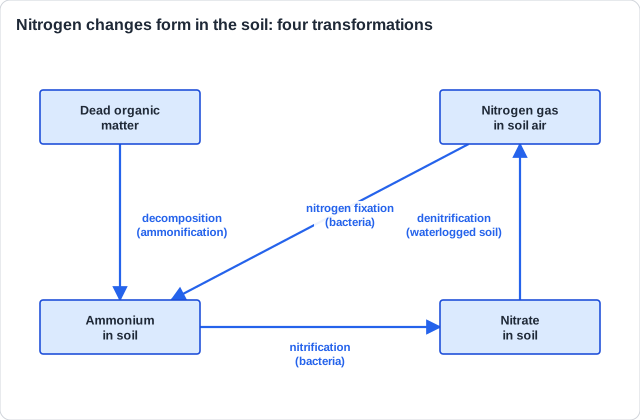
Real example: rice farmers in Vietnam and China grow Azolla on their flooded paddies. Bacteria living inside it fix nitrogen from the air; when the fern dies and rots, that nitrogen is released into the soil for the rice.
Salinization changes the whole soil. It happens where farmers irrigate in a hot, dry climate.
The points to remember
- Irrigation water carries a little dissolved salt; some groundwater carries a lot.
- In a hot, dry climate much of the water evaporates from the soil surface.
- The salt cannot evaporate, so it is left behind and turns from dissolved to solid.
- Over-watering raises the water table; salty water then rises by capillary action and evaporates too.
- Year after year the salt builds up: a white crust on the soil.
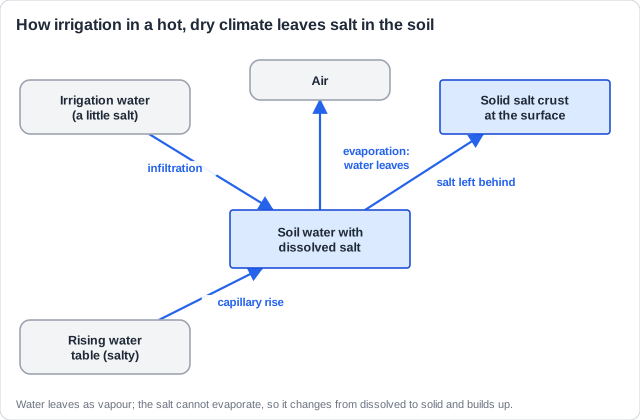
Real example: in Uzbekistan, rivers that once fed the Aral Sea were used to irrigate cotton. In the hot, dry climate the water evaporated and salt built up, and around half of the country's irrigated land is now affected by salinization.
A crust is a change of form: Salt dissolved in soil water turning into a solid crust is a transformation. Evaporation of soil water (liquid to vapour) is one too.
Get feedback like a real examiner
Submit your answers and get instant feedback — what you did well, what's missing, and exactly what to write to score full marks.
Salty soil grows smaller crops. To explain why, say what the salt does to the soil and to the plants.
The points to remember
- Sodium and chloride ions take the place of nutrients such as potassium and phosphorus.
- Salty soil water makes it hard for roots to take up water, so crops wilt even in wet soil.
- Salt above their tolerance kills decomposers and soil animals: less nutrient cycling.
- Over-watering also leaches nutrients, waterlogs the soil and cuts its air supply.
- So yield falls as salinity rises: an inverse relationship.
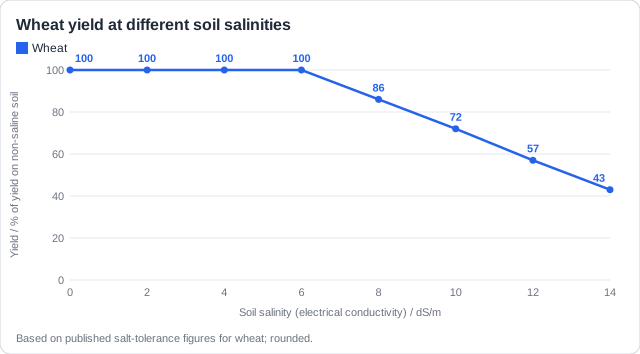
Reading the graph: up to 6 dS/m wheat is not harmed; above it, the yield falls by about 7% for every extra 1 dS/m. As salinity increases, yield decreases: an inverse relationship.
Two traps: State the relationship in the right direction: 'as salinity rises, yield falls', not 'as yield falls, salinity rises'.
In an explain question, 'salinization' alone is not an explanation: say how the salt lowers fertility.
How this comes up: Paper 2, Section B (b): explain how transformations change the soil [7]. Seven separate points, each naming a transformation and what it changes.
Farmers on the Hungarian plain plough in maize stubble, grow clover every few years and irrigate their fields in hot, dry summers.
Explain how transformations within the soil can change both its components and the whole soil system.
Model answer plan
See the mark-by-mark plan — for / against / judgement, with marking guidance — in study mode.