Transfers in soil at Higher Level: The same ideas as SL with different examples: monsoon rain in Darjeeling, the Veluwe sands, the Amazon, Kenya's termites and the Mississippi Delta. At HL, expect to sort soil processes into transfers and transformations quickly.
Practise this as you read
- Sort every soil process: does it move, or does it change?
- Place each transfer: across horizons, into or out of the soil.
Free preview
This is the free notes preview
You're reading the free notes. Aimnova Pro unlocks the full study experience — and you can try it with your first topic free to keep:
- FlashcardsLock in vocabulary and key terms with spaced repetition.
- Practice questionsAnswer exam-style questions and get instant AI marking.
- Mock exams & past-paper vaultSit full mocks and see exactly how examiners award marks.
- Personalised study planA daily plan built around your exam date and weak areas.
Same matter, new place: Soil is a system, and matter flows through it. A transfer moves matter from one place to another: across the soil's horizons, into the soil or out of it. What moves stays the same.
The points to remember
- A transfer moves matter to a new place without changing what it is.
- Water that soaks in is still water; a dissolved mineral washed down is still that mineral.
- Transfers happen across horizons, into the soil and out of it.
- A transformation changes what the matter is (rock into clay, leaves into humus).
- In the exam, label each process as a transfer or a transformation, and tie it to the soil.
Remember it as: Transfer = moves. Transformation = changes.
Transfer (moves)
- Rain soaking into the soil
- Earthworms carrying leaves down
- Minerals washed to the B horizon
Transformation (changes)
- Leaves rotting into humus
- Rock weathering into clay
- Ammonium turned into nitrate
Real example: in the monsoon, rain falls on the steep tea gardens of Darjeeling, India. It soaks into the soil, seeps down the slope through the subsoil and carries dissolved nutrients with it. The water and the nutrients move but stay the same: transfers.
Know your predicted grade
Take timed mock exams and get detailed feedback on every answer. See exactly where you're losing marks.
Most transfers in soil are water on the move. Water arrives by infiltration, sinks by percolation and joins the groundwater.
The points to remember
- Infiltration: rain or meltwater soaks into the soil surface.
- Percolation: water seeps down through the soil into the rock below.
- Groundwater flow: water moves slowly sideways through saturated rock to rivers and springs.
- Capillary rise: in dry weather, water is drawn up through tiny pores towards the surface.
- Gravity drives the downward flows; the water does not change, so these are transfers.
Infiltration
- Rain soaks quickly into the loose sandy soil of the Veluwe forest and heath.
Percolation
- It drains fast through the very deep sand, so there is little run-off.
Groundwater
- It joins a huge store of clean groundwater that moves slowly towards the rivers.
Taps
- Water companies pump it up as drinking water for towns across the Netherlands.
Up as well as down: In hot, dry weather water can move up: it is drawn through tiny pores towards the surface by capillary action. That is also a transfer.
As water seeps down it takes dissolved minerals with it. This is leaching, and it moves nutrients from the top of the soil to lower horizons or right out of the soil.
The points to remember
- Leaching: water carries dissolved minerals and nutrients down the profile.
- It moves them from the upper horizons to the B horizon, or out to groundwater.
- Eluviation washes material out of a layer; it collects lower down (illuviation).
- Heavy rain and sandy, open soils leach the most.
- Leaching and percolation mean the same movement of water: count them once.
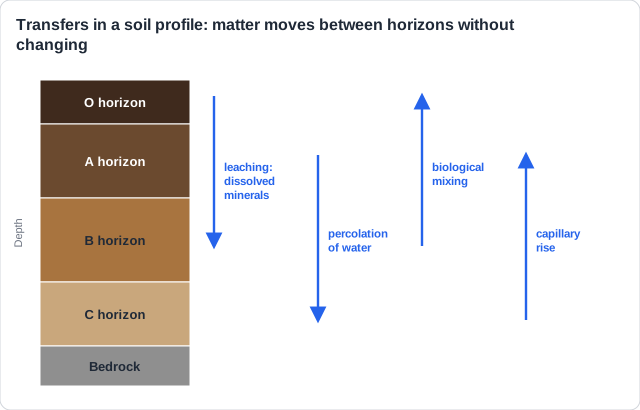
Real example: the Amazon gets over 2,000 mm of rain a year. Water percolating through the warm soil has leached most of its nutrients away, so the soil itself is poor; most of the forest's nutrients are held in the living trees and the leaf litter, not in the soil.
Do not count it twice: Leaching, drainage and percolation describe the same movement of water. In 'two transfers', give leaching and a different one, such as biological mixing.
Get feedback like a real examiner
Submit your answers and get instant feedback — what you did well, what's missing, and exactly what to write to score full marks.
Living things move soil too. Animals carry matter between horizons, and their burrows let air in and out. Both are transfers.
The points to remember
- Biological mixing: earthworms, ants, termites and moles carry soil between horizons.
- They pull leaves down and push subsoil up, mixing organic and mineral matter.
- Animals ingesting organic matter and moving it is a transfer too.
- Aeration: air moves into the pores (oxygen in) and out (carbon dioxide out).
- Burrows and roots make channels that speed up aeration and infiltration.
- People translocate soil too: ploughing mixes the top 20-30 cm.
Earthworms
- Pull fallen leaves down from the O horizon.
- Bring subsoil up as casts on the surface.
Ants and termites
- Carry soil up to build nests and mounds.
- Leave tunnels that let in air and water.
People
- Ploughing turns over the top 20-30 cm.
- Digging and building move whole layers.
Real example: in the savannas of Kenya, termites build mounds that can be over 2 m tall from subsoil they carry up from deep below. Their tunnels let air and rain into the hard ground, and the mounds slowly wash back over the surface, mixing the soil.
Aeration is a transfer: Oxygen moving into the pores and carbon dioxide moving out are gases changing place, not changing form. Name the gas and the direction.
Some transfers carry matter right out of the soil, or across the land to another soil.
The points to remember
- Erosion: wind or water moves soil particles across and out of the soil.
- Deposition: the moved particles settle somewhere else, adding to another soil.
- Uptake: roots absorb water and dissolved minerals, moving them into plants.
- Erosion and uptake carry matter out of the soil, so they are also outputs.
- If a question says within the profile, give a flow that stays inside: leaching, mixing.
Within the profile
- Leaching to the B horizon
- Percolation
- Mixing by earthworms
- Capillary rise
Into or out of the soil
- Infiltration of rain
- Erosion by wind or water
- Deposition of silt
- Uptake by roots
Real example: the Mississippi carries soil eroded from farms across the middle of the USA and deposits it at its mouth, which built the Mississippi Delta. Dams upstream now trap much of it, and Louisiana has lost about 5,000 km² of coastal land since the 1930s.
Read the question's boundary: 'Transfers in soil systems': erosion counts. 'A transfer within the soil profile': erosion is an output, so give leaching or biological mixing instead.
Learn what examiners really want
See exactly what to write to score full marks. Our AI shows you model answers and the key phrases examiners look for.
How this comes up: Paper 2, Section B (a): outline two transfers and two transformations [4]. At most two marks for each kind, and each must be labelled and tied to the soil.
In a rice paddy in Bangladesh, the soil is flooded for months, then dries out after the harvest.
Outline two transfers and two transformations that occur within the soil system.
Model answer plan
See the mark-by-mark plan — for / against / judgement, with marking guidance — in study mode.
What does not count: Rainfall, falling leaves, flooding, transpiration and photosynthesis do not happen within the soil. 'Leaching' or 'respiration' on its own, with no link to the soil, gets no mark.