Soil texture and productivity at Higher Level: The same ideas as SL, with different examples: Iowa's prairie loams, the Pampas, the Rodale farming trial, Java's volcanic soils and the salty cotton fields of Uzbekistan. At HL, weigh how farming choices raise or lower a soil's productivity over decades.
Practise this as you read
- Link each property to nutrients, water or air, then to growth.
- Connect every human activity to fertility AND productivity.
Free preview
This is the free notes preview
You're reading the free notes. Aimnova Pro unlocks the full study experience — and you can try it with your first topic free to keep:
- FlashcardsLock in vocabulary and key terms with spaced repetition.
- Practice questionsAnswer exam-style questions and get instant AI marking.
- Mock exams & past-paper vaultSit full mocks and see exactly how examiners award marks.
- Personalised study planA daily plan built around your exam date and weak areas.
Three balances decide how well plants grow: Soil texture affects primary productivity. Each kind of particle, and the humus, changes how the soil holds nutrients, water and air.
The points to remember
- Primary productivity = the rate at which plants make new biomass; the soil sets how fast they can.
- Balance 1: holding nutrients v losing them by leaching (washing down out of reach).
- Balance 2: holding water v draining it away.
- Balance 3: aeration (air for roots) v compaction or waterlogging.
- Sand, silt, clay and humus each push these balances a different way; the best soil balances all three.
| Nutrients | Water | Air | |
|---|---|---|---|
| Sand | Few held; easily leached | Drains fast; dries out | Well aerated |
| Silt | Some held | Holds water well | Can pack down (compact) |
| Clay | Many held on its charged surfaces | Holds water; drains slowly | Poor air; waterlogs |
| Humus | Holds and releases them | Holds water like a sponge | Makes crumbs with air spaces |
Remember it as: Hold the food, hold the water, let the air in.
Real example: the deep, dark loam soils of Iowa formed under tall prairie grass. They hold water and nutrients so well that Iowa is one of the biggest maize-growing states in the USA.
Feeling unprepared for exams?
Get a clear study plan, practice with real questions, and know exactly where you stand before exam day. No more guessing.
Loam is the most productive texture for most crops. Each reason compares it with sand or with clay.
The points to remember
- A good balance of sand, silt and clay, so it avoids the worst of each.
- Drains well, so it does not waterlog (better than clay).
- Aerated: roots get oxygen (better than clay).
- Easy for roots to push through and easy to dig (better than clay).
- Holds water and nutrients (better than sand).
- Stable: less likely to blow away (better than sand).
Remember it as: Loam takes the best of sand and the best of clay.
Real example: the Pampas of Argentina have deep, fertile loam soils, which make the country one of the world's biggest exporters of soya and wheat.
Say what it is better than: 'Loam drains well' is half a reason. 'Loam drains better than clay, so the roots are not waterlogged' makes the comparison and the link to growth.
Humus: a small amount, a big effect: Humus is the dark brown or black material just below the leaf litter. It is loose and crumbly, made by the partial decay of dead plants. Although it is often only about 5% of a soil, it changes how the whole soil behaves.
The points to remember
- Nutrients: holds them and releases them as it decomposes; it feeds the soil's microorganisms.
- Water: holds water in its organic material, like a sponge.
- Structure and air: binds particles into crumbs with air spaces between them.
- Infiltration: raises porosity, so rain soaks in instead of running off.
- pH: acts as a buffer, keeping the soil's pH steady.
- Temperature: releases heat as it decomposes and insulates the soil.
Remember it as: Humus holds, binds, buffers and warms.
Real example: the Rodale Institute in Pennsylvania, USA, has compared farming methods since 1981. Plots rich in organic matter held more water and gave better yields than the others in drought years.
Link humus to a property: 'Humus is good for soil' scores nothing. Name the property it changes and how: 'humus binds particles into crumbs, leaving air spaces, so roots get oxygen'.
Memorize terms 3x faster
Smart flashcards show you cards right before you forget them. Perfect for definitions and key concepts.
A question may ask for the characteristics of a highly productive soil. Each point is a property of the soil itself, linked to plant growth. One teaspoon of such soil holds billions of living organisms.
The points to remember
- Enough nutrients, the usual limiting factors: nitrates, phosphates, potassium; also calcium, magnesium, sulfates, iron.
- Plenty of humus / organic matter: holds water and nutrients.
- A loamy, balanced texture: good drainage, porosity, no waterlogging.
- A suitable pH, about 6 to 7 for most crops (accept 5.5 to 7.0).
- A deep topsoil, so roots find more water and nutrients and plants are well anchored.
- Rich soil life: decomposers, nitrogen-fixing bacteria (in legume roots), mycorrhizal fungi, earthworms.
- No toxic substances (and low salt).
Real example: the island of Java in Indonesia has young volcanic soils rich in minerals such as potassium and phosphorus. They support some of the most intensive rice farming in the world.
What does not count: Soil colour on its own is not a characteristic that scores. Ground cover and soil conservation methods are things people do, not properties of the soil: they do not count in a 'soil properties' question.
People change soils, for better and worse: Soil fertility depends on nutrients, water, pH, low salt, texture, air and soil life. Changing any of them changes productivity.
The points to remember
- Adding sand to a clay-rich soil: better drainage and infiltration, more air, easier root growth.
- But more sand also means less water held, more leaching and less anchorage for roots.
- Adding organic matter (compost, manure) raises humus: more water and nutrients held, better structure.
- Lowering fertility: over-irrigation (salt), overcropping, monoculture, overgrazing (nutrients lost).
- Also: tilling, overgrazing, land clearance (erosion, compaction), acid rain (lower pH).
- Global warming raises evaporation, so soils hold less water and plants grow less.
- Raising fertility: fertilizers, polyculture, drip irrigation, terracing, windbreaks, contour ploughing.
Lowers fertility
- Over-irrigation: salt builds up
- Overcropping, monoculture: nutrients used up
- Tilling, overgrazing: erosion, compaction
- Acid rain: pH falls
Raises fertility
- Fertilizer, manure, compost
- Polyculture, crop rotation with legumes
- Drip irrigation: less salt, less erosion
- Terraces, windbreaks, contour ploughing
Real example: in Uzbekistan, decades of heavy irrigation for cotton raised the water table and left salt in the soil, so large areas of farmland now give lower yields.
Link all three: In a 'fertility, productivity and human activity' question, each human activity must be linked to a change in fertility AND to its effect on productivity, or the answer is capped.
Know your predicted grade
Take timed mock exams and get detailed feedback on every answer. See exactly where you're losing marks.
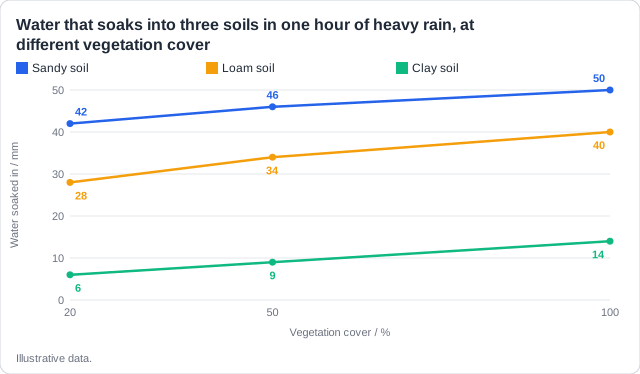
Some questions give a line graph for three soils and ask you to describe a trend and calculate a change. The graph below is the same kind.
The points to remember
- Describe a trend: say what happens to one variable as the other rises, with values from the graph.
- As one rises and the other falls, it is a negative correlation; both rising is a positive one.
- Calculate a change: read both values, then subtract, and show the working.
- Give the unit (here %, or mm) with your answer.
- Read the right line: check the key before you read a value.
Describe the loam line
As vegetation cover rises from 20% to 100%, water soaked in rises from 28 to 40 mm: a positive correlation.
Calculate the clay change
From 50% to 100% cover: 14 - 9 = 5 mm more water soaked in.
Explain it
Roots and humus open up pores, so more rain can soak in.
Real example: on Iowa farms that plant cover crops over winter, more rain soaks into the soil and less runs off.
How this comes up: Paper 2, Section B (b): explain the links between soil fertility, primary productivity and human activity [7]. Every point links all three.
Farmland in many countries is losing its fertility, while some farmers are restoring theirs.
Explain the links between soil fertility, primary productivity and human activity.
Model answer plan
See the mark-by-mark plan — for / against / judgement, with marking guidance — in study mode.