Soil texture at Higher Level: The same methods as SL, with different examples: the sea clay of Flevoland, Australia's bolus test, the quartz sand of Siesta Key and the laboratory pipette method. At HL, texture data also feed the texture triangle questions later in this topic.
Practise this as you read
- Measure: percentages from a sedimentation test, divided by the total.
- Name: the texture from the triangle, one name only.
Free preview
This is the free notes preview
You're reading the free notes. Aimnova Pro unlocks the full study experience — and you can try it with your first topic free to keep:
- FlashcardsLock in vocabulary and key terms with spaced repetition.
- Practice questionsAnswer exam-style questions and get instant AI marking.
- Mock exams & past-paper vaultSit full mocks and see exactly how examiners award marks.
- Personalised study planA daily plan built around your exam date and weak areas.
What is the soil made of, grain by grain?: Soil texture is the physical make-up of the mineral soil. Big grains feel gritty, middle-sized grains feel smooth, and the tiniest grains feel sticky.
The points to remember
- Soil texture = the physical make-up of the mineral soil: the relative proportions of sand, silt and clay.
- Particle sizes: sand 2 to 0.05 mm (gritty), silt 0.05 to 0.002 mm (smooth), clay under 0.002 mm (sticky).
- Sand: big particles, big pores: drains fast, well aerated, holds little water, warms quickly in spring.
- Clay: tiny particles, tiny pores: drains slowly, easily waterlogged, holds water, slow to warm, hard when dry.
- Loam: a balanced mix of sand, silt and clay; it drains well AND holds water and nutrients.
- Where it is abundant, humus changes texture too: it makes soil dark, crumbly and spongy.
Sandy soil
- Large particles (2 to 0.05 mm)
- Good drainage and aeration
- Low water and nutrient retention
- Warms up quickly in spring
Clay soil
- Tiny particles (under 0.002 mm)
- Poor drainage, easily waterlogged
- High water and nutrient retention
- Slow to warm, hard when dry
Remember it as: Sand is gritty, silt is silky, clay is sticky.
Real example: Flevoland in the Netherlands was the bottom of a shallow sea until it was drained in the 1950s and 1960s. Its soil is heavy sea clay, so farmers lay drainage pipes under the fields to stop them waterlogging.
Study smarter, not longer
Most students waste 40% of study time on topics they already know. Our AI tracks your progress and optimizes every minute.
The quickest way to find a soil's texture needs no equipment: the feel test.
The points to remember
- Take a teaspoon of soil, remove stones and roots, and wet it until it is like putty.
- Rub it between finger and thumb: gritty = sand, smooth and silky = silt, sticky = clay.
- Try to roll it into a ball: sandy soil falls apart; loam and clay hold together.
- Squeeze it out into a ribbon: the longer the ribbon before it breaks, the more clay.
- Quick, cheap and done in the field, but subjective (it depends on the person) and gives no exact percentages.
Gritty, falls apart
Mostly sand: no ball, no ribbon.
Smooth, short ribbon
Silt or loam: holds a ball, ribbon under about 2.5 cm.
Sticky, long ribbon
Clay: a shiny ribbon more than about 5 cm long.
Real example: in Australia, farm advisers call it the bolus test: knead a ball of moist soil for a minute or two, then press it out between thumb and finger and measure the ribbon.
A limitation to name: The feel test is subjective: two people may judge the same soil differently, and it gives a name, not percentages. Practice and a key make it more reliable.
A texture key turns the feel test into a fixed set of questions, so everyone reaches the same answer in the same way.
The points to remember
- A key is a list of yes or no questions; each answer sends you to the next question.
- The questions come from the feel test: does it hold a ball? Does it make a ribbon? How long? How does it feel?
- The last answer gives a texture name: sand, loamy sand, sandy loam, loam, silt loam, clay loam or clay.
- Keys make the feel test more consistent: everyone asks the same questions in the same order.
| Question | If yes | If no |
|---|---|---|
| 1. Does the moist soil hold together in a ball? | Go to 2 | Sand |
| 2. Can it be pressed into a ribbon? | Go to 3 | Loamy sand |
| 3. Is the ribbon longer than about 5 cm? | Clay or clay loam: go to 4 | Go to 5 |
| 4. Does it feel very sticky? | Clay | Clay loam |
| 5. Does it feel mainly smooth and silky? | Silt loam | Loam or sandy loam (gritty) |
Real example: the beach at Siesta Key in Florida is almost pure quartz sand. A moist handful will not hold a ball, so the key stops at question 1: sand.
Say which method: If asked how texture can be found, name the method (a key, a feel test or a sedimentation test) and say in one line how it works.
Practice with exam-style questions
Answer exam-style questions and get AI feedback that shows you exactly what examiners want to see in a full-marks response.
Let the water sort the grains: In a sedimentation test, heavy sand sinks first and tiny clay particles sink last. Measure the layers to get percentages.
The points to remember
- Put soil in a tall jar, add water (and a little detergent), shake hard and leave it to settle.
- Particles settle by size: sand first (bottom, within a minute), silt next (hours), clay last (top, a day or more).
- Measure the depth of each layer and the total depth of sediment.
- % of a particle = its layer depth / total depth x 100. Divide by the TOTAL, not by 100 mm.
- In a laboratory, the same idea is done with exact timings and weights: more accurate than a feel test.
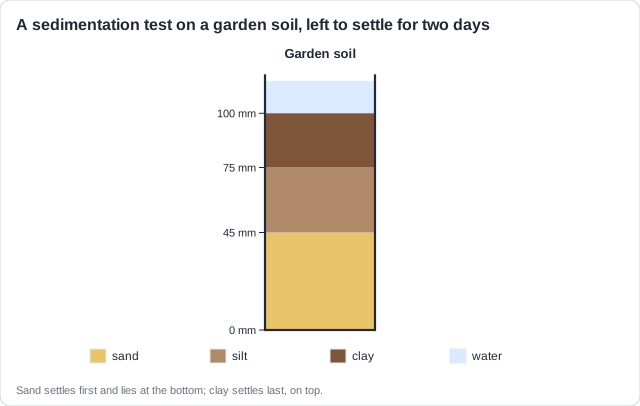
Remember it as: Sand sinks first, silt next, clay last.
Real example: soil laboratories use the pipette method: they stir the soil in water and draw off a sample at set times. Large grains settle faster, so timing tells them how much of each size there is.
Divide by the total: If the sediment is 60 mm deep and the sand layer 24 mm, sand = 24 / 60 x 100 = 40%. Show the calculation: a number alone may not score.
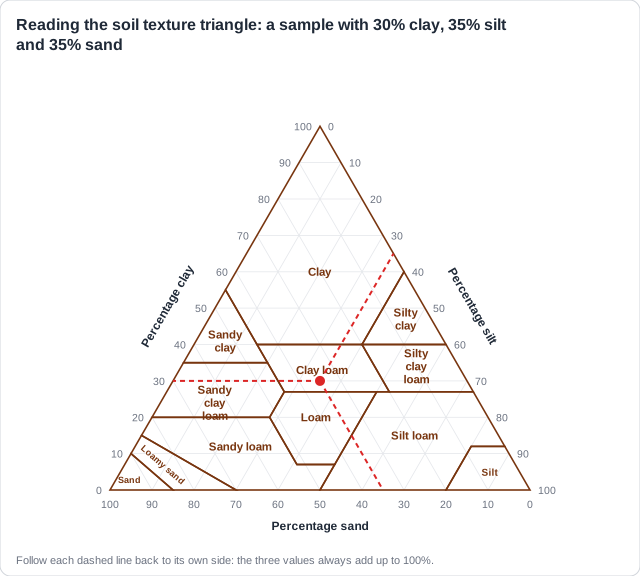
Once you have the three percentages, the soil texture triangle gives the soil its name.
The points to remember
- The soil texture triangle turns the three percentages into a texture name.
- Clay % is read on the left side, silt % on the right side, sand % along the bottom.
- Follow each value into the triangle along its own grid lines; where the lines meet, read the name.
- Two values are enough: the third is 100 minus the other two.
- Write one name only: if you write two, only the first counts.
Real example: soils on the Ganges floodplain in India are mostly silt washed down from the Himalayas, so many plot as silt loam.
Check the sum: Clay + silt + sand must add up to 100%. If your three readings do not, you followed a line the wrong way.
Feeling unprepared for exams?
Get a clear study plan, practice with real questions, and know exactly where you stand before exam day. No more guessing.
How this comes up: Paper 2, Section A: calculate percentages from a sedimentation test, then name the texture from a triangle [1] each.
A student shook a soil from a riverbank in Wales with water and let it settle. The sediment was 80 mm deep: 32 mm of sand, 32 mm of silt and 16 mm of clay.
Calculate the percentages of sand, silt and clay, and use the soil texture triangle to state the texture of the soil.
Model answer plan
See the mark-by-mark plan — for / against / judgement, with marking guidance — in study mode.