Managing fisheries at Higher Level: Different examples from SL: New Zealand's traded quotas, China's summer fishing ban, albatross-safe longlines and the EU's yellow card to Thailand. At HL, ask who makes each rule (law), what it costs and who pays (economics), and whether it is fair to small fishers (ethics).
Practise this as you read
- Match each rule to the level that makes it.
- Weigh each rule's strength against its weakness.
Free preview
This is the free notes preview
You're reading the free notes. Aimnova Pro unlocks the full study experience — and you can try it with your first topic free to keep:
- FlashcardsLock in vocabulary and key terms with spaced repetition.
- Practice questionsAnswer exam-style questions and get instant AI marking.
- Mock exams & past-paper vaultSit full mocks and see exactly how examiners award marks.
- Personalised study planA daily plan built around your exam date and weak areas.
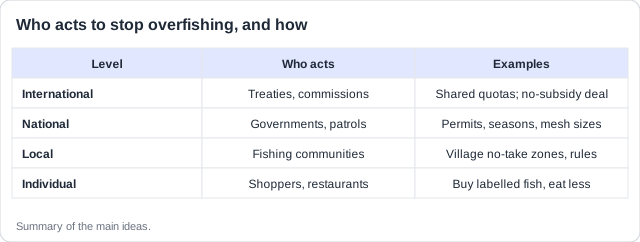
Rules and choices: Overfishing can be reduced in two ways: policy and laws that control the fishing industry, and changes in what consumers buy. Action happens at four levels, from world treaties to one person's shopping.
The points to remember
- International: treaties and commissions share out quotas for fish that cross borders and ban harmful subsidies.
- National: governments issue permits, set quotas, seasons, mesh sizes and zones, and patrol their waters.
- Local: fishing communities make their own rules, such as village no-take zones.
- Individual: shoppers choose labelled, sustainable fish and eat less of overfished species.
- Rules work only with monitoring and enforcement: patrols, observers, satellite tracking.
Example (HL): closing the ports to pirates. Under a United Nations agreement in force since 2016, ports in many countries inspect foreign fishing boats and refuse to land fish caught illegally, so pirate catches are harder to sell.
Study smarter, not longer
Most students waste 40% of study time on topics they already know. Our AI tracks your progress and optimizes every minute.
The simplest rules limit how many boats may fish and how much they may land.
The points to remember
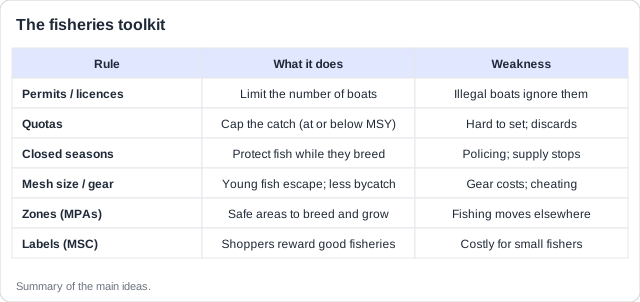
- Permits or licences: only boats with one may fish, so the fleet does not grow too big.
- Quotas: a total allowable catch each year, set at or below the maximum sustainable yield (MSY), shared between countries or boats.
- Minimum landing size: fish below a set size must not be kept, so they can breed first.
- Strength: the total harvest is controlled, and sharing quotas avoids one firm taking it all.
- Weakness: quotas are hard to set accurately, catches are hard to monitor, and boats may throw back fish over their quota, dead.
Remember it as: Permits limit the boats; quotas limit the catch.
Example (HL): New Zealand's quota system. Since 1986 every main commercial species has a total allowable catch, divided into quotas that can be traded. Fishers who own a share have a reason to keep the stock healthy.
Other rules limit when and where fishing can happen, to protect fish while they breed and grow.
The points to remember
- Closed seasons: no fishing while fish spawn, so they breed undisturbed and young fish survive.
- Zones: some areas are closed to all fishing (no-take zones, MPAs) or to some gear, as nursery and spawning grounds.
- Strength: stocks get time and space to recover; immature fish are not caught.
- Weakness: needs policing; the supply of fish stops for a while; climate change can shift the breeding season.
Example (HL): China's summer fishing ban. Since 1995 most fishing in the East and South China Seas stops for three to four months each summer, when many fish spawn. It is one of the biggest closed seasons in the world, though it is hard to enforce on thousands of boats.
Practice with exam-style questions
Answer exam-style questions and get AI feedback that shows you exactly what examiners want to see in a full-marks response.
Gear rules control how fish are caught: which nets and hooks, and how big the holes are.
The points to remember
- Mesh size: a minimum size of the holes in a net lets young fish escape, so they can grow and breed.
- Bans on destructive methods: bottom trawling in some areas, large drift nets, poison and explosives.
- Bycatch devices: escape hatches for turtles, hooks that seabirds cannot reach.
- Marking gear and bringing old nets back to port, so fewer are lost as ghost nets.
Example (HL): albatrosses in the Southern Ocean. Longline boats fishing for toothfish once drowned thousands of albatrosses a year. The fishing commission made boats set lines at night, weight them and fly bird-scaring streamers, and seabird bycatch fell by over 99%.
Consumers can change fishing too: if shoppers and restaurants buy only fish caught sustainably, fleets have a reason to fish that way.
The points to remember
- Food labels: the MSC blue fish label means a wild fishery is sustainable and well managed; ASC does the same for farms.
- Seafood guides rank fish as best choice, good alternative or avoid.
- Catch certificates trace fish from boat to shop, keeping illegal fish out of markets.
- Shoppers can eat less wild fish, choose smaller, faster-breeding species, or farmed mussels.
- Weakness: labels cost money, so small fishers in poor countries may be shut out; many shoppers ignore them.
Example (HL): the EU's yellow card to Thailand. In 2015 the European Union warned it might ban Thai seafood over illegal fishing. Thailand tracked its boats by satellite and rewrote its fishing laws, and the warning was lifted in 2019.
Feeling unprepared for exams?
Get a clear study plan, practice with real questions, and know exactly where you stand before exam day. No more guessing.
Evaluation questions ask for the strengths and weaknesses of two strategies, or whether fishing can ever be fully sustainable.
Even at a sustainable yield...
- Bycatch of turtles, dolphins, young fish.
- Lost nets go on ghost fishing.
- Trawls damage the sea bed.
- Boats burn fossil fuels.
- MSY may be miscalculated.
- Farms add feed waste, escapees, medicines.
...rules can reduce the harm
- Bycatch devices, closed areas.
- Marked gear, net return schemes.
- Bans on trawling in sensitive zones.
- Fewer boats, fuel-saving gear.
- Quotas below MSY, a safety margin.
- Integrated farms, vaccines, certification.
The judgement: Laws and labels can make fishing far more sustainable, but some harm, such as bycatch and fuel use, cannot be removed completely.
How this comes up: Paper 2 asks for strategies [2] or [4], to evaluate two strategies [7], and Section B asks whether aquatic food production can be truly sustainable [9].
When harvesting is limited to the sustainable yield, other parts of a food production system may still make it unsustainable.
To what extent can aquatic food production systems be truly sustainable?
Model answer plan
See the mark-by-mark plan — for / against / judgement, with marking guidance — in study mode.