Unsustainable fishing methods at Higher Level: Different examples from SL: toothfish pirates, orange roughy, the Great Pacific Garbage Patch, cyanide for Hong Kong's restaurants and shark finning. At HL, link each method to law (who can stop it at sea?), economics (subsidies, high prices) and ethics (animal rights).
Practise this as you read
- Explain why each destructive method is unsustainable.
- Weigh both sides of a controversial harvest.
Free preview
This is the free notes preview
You're reading the free notes. Aimnova Pro unlocks the full study experience — and you can try it with your first topic free to keep:
- FlashcardsLock in vocabulary and key terms with spaced repetition.
- Practice questionsAnswer exam-style questions and get instant AI marking.
- Mock exams & past-paper vaultSit full mocks and see exactly how examiners award marks.
- Personalised study planA daily plan built around your exam date and weak areas.
More demand, more pressure on wild fish: Capture fisheries must supply a world that wants ever more seafood. Fleets have answered with methods that catch more, faster, and many stocks are now overexploited.
The points to remember
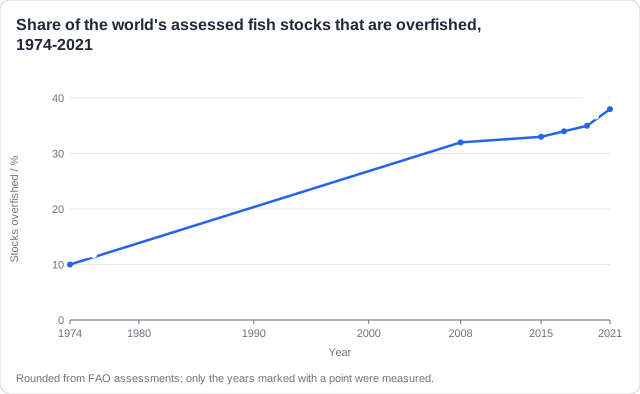
- About 38% of the world's assessed fish stocks were overfished in 2021, up from 10% in 1974.
- Technology makes fishing very efficient: sonar finds shoals, GPS finds the spot again, huge nets.
- Bycatch: animals caught by accident, such as turtles, dolphins and young fish, often thrown back dead.
- Illegal, unreported and unregulated (IUU) fishing ignores quotas.
- Subsidies for fuel and boats keep too many boats fishing.
- Results: stock collapse, broken food webs, lost jobs, less food for coastal people.
Example (HL): Patagonian toothfish. Sold as 'Chilean sea bass' in the 1990s, this slow-growing fish of the Southern Ocean fetched high prices. Pirate boats with no licences took more than the legal fleet for several years, until patrols, catch checks and port bans cut the illegal catch.
Reading a fish production graph: Percentage change = (new - old) ÷ old x 100; a fall gives a minus sign. For a reason for the change, link one cause to the rise or fall: more demand, better equipment, subsidies, a ban, overfishing.
Practice with exam-style questions
Answer exam-style questions and get AI feedback that shows you exactly what examiners want to see in a full-marks response.
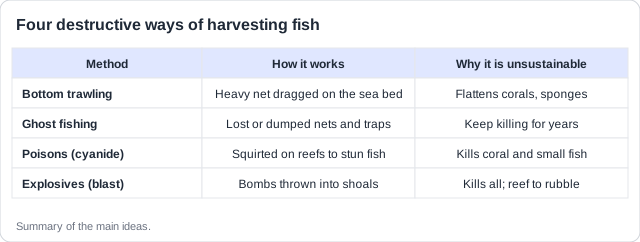
In bottom trawling, heavy doors and chains plough the sea bed as the net is pulled along.
The points to remember
- It flattens slow-growing corals, sponges and seagrass: the habitat many species need.
- It catches everything in its path: huge bycatch of young fish and other animals.
- It stirs up sediment, which clouds the water and smothers life nearby.
- Damaged reefs and sea beds take decades to centuries to recover.
Remember it as: Like clearing a forest to catch the deer.
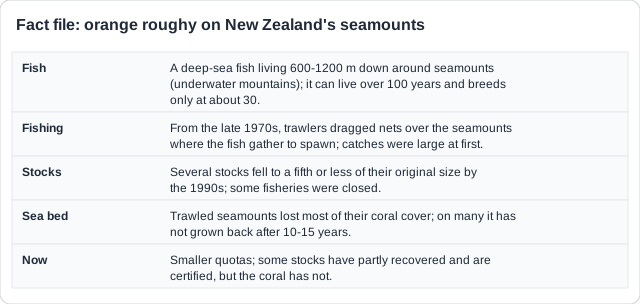
Example (HL): orange roughy, New Zealand. Trawlers caught the fish where they gathered to spawn on seamounts. Because roughy breed only at about 30 years old, stocks crashed within a few decades, and the coral the nets destroyed has not grown back.
Ghost fishing happens when nets, traps and lines are lost in storms, snagged on rocks or thrown overboard.
The points to remember
- Nets made of plastic last for decades, so they go on catching with no one to empty them.
- Trapped animals die and attract more animals, which are caught too.
- Turtles, seals, dolphins, seabirds and fish drown or starve in them.
- Lost gear also smothers and breaks corals, and adds to plastic pollution.
Example (HL): the Great Pacific Garbage Patch. A 2018 study found that fishing nets make up nearly half of the weight of the plastic floating in this area of the North Pacific. In Puget Sound, USA, divers have removed thousands of lost nets that had been killing fish, crabs, birds and seals for years.
Ghost fishing is not bycatch: Bycatch is caught by a net that is still being fished. Ghost fishing is done by gear no one controls any more, so it kills for years and is never counted in any catch.
Feeling unprepared for exams?
Get a clear study plan, practice with real questions, and know exactly where you stand before exam day. No more guessing.
On coral reefs some fishers use poison or bombs. Both catch fish quickly and cheaply, and both destroy the reef that the fish depend on.
The points to remember
- Cyanide is squirted onto the reef to stun fish so they can be caught alive.
- Live reef fish sell for high prices to restaurants and aquariums.
- The poison kills coral and many small animals that are not wanted.
- Blast fishing: a bomb thrown into a shoal kills every fish nearby; only some float up and are collected.
- The blast turns the reef into rubble, which takes decades to recover, if ever.
Example (HL): the live reef fish trade. Divers in the Philippines and Indonesia squirt cyanide into reef crevices to catch groupers and humphead wrasse alive, for restaurant tanks in Hong Kong. The same method supplies colourful fish to home aquariums around the world.
Harvesting some aquatic species is controversial: people strongly disagree about whether it should happen at all. To explain why, give arguments on both sides for one named species.
Arguments against
- The species is endangered or overfished.
- Animals have a right to exist (biorights).
- The method is cruel or wasteful.
- It may break international agreements.
- Bycatch kills other species.
- Ecocentrics oppose large-scale harvests.
Arguments for
- People need it to survive (subsistence).
- Whole economies and jobs depend on it.
- It is a cultural tradition.
- Harvests within sustainable limits do no harm.
- Aquaculture can supply it instead.
- Anthropocentrics support managed harvests.
The points to remember
- Name one species and use real facts about it.
- Give arguments against as well as for: 'controversial' means people disagree.
- One point per paragraph: each [1], up to [7].
Example (HL): sharks for their fins. Tens of millions of sharks are killed each year, often for their fins alone; in finning the shark is thrown back to die. Sharks breed slowly, but shark fin soup is a valued dish at weddings, and fins are income for poor fishers.
Memorize terms 3x faster
Smart flashcards show you cards right before you forget them. Perfect for definitions and key concepts.
How this comes up: Paper 2 Section B asks why harvesting a named aquatic species may be controversial [7]; Paper 1 asks for the percentage change in a fish catch [1].
Some aquatic species are harvested even though many people object.
Explain why the harvesting of a named aquatic species may be controversial.
Model answer plan
See the mark-by-mark plan — for / against / judgement, with marking guidance — in study mode.