Food from fresh water and the sea at Higher Level: Different examples from SL: farmed shrimp and Eucheuma seaweed, Minnesota's wild rice and walleye, Bangladesh and the Mekong. At HL, think about who profits from a global aquatic food and who bears its costs, such as the mangroves cleared for shrimp ponds.
Practise this as you read
- Outline one local and one global example, each with flora and fauna.
- Explain why some communities depend on food from the water.
Free preview
This is the free notes preview
You're reading the free notes. Aimnova Pro unlocks the full study experience — and you can try it with your first topic free to keep:
- FlashcardsLock in vocabulary and key terms with spaced repetition.
- Practice questionsAnswer exam-style questions and get instant AI marking.
- Mock exams & past-paper vaultSit full mocks and see exactly how examiners award marks.
- Personalised study planA daily plan built around your exam date and weak areas.
Food from the water: People eat a huge range of living things from rivers, lakes and the sea: animals (fauna) and plants and seaweeds (flora). They are caught in the wild or farmed.
The points to remember
- Fauna: fish (tuna, cod, tilapia), molluscs (mussels, clams, squid) and crustaceans (shrimp, crabs).
- Other fauna: sea cucumbers, sea urchins, frogs, and in some places seals and whales.
- Flora: seaweeds (nori, kelp) and freshwater plants (watercress, lotus root, wild rice).
- They are caught wild (capture fisheries) or farmed (aquaculture).
- Most is eaten by people; some becomes fishmeal to feed farmed fish, pigs and chickens.
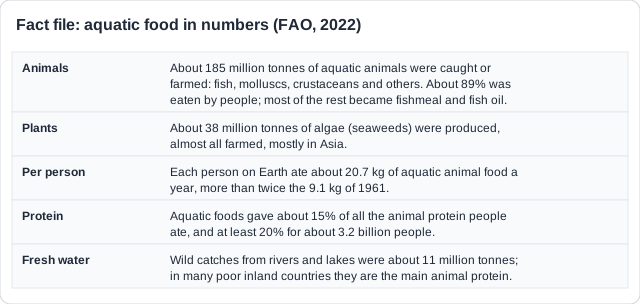
Example (HL): a paella in Valencia, Spain. Rice cooked with mussels, prawns, squid and clams: molluscs and crustaceans from the Mediterranean Sea, some farmed and some caught wild.
Never wonder what to study next
Get a personalized daily plan based on your exam date, progress, and weak areas. We'll tell you exactly what to review each day.
A global example is an aquatic food that is caught or farmed in a few places but traded and eaten all over the world.
The points to remember
- It is produced in large amounts (millions of tonnes a year).
- It is traded across the world: frozen, canned or dried, so it keeps.
- It is eaten far from where it is caught or grown.
- Learn one animal and one plant or seaweed: the guide asks for flora and fauna.
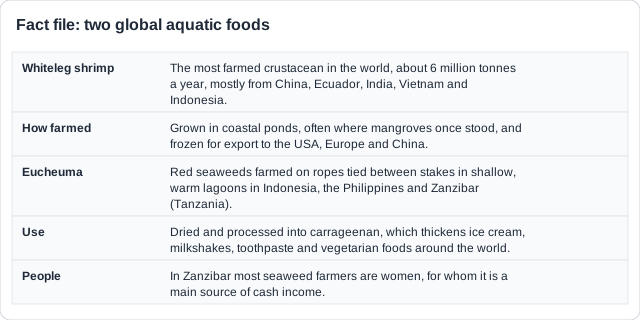
Example (HL): whiteleg shrimp and Eucheuma. Shrimp from ponds in Ecuador and India are frozen and shipped to the USA, Europe and China. Eucheuma seaweed grown by women farmers in Zanzibar is made into carrageenan, so most people eat it in ice cream without knowing.
A local example is an aquatic food caught or gathered and eaten in one area, often with a long tradition behind it. Use one from where you live if you know it well; otherwise learn this one.
The points to remember
- It is harvested near where it is eaten, often by small-scale methods.
- It is part of the local culture: traditional dishes, festivals, skills passed down.
- Give the organism, where it comes from and how it is harvested.
Remember it as: What, where, how: one animal and one plant.
Flora: wild rice (manoomin)
- An aquatic grass, an emergent macrophyte of shallow lakes in Minnesota, USA.
- Harvested by canoe: one person pushes with a pole, the other knocks the grains in with sticks.
- Sacred food of the Ojibwe people; only hand harvesting is allowed on many lakes.
Fauna: walleye
- A freshwater fish of Minnesota's lakes, the state fish.
- Caught with rod and line, in winter through holes in the ice.
- Daily catch limits and size limits protect the stock.
Stop wasting time on topics you know
Our AI identifies your weak areas and focuses your study time where it matters. No more overstudying easy topics.
For many coastal and lakeside communities, food from the water is the main source of animal protein. Harvesting it themselves has clear advantages over farming the land.
The points to remember
- It needs no farmland, so no forest is cleared.
- It needs few inputs: a net, a trap, a canoe; it can be free for those who harvest it.
- It is natural income: renewed every year if it is harvested sustainably.
- It is rich in protein and minerals such as iodine, and there is a wide variety.
- It is less hit by droughts, floods and storms than crops, and fits local culture.
Example (HL): Bangladesh. 'Fish and rice make a Bengali', as the saying goes. Rivers, ponds and floodplains give about 60% of the animal protein people eat, and the hilsa is the favourite.
Be specific: 'It is a source of food', 'it is healthier', 'it is easy to get' or 'there is no transport cost' are too vague. Give the real advantage: no land needed, few inputs, natural income, protein and iodine, not destroyed by drought.
Fish, shellfish and seaweeds are natural capital. Food is one of the goods aquatic systems provide; they give much more.
The points to remember
- Provisioning: fish, shellfish, seaweed, fresh water.
- Regulating: climate regulation, carbon storage, water purification, coastal protection.
- Supporting: nutrient cycling, habitats and nursery areas for biodiversity.
- Cultural: recreation, tourism, spiritual and traditional value.
- Fish stocks are renewable natural capital; the yearly natural increase is the natural income.
Example (HL): the Mekong River. The river's fisheries give about 2 million tonnes of fish a year, the largest freshwater catch in the world, from fish that migrate up and down the river to breed. Dams that block their routes run down this natural capital.
Renewable is not the same as unlimited: Fish are renewable only if people take no more than the natural increase. Overfishing can push a stock so low that it cannot recover, so it behaves like a non-renewable resource.
See how examiners mark answers
Answer exam-style questions with model answers. Learn exactly what earns marks and what doesn't.
How this comes up: Paper 1 gives a case study and asks for advantages for local people of harvesting food from the water [1-2]; Paper 2 can ask you to outline examples of aquatic foods [4].
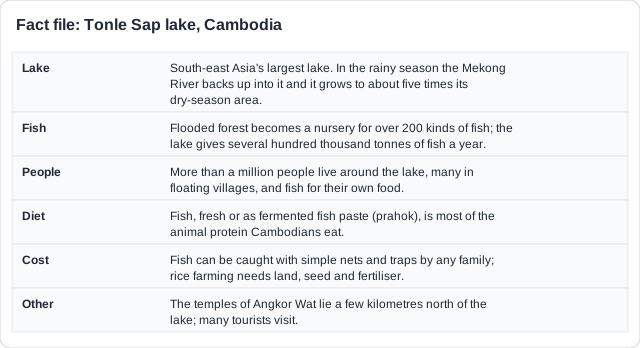
The fact file describes Tonle Sap lake in Cambodia.
Outline two advantages for the people living around Tonle Sap of harvesting their food from the lake.
Model answer plan
See the mark-by-mark plan — for / against / judgement, with marking guidance — in study mode.