aımnova
DashboardMy LearningCrash CoursesStudy Plan

Aimnova site navigation

Stay in the loop

Get the latest study resources and updates

New features, study tips and exam insights — straight to your inbox.

IB Diploma

  • IB Past Papers
  • IB Study Notes
  • IB Question Bank
  • IB Mock Exams
  • IB Revision

IB Subjects

  • IB Math AA
  • IB Math AI
  • IB Economics
  • IB Business Management
  • IB Physics
  • IB Biology
  • View all IB subjects→

IB Past Papers

  • IB Math AA HL Past Papers
  • IB Math AA SL Past Papers
  • IB Math AI HL Past Papers
  • IB Math AI SL Past Papers
  • IB Economics HL Past Papers
  • IB Economics SL Past Papers
  • IB ESS Past Papers
  • View all past papers→

Study Resources

  • Study Notes
  • Question Bank
  • Mock Exams
  • Crash Courses
  • Flashcards
  • Revision Guide
  • Exam Skills
  • Command Terms
  • Grade Calculator
  • Exam Timetable 2027

Aimnova

  • Features
  • Pricing
  • For Teachers
  • For Schools
  • For Parents
  • About Us
  • Blog
  • Contact
aımnova

IB study, practice and feedback built around the real exam.

TermsPrivacyCookies·© 2026 Aimnova. All rights reserved.d9e1c61

Aimnova is not affiliated with or endorsed by the International Baccalaureate Organization (IB).

NotesESS HLTopic 1.2Open and Closed Systems
Back to ESS HL Topics
1.2.54 min read

Open and Closed Systems (ESS HL)

IB Environmental Systems and Societies · Unit 1

AI-powered feedback

Stop guessing — know where you lost marks

Get instant, examiner-style feedback on every answer. See exactly how to improve and what the markscheme expects.

Try It Free

Contents

  1. 1Open and closed systems at Higher Level
  2. 2Open systems
  3. 3Closed systems
  4. 4Open or closed?
  5. 5Exam-style question
Open and closed systems at Higher Level: The same two definitions as SL. At HL, judge how closed a real system is, and name the small flows of matter that break the rule.

Practise this as you read

  • Prove open or closed with a named flow.
  • Judge why a system is only nearly closed.

Free preview

This is the free notes preview

You're reading the free notes. Aimnova Pro unlocks the full study experience — and you can try it with your first topic free to keep:

  • FlashcardsLock in vocabulary and key terms with spaced repetition.
  • Practice questionsAnswer exam-style questions and get instant AI marking.
  • Mock exams & past-paper vaultSit full mocks and see exactly how examiners award marks.
  • Personalised study planA daily plan built around your exam date and weak areas.
Start Studying Free Full access to Aimnova Pro · cancel anytime
Open: energy and matter: An open system lets energy and matter cross its boundary. Almost every system is open.

The points to remember

  • An open system exchanges energy and matter across its boundary.
  • Almost every system is open, such as a local ecosystem.
  • Prove it with one named flow of matter in or out.
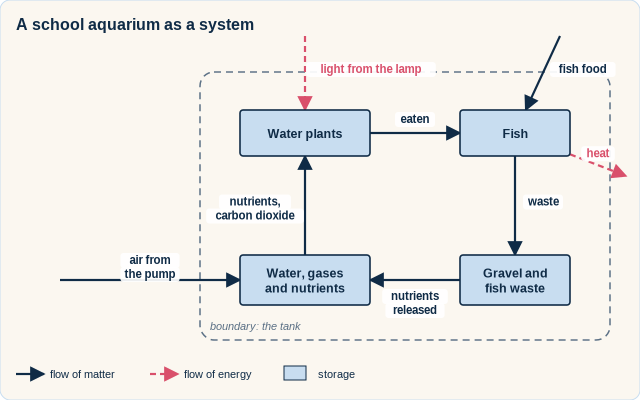
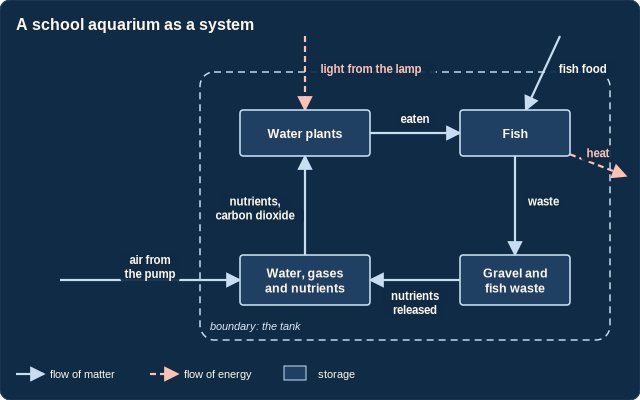
A school aquarium as an open system: light, fish food and air enter; heat leavesA school aquarium as an open system: light, fish food and air enter; heat leaves
An aquarium: food and air are added, so matter enters.
The test: Name a flow of matter across the boundary, in or out. One is enough to show the system is open.

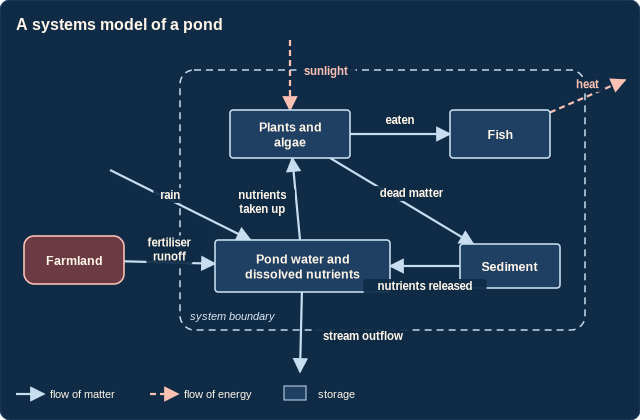
The same test on a pond: rain and runoff are matter coming in.
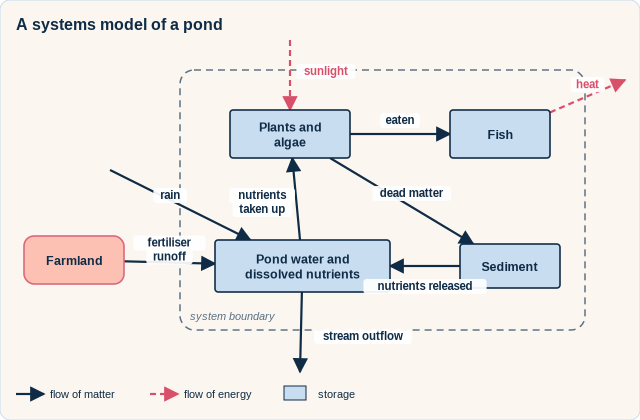
A pond as an open system: sunlight and rain enter, fertiliser runs in, heat and stream water leaveA pond as an open system: sunlight and rain enter, fertiliser runs in, heat and stream water leave
A pond: rain and runoff come in, stream water and heat go out.

Try it: tap each input and output of a pond.

Inputs enter the pond and outputs leave it: energy and matter both cross the boundary.

Interactive diagram

Explore the labelled diagram, charts and maps for this topic in full study mode.

Claim your free topic

Know your predicted grade

Take timed mock exams and get detailed feedback on every answer. See exactly where you're losing marks.

Try Mock Exams FreeYour first topic is free to keep • No credit card required
Closed: energy only: A closed system lets energy in and out, but no matter. Its matter is recycled inside.

The points to remember

  • A closed system exchanges energy only: sunlight in, heat out.
  • No matter crosses, so its matter is recycled inside.
  • Only the global cycles, such as the water and carbon cycles, come close.
  • They are only nearly closed: comets and meteorites add a little, and some gas escapes to space.
  • Biosphere 2 was built to be closed, but air had to be pumped in.
  • In an answer, cover both: what energy crosses and why matter does not.
Remember it as: Open lets energy and stuff through; closed lets only energy through.
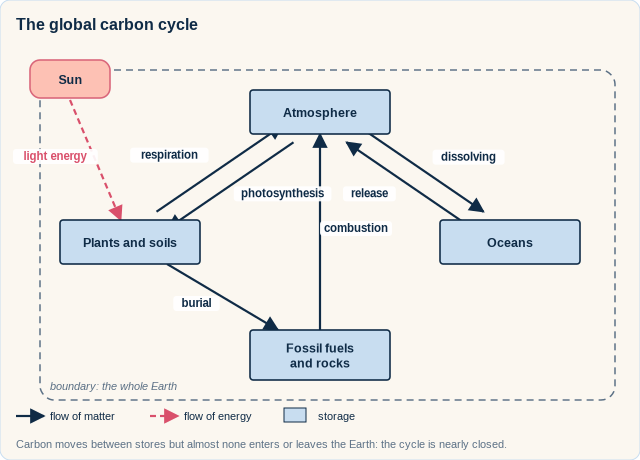
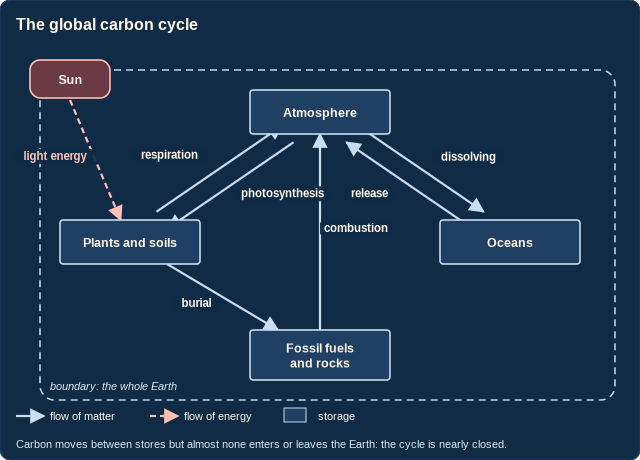
The global carbon cycle: carbon moves between atmosphere, plants and soils, oceans and rocks, and almost none leaves the EarthThe global carbon cycle: carbon moves between atmosphere, plants and soils, oceans and rocks, and almost none leaves the Earth
The global carbon cycle is nearly closed.

Only the global geochemical cycles, like the carbon and water cycles, come close: a little meteorite dust and icy comet water fall in, and a little hydrogen from split water escapes to space. Biosphere 2 tried to be closed on purpose, but oxygen fell and air had to be added.

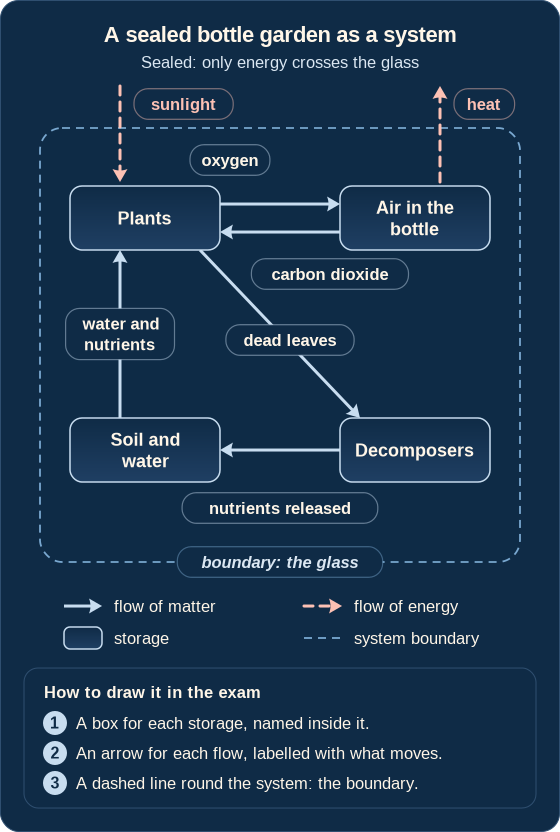
A closed system you can build: A sealed bottle garden: light goes in and heat comes out, but no matter crosses the glass.
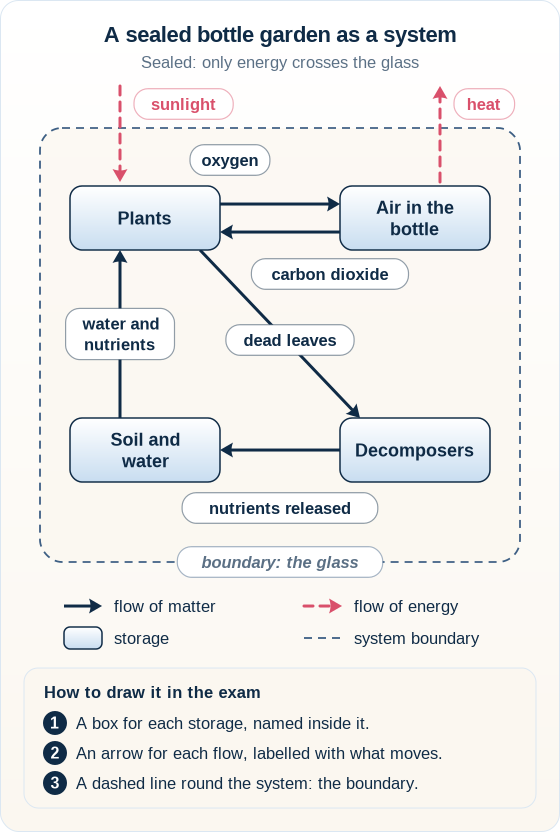
A sealed bottle garden as a closed system: sunlight enters and heat leaves, but no matter crosses the glassA sealed bottle garden as a closed system: sunlight enters and heat leaves, but no matter crosses the glass
A sealed bottle garden: light in, heat out, nothing else.

Side by side:

Open systemClosed system
Energy crosses the boundary?YesYes
Matter crosses the boundary?YesNo
How common?Almost every systemVery rare
ExamplesA local ecosystem: a pond, a forestBiosphere 2; the global cycles (nearly)
The Earth: Sunlight in, heat out, and almost no matter crossing: the Earth as a whole is nearly a closed system.

The amount of water on Earth has stayed about the same for millions of years. Sunlight drives evaporation and melting, and heat is given out again when vapour condenses or water freezes.

Get feedback like a real examiner

Submit your answers and get instant feedback — what you did well, what's missing, and exactly what to write to score full marks.

Try AI Tutor FreeYour first topic is free to keep • No credit card required
How this comes up: Show that a named system is open or closed by naming what crosses its boundary.
IB-style questionExplain[3 marks]

Explain why the global carbon cycle is described as approximating to a closed system.

Model answer plan

See the answer broken into clear points, with guidance on how each point earns marks.

Claim your free topic
Say 'nearly': The guide says the global cycles approximate to closed systems. Name what little crosses.

Try an IB Exam Question — Free AI Feedback

Test yourself on Open and Closed Systems. Write your answer and get instant AI feedback — just like a real IB examiner.

the term open system. [1 mark]

Key Terms

Closed system
A system that exchanges energy but not matter with its surroundings.
Isolated system
A system that does not exchange energy or matter with its surroundings (rare in nature).
Open system
A system that exchanges both energy and matter with its surroundings.

Related ESS HL Topics

Continue learning with these related topics from the same unit:

1.1.1Perspectives1.1.2What shapes a perspective1.1.3Values1.1.4Where values show
View all ESS HL topics
Practice with flashcardsSpaced repetition flashcards for Open and Closed SystemsImprove your exam techniqueCommand terms, paper structure, and mark-scheme tips for ESS HL
Previous1.2.4Transfers and transformationsNextThe Earth as a system1.2.6

6 practice questions on Open and Closed Systems

Students who practiced this topic on Aimnova scored 82% on average. Try free practice questions and get instant AI feedback.

Try 3 Free QuestionsView All ESS HL Topics