Transfers and transformations at Higher Level: The same two kinds of flow. At HL, follow energy through a whole system, naming each change of form, and apply it to societies too.
Practise this as you read
- Name the energy form before and after each change.
- Explain why energy leaves as heat.
Free preview
This is the free notes preview
You're reading the free notes. Aimnova Pro unlocks the full study experience — and you can try it with your first topic free to keep:
- FlashcardsLock in vocabulary and key terms with spaced repetition.
- Practice questionsAnswer exam-style questions and get instant AI marking.
- Mock exams & past-paper vaultSit full mocks and see exactly how examiners award marks.
- Personalised study planA daily plan built around your exam date and weak areas.
Two kinds of flow: Every flow is a transfer or a transformation.
The points to remember
- A transfer changes only where matter or energy is.
- A transformation changes what it is: its chemical nature, its state or its energy form.
- Say why each flow is a transfer or a transformation.
Remember it as: Transfer = it moves. Transformation = it changes.
Transfer
- It only changes location.
- Coal carried to a power station; electricity along cables.
- Heat carried by wind and ocean currents.
Transformation
- It changes chemical nature, state or energy.
- Coal burned; heat turning a turbine.
Chemical nature
- Burning coal makes carbon dioxide.
State
- Water boiled into steam.
Energy
- Chemical to heat, heat to movement, movement to electricity.
In the air: clouds reflecting sunlight, dust scattering it and wind carrying heat in water vapour are transfers; ozone breaking down is a transformation.
Know your predicted grade
Take timed mock exams and get detailed feedback on every answer. See exactly where you're losing marks.
The water cycle is the favourite test. Learn which flow is which.
The points to remember
- Transfers: precipitation, runoff, infiltration, percolation, groundwater flow, plant uptake, advection.
- Transformations: evaporation, transpiration, condensation, melting, freezing, sublimation.
- Pick flows shown in the figure.
| Process | Transfer or transformation | Why |
|---|---|---|
| Precipitation | Transfer | Water falls from clouds to the ground |
| Runoff, infiltration, percolation | Transfer | Water moves over or into the ground |
| Groundwater flow, plant uptake | Transfer | Water moves to a new place |
| Evaporation, transpiration | Transformation | Liquid water becomes vapour |
| Condensation | Transformation | Vapour becomes liquid |
| Snowmelt, freezing | Transformation | Ice becomes liquid, or liquid becomes ice |
| Advection | Transfer | Wind moves water vapour |
| Sublimation | Transformation | Ice becomes vapour directly |
Choose a flow: navy arrows transfer water; pink arrows transform its state.
Interactive diagram
Explore the labelled diagram, charts and maps for this topic in full study mode.
In the exam you draw the same cycle as boxes and arrows: a box for each storage, a labelled arrow for each flow.
See it drawn, step by step
In My Learning, handwritten diagrams build one step at a time. Play, pause and replay each explanation until it clicks. Create your free account to try it.
Exam tip: questions with a figure: A question may show a diagram and ask: "Identify one transfer shown in Figure 1." Look at the figure and pick a process you can see on it, such as runoff. A process that is not drawn there gets no mark. Write only one answer: if you write two, only the first one counts.
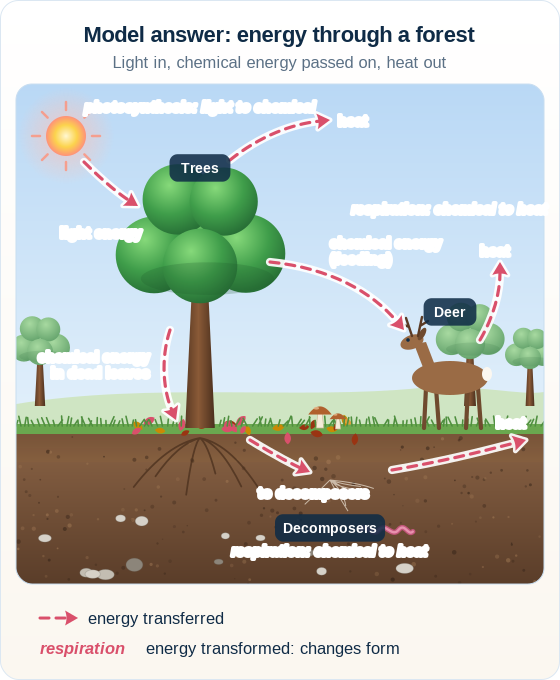
In an ecosystem, matter cycles but energy flows through and leaves as heat.
See it drawn, step by step
In My Learning, handwritten diagrams build one step at a time. Play, pause and replay each explanation until it clicks. Create your free account to try it.
Reflected light does not count: Light that bounces off a leaf never enters the plant, so it is not a transfer into it.
Matter
- Transferred: minerals into roots, food eaten.
- Transformed: photosynthesis, respiration, decomposition.
- Used again and again.
Energy
- Transformed: light to chemical in photosynthesis.
- Transferred: chemical energy passed on by feeding.
- Transformed to heat by respiration, and lost.
Why energy runs down: At every trophic level, respiration turns chemical energy into heat that leaves the system. Energy is not recycled.
Get feedback like a real examiner
Submit your answers and get instant feedback — what you did well, what's missing, and exactly what to write to score full marks.
How this comes up: "Using a system diagram, explain the transfer and transformation of energy" [7]: draw it, then explain it.
Using a system diagram, explain the transfer and transformation of energy as it flows through a forest ecosystem.
Model answer plan
See the answer broken into clear points, with guidance on how each point earns marks.
See it drawn, step by step
In My Learning, handwritten diagrams build one step at a time. Play, pause and replay each explanation until it clicks. Create your free account to try it.
Why does every living thing lose heat?: Trees, deer, fungi and bacteria all need energy to stay alive: to grow, move and repair themselves.
Where the heat comes from
- They get energy by respiration: breaking down sugars to release the chemical energy stored in them.
- Respiration is never perfect, so some of that energy always escapes as heat.
- That is why every box on the diagram has a heat arrow.
- It is also why energy flows through the ecosystem once and is never recycled.
The same energy flows in a real forest: