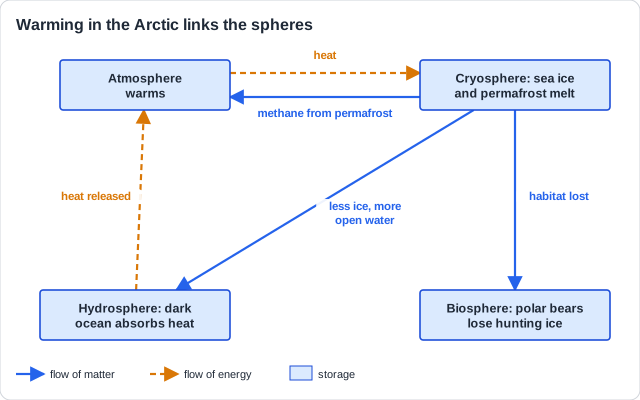
The Earth as a system at Higher Level: The same six spheres as SL. At HL, trace feedback between them and weigh how far the Gaia model holds.
Practise this as you read
- Trace a change through several spheres.
- Judge strong and weak versions of Gaia.
Free preview
This is the free notes preview
You're reading the free notes. Aimnova Pro unlocks the full study experience — and you can try it with your first topic free to keep:
- FlashcardsLock in vocabulary and key terms with spaced repetition.
- Practice questionsAnswer exam-style questions and get instant AI marking.
- Mock exams & past-paper vaultSit full mocks and see exactly how examiners award marks.
- Personalised study planA daily plan built around your exam date and weak areas.
One Earth, six spheres: The Earth is a single integrated system made of six spheres that constantly exchange energy and matter.
| Sphere | What it is | Example |
|---|---|---|
| Biosphere | All living things | Forests, plankton, people |
| Hydrosphere | All liquid water and water vapour | Oceans, rivers, groundwater |
| Cryosphere | All frozen water | Ice sheets, glaciers, permafrost |
| Geosphere | Rocks, soil and the Earth's interior | Mountains, volcanoes |
| Atmosphere | The layer of gases | The air |
| Anthroposphere | The parts of the Earth made or changed by people | Cities, farms, roads |
Feeling unprepared for exams?
Get a clear study plan, practice with real questions, and know exactly where you stand before exam day. No more guessing.
A self-regulating Earth: The Gaia hypothesis explains how the gases in the air and the Earth's temperature are linked through feedback, with life as part of the loop.
Lovelock proposed it in the 1970s; he and Lynn Margulis later developed several versions of it.
A proposed feedback: ocean algae and clouds
- Warmer seas let algae grow faster.
- The algae release a sulfur gas (dimethyl sulfide).
- It forms tiny particles that help clouds form.
- More cloud reflects sunlight, so the sea cools again.
The long view: The Sun is about 30% brighter than 4 billion years ago, yet liquid water has lasted throughout. Gaia links this to life drawing carbon dioxide out of the air.
Like every model, Gaia helps and has limits.
Strengths
- It links all six spheres in one system.
- It explains long-lasting conditions for life.
- It led to new research, such as the algae and cloud link.
Limits
- Strong Gaia, the Earth acting like one organism, is widely rejected.
- Weaker versions, life and environment shaping each other, are widely accepted.
- Big shifts, like ice ages, show regulation has limits.
Memorize terms 3x faster
Smart flashcards show you cards right before you forget them. Perfect for definitions and key concepts.
How this comes up: Outline the Gaia hypothesis, or use it to explain a feedback.
Outline how the Gaia hypothesis explains the regulation of the Earth's temperature.
Model answer plan
See the mark-by-mark plan — for / against / judgement, with marking guidance — in study mode.
Say 'hypothesis': Gaia is a model. Present it as one way of explaining regulation, not as proven fact.