The big idea: The guide names five things a physical prototype tests: scale, aesthetics, materials, function and performance.
Each prototype answers one of them, so five prototypes of one product can look nothing alike.
One handheld vacuum, five prototypes. Step through to see how differently each is built.
Interactive diagram
Explore the labelled diagram, charts and maps for this topic in full study mode.
Free preview
This is the free notes preview
You're reading the free notes. Aimnova Pro unlocks the full study experience — and you can try it with your first topic free to keep:
- FlashcardsLock in vocabulary and key terms with spaced repetition.
- Practice questionsAnswer exam-style questions and get instant AI marking.
- Mock exams & past-paper vaultSit full mocks and see exactly how examiners award marks.
- Personalised study planA daily plan built around your exam date and weak areas.
Scale — is it the right size?
A plain block at full size, no detail at all. It answers whether the product fits the hand, the shelf, the car boot. Adding detail would waste days and change nothing about the answer.
Aesthetics — does it look right?
A painted and finished shell that does not work. Colour, form, surface and proportion, presented as the user would see it. Whether anything inside functions is irrelevant to this question.
Materials — does the material behave?
The same geometry made in three candidate materials, so the comparison is fair. It answers how each feels, wears, flexes and finishes — which no data sheet fully predicts.
Function — does the mechanism work?
The mechanism alone, in an ugly open frame. Deliberately unfinished, so testers comment on whether it works instead of on how it looks.
Performance — does it last?
A near-final build run for thousands of cycles. It answers what happens over time: wear, heat, fatigue, and the failure that only appears at cycle 8,000.
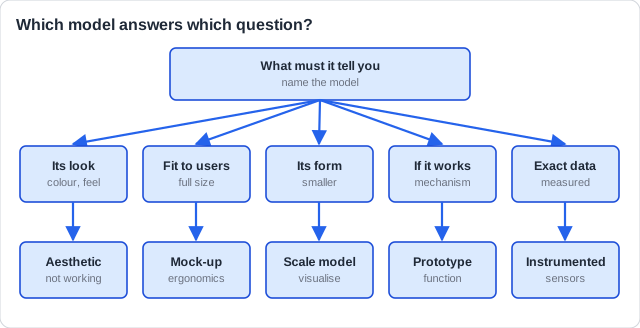
The model names the papers use
Aesthetic model
Looks and feels like the final product (colour, form, texture) but does not work. A painted clay car body is an aesthetic model.
Mock-up
Usually full size, does not work, built to test fit and ergonomics with real users: a card-and-timber mock-up of a standing desk.
Scale model
Smaller (or larger) than the real thing. Good for visualising the form and getting feedback; it cannot be tested where the product will really be used.
Prototype
Works like the final product, so it tests function: does the folding frame of a pushchair actually fold and lock?
Instrumented model
Fitted with sensors to collect quantitative data on performance: a crash-test dummy measures the forces in a collision.
Memorize terms 3x faster
Smart flashcards show you cards right before you forget them. Perfect for definitions and key concepts.
The discipline students find hardest is leaving things out. A prototype that looks finished when it did not need to is wasted work — and worse, it misdirects the people testing it.
Built for the question
- Function prototype in a rough open frame
- Testers comment on whether it works
- Made in two days, so there is time to iterate
- Rejecting it costs nothing
Built for the photograph
- Same mechanism, inside a painted shell
- Testers comment on the colour
- Took two weeks; there is no time for a second
- Nobody wants to scrap it
A useful habit: Before building, write the question down. If a feature of the prototype does not help answer it, leave the feature out.
How this is tested — explaining how and why physical prototypes are used to develop a product. It comes up two ways:
Paper 1 — multiple choice
- Identify which of the five a described prototype tests.
- Pick how a prototype should be built for a stated purpose.
Paper 2 — analysing a product
- Explain how physical prototypes would develop a named product.
- Explain why a prototype is deliberately left unfinished.
The trap: Describing a prototype as a small version of the product. Scale models are only one of the five, and most prototypes are not miniatures of anything.
A company is developing a reusable coffee cup with a leak-proof lid. Explain how it would use physical prototypes to develop the product.
Model answer plan
See the answer broken into clear points, with guidance on how each point earns marks.