The big idea: A pedigree chart is a family tree that shows who has a trait. From it you can deduce the pattern of inheritance and then people's genotypes.
See it drawn, step by step
In My Learning, handwritten diagrams build one step at a time. Play, pause and replay each explanation until it clicks. Create your free account to try it.
| Symbol | Meaning |
|---|---|
| Square | Male |
| Circle | Female |
| Filled | Affected |
| Empty | Unaffected |
| Roman numeral | Generation (I is the oldest) |
Remember it as: Shapes for sex, shading for the trait.
Free preview
This is the free notes preview
You're reading the free notes. Aimnova Pro unlocks the full study experience — and you can try it with your first topic free to keep:
- FlashcardsLock in vocabulary and key terms with spaced repetition.
- Practice questionsAnswer exam-style questions and get instant AI marking.
- Mock exams & past-paper vaultSit full mocks and see exactly how examiners award marks.
- Personalised study planA daily plan built around your exam date and weak areas.
The big idea: Look for a clue that only one pattern can explain, then test it against the rest of the chart.
| Clue in the chart | What it shows |
|---|---|
| Two unaffected parents have an affected child | Recessive: both parents are carriers |
| Two affected parents have an unaffected child | Dominant: both parents are heterozygous |
| Every affected person has an affected parent | Probably dominant |
| Affected father has an affected son | Not X-linked: sons get his Y |
| Affected father has an unaffected daughter | Not X-linked dominant |
| Mostly males affected; passed through unaffected mothers | Sex-linked recessive |
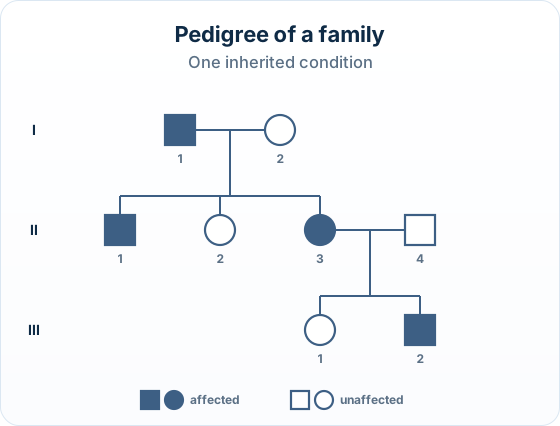
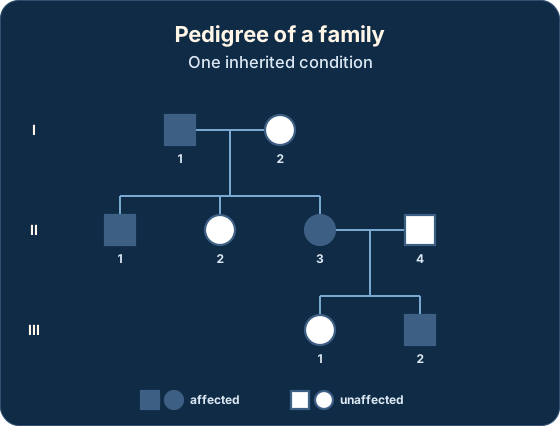
Two kinds of reasoning. Working out the pattern from some of the individuals is inductive reasoning (from cases to a general rule). Using the pattern to work out one person's genotype is deductive reasoning (from the rule to a case).
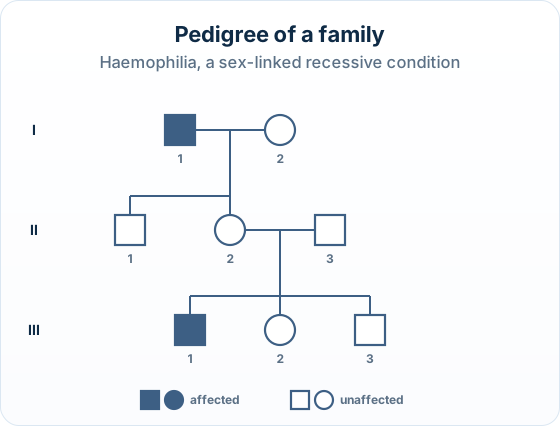
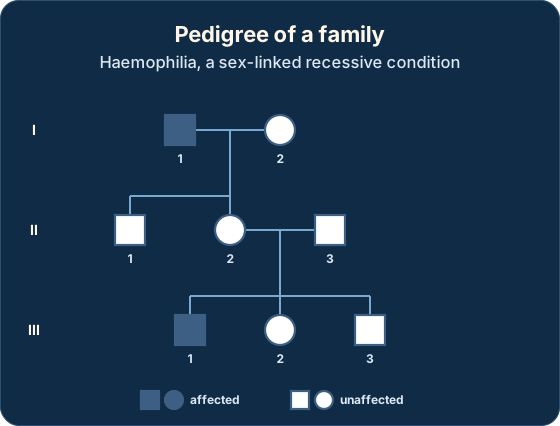
The points to remember
- A small family can mislead: say 'most likely' and give the evidence.
- Close relatives often carry the same recessive allele, so their children are more likely to be homozygous recessive.
- That is the genetic basis for forbidding marriage between close relatives.
See how examiners mark answers
Answer exam-style questions with model answers. Learn exactly what earns marks and what doesn't.
How it is asked: Always with a chart: name the pattern (1A), state possible genotypes, calculate the chance for the next child, or explain the evidence for or against sex linkage.
A pedigree shows a condition caused by a dominant allele. An affected father has an affected son and an unaffected daughter. Explain how this shows that the allele is not on the X chromosome.
Model answer plan
See the answer broken into clear points, with guidance on how each point earns marks.
Another question in the papers' style, worked in full:
In a family, two parents without a genetic condition have three children: a daughter with the condition, an unaffected son and an unaffected daughter. Use A and a for the alleles. (a) Deduce, with a reason, whether the allele for the condition is dominant or recessive. (b) State whether the allele is most likely autosomal or on the X chromosome, with a reason. (c) State the genotype of the mother.
Model answer plan
See the answer broken into clear points, with guidance on how each point earns marks.
Why this scores full marks: Each part gives the answer and the reason from the family: the reason is where most of the marks are.
In (c), an unaffected parent of a child with a recessive condition must be a carrier (Aa), not AA: that one deduction is the mark.