The big idea: Fluids that touch living cells in medicine are made isotonic to those cells, so there is no net movement of water and the cells neither swell nor shrink.
- Intravenous (IV) fluid
- Fluid dripped straight into a vein, for example to replace water and salts lost through bleeding or vomiting.
- Normal saline
- 0.9 % sodium chloride solution: about the same solute concentration as blood plasma, so isotonic to blood cells.
See it drawn, step by step
In My Learning, handwritten diagrams build one step at a time. Play, pause and replay each explanation until it clicks. Create your free account to try it.
The points to remember
- The drip fluid mixes with blood plasma, which bathes the blood cells.
- Isotonic fluid: no net osmosis, cells keep their shape.
- Pure water: plasma becomes hypotonic, cells swell and burst.
- Too concentrated: plasma becomes hypertonic, cells shrink.
Remember it as: Same as the cells: no harm done.
Free preview
This is the free notes preview
You're reading the free notes. Aimnova Pro unlocks the full study experience — and you can try it with your first topic free to keep:
- FlashcardsLock in vocabulary and key terms with spaced repetition.
- Practice questionsAnswer exam-style questions and get instant AI marking.
- Mock exams & past-paper vaultSit full mocks and see exactly how examiners award marks.
- Personalised study planA daily plan built around your exam date and weak areas.
Start Studying Free Full access to Aimnova Pro · cancel anytime
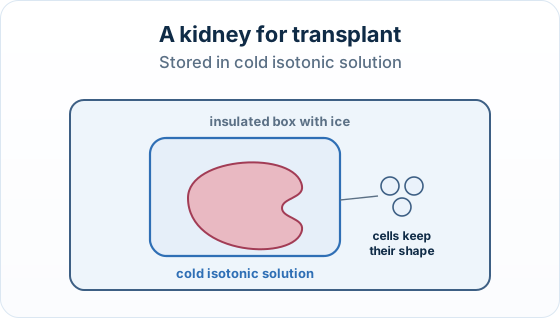
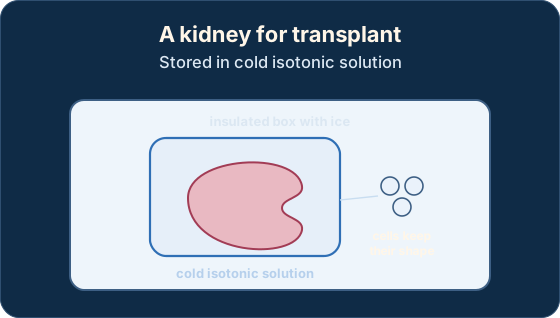
Organs out of the body: Between the donor and the patient, an organ such as a kidney is flushed with and bathed in an isotonic solution.
| Feature of the storage | Why |
|---|---|
| The solution is isotonic to the cells | No net osmosis: cells do not swell, burst or shrink |
| The organ is kept cold (on ice) | Slows the cells' metabolism, so they use less oxygen and glucose while there is no blood supply |
The same idea twice: A drip and an organ bath solve the same problem: cells with no wall are bathed in a liquid, so that liquid must have the same solute concentration as the cells.
Study smarter, not longer
Most students waste 40% of study time on topics they already know. Our AI tracks your progress and optimizes every minute.
Try Smart Study FreeYour first topic is free to keep • No credit card required
How it is asked: Short explanations of why drips and organ-storage solutions are isotonic, and 1A items that ask which solution could be used, often from a chart of solute concentrations.
IB-style questionExplain[3 marks]
Explain why fluids given by intravenous drip must be isotonic to blood plasma.
Model answer plan
See the answer broken into clear points, with guidance on how each point earns marks.