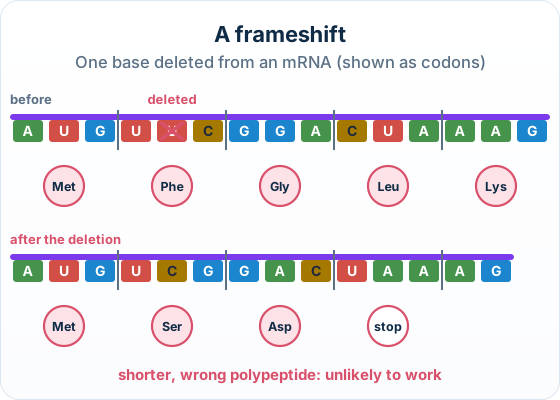
The big idea: Inserting or deleting a base shifts the reading frame. Every codon after it changes, so the polypeptide is likely to stop working.
The points to remember
- The mRNA is read in codons of three, from a fixed starting point.
- An insertion or deletion of one or two bases shifts every later codon: a frameshift.
- All the amino acids after the change are likely to be different.
- A stop codon often appears early, so the polypeptide is shorter.
- A polypeptide with the wrong sequence usually cannot fold properly and stops working.
Remember it as: Lose one letter and every word after it reads wrong.
Real example: Tay-Sachs disease. A common Tay-Sachs mutation inserts four bases into the HEXA gene. The frameshift stops the enzyme being made correctly, so a fatty substance builds up in nerve cells.
Free preview
This is the free notes preview
You're reading the free notes. Aimnova Pro unlocks the full study experience — and you can try it with your first topic free to keep:
- FlashcardsLock in vocabulary and key terms with spaced repetition.
- Practice questionsAnswer exam-style questions and get instant AI marking.
- Mock exams & past-paper vaultSit full mocks and see exactly how examiners award marks.
- Personalised study planA daily plan built around your exam date and weak areas.
Start Studying Free Full access to Aimnova Pro · cancel anytime
Big changes, small changes: How much the polypeptide changes depends on how many bases are added or removed, and where.
| Change | What happens | Likely effect |
|---|---|---|
| One or two bases added or removed | Frameshift: every later codon changes | Polypeptide very different, often shorter; stops working |
| Three bases added or removed | One codon added or lost; no frameshift | One amino acid more or fewer; may still work |
| A large insertion or deletion | Big parts of the gene added, lost or disrupted | Polypeptide very likely to stop working |
Near the start is worse: A frameshift near the start of a gene changes almost the whole polypeptide; one near the end changes only the last few amino acids.
Get feedback like a real examiner
Submit your answers and get instant feedback — what you did well, what's missing, and exactly what to write to score full marks.
Try AI Tutor FreeYour first topic is free to keep • No credit card required
How it is asked: A 1A item asking for a codon after a deletion, or a few marks on why an insertion or deletion has a bigger effect than a substitution.
IB-style questionExplain[3 marks]
Explain why an insertion of one base usually has a greater effect on a polypeptide than a substitution of one base.
Model answer plan
See the answer broken into clear points, with guidance on how each point earns marks.