The big idea: DNA profiling (also called DNA fingerprinting) reads the parts of a person's DNA that differ the most from one individual to the next, producing a unique pattern.
Two main stages
PCR
Copies the chosen DNA millions of times (because a sample is usually tiny).
Gel electrophoresis
Separates those copies by size, giving a pattern of bands that is (almost) unique to each person.
- DNA profiling
- A technique that produces a pattern of DNA fragments unique to an individual, used to identify people or test relationships.
- PCR (polymerase chain reaction)
- A laboratory method that makes millions of copies of a chosen piece of DNA — the amplification stage of profiling.
- Amplification
- Making many copies of a piece of DNA so there is enough to analyse.
- Gel electrophoresis
- A technique that separates DNA fragments by size by pulling them through a gel with an electric field.
- Fragment
- A short piece of DNA. People differ in how long their fragments are, which is what profiling detects.
| Stage | What it does | Why it is needed |
|---|---|---|
| 1. PCR (amplification) | Makes millions of copies of the chosen DNA fragments | A crime-scene or test sample is usually far too small to analyse — PCR multiplies it up |
| 2. Gel electrophoresis | Separates the DNA fragments by size | Different people have fragments of different lengths — separating them reveals each person's unique pattern of bands |
| 3. Read the profile | Compares the band pattern between samples | Matching patterns suggest the samples came from the same person (or close relatives) |
Copy first, then separate: The order matters: you amplify first (PCR makes enough DNA to see), then you separate (gel electrophoresis spreads the fragments out by size).
PCR is about quantity; gel electrophoresis is about sorting.
Free preview
This is the free notes preview
You're reading the free notes. Aimnova Pro unlocks the full study experience — and you can try it with your first topic free to keep:
- FlashcardsLock in vocabulary and key terms with spaced repetition.
- Practice questionsAnswer exam-style questions and get instant AI marking.
- Mock exams & past-paper vaultSit full mocks and see exactly how examiners award marks.
- Personalised study planA daily plan built around your exam date and weak areas.
Every nucleated body cell of an organism carries a complete copy of the whole genome — a skin cell holds exactly the same genome as a liver cell.
Why a tiny sample is enough: That is why a single cell from almost anywhere in the body can supply a full copy of the genome for analysis, and why a tiny sample (a drop of blood, a hair root, a cheek swab) is enough for DNA profiling.
Why profiling looks at the VARIABLE regions: Most of the genome is almost identical from person to person — that is why we are all human. So the coding genes are no use for telling individuals apart.
How a DNA profile is built
Find the repeats
DNA profiling looks at short stretches of non-coding DNA that are repeated over and over — called short tandem repeats.
Count them
The number of repeats at each place varies a lot between individuals.
Build the pattern
By counting the repeats at several places in the genome, you build a pattern — a DNA profile — that is essentially unique to each person (identical twins aside).
What a profile can show: Because half of your DNA comes from each parent, your profile shares repeat patterns with your relatives.
So comparing profiles can:
• match a sample to the individual it came from (forensics);
• test whether two people are related (for example a parentage test);
• the more repeat patterns two profiles share, the more closely related the two individuals are.
| Feature | Coding regions (genes) | Short tandem repeats (used for profiling) |
|---|---|---|
| What they do | Code for proteins / products | Do not code for a product (non-coding) |
| How alike between people | Very similar — most people share them | Highly variable — differ a lot between individuals |
| Useful for telling people apart? | No — too similar to distinguish | Yes — the variation is the whole point |
| What a profile compares | Not used | The number of repeats at several places in the genome |
The genome
- ALL of an organism's DNA
- The same complete copy in every nucleated cell
- Mostly shared between members of a species
- Contains genes and non-coding DNA
A DNA profile
- Reads only the variable repeat regions
- Differs between individuals
- Used to identify a person or test relatedness
- More shared patterns = more closely related
An easy way to remember: The genome is what makes us the same (mostly identical DNA). DNA profiling zooms in on the few variable repeat regions that make each of us different.
Feeling unprepared for exams?
Get a clear study plan, practice with real questions, and know exactly where you stand before exam day. No more guessing.
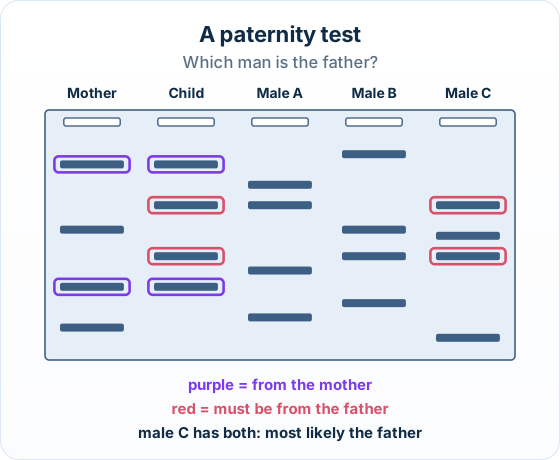
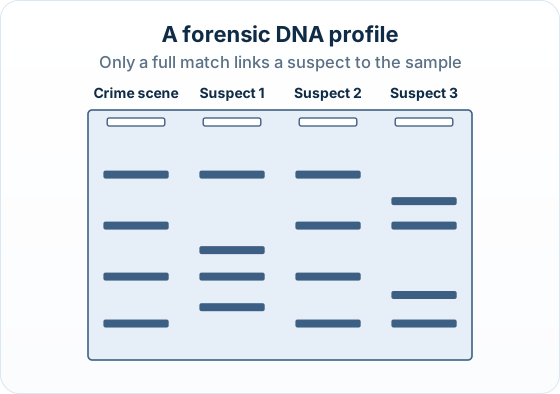
The big idea: DNA profiling compares band patterns. A child shares bands with both parents; a crime-scene sample matches only one person.
The points to remember
- Paternity: every band in the child comes from the mother or the father.
- The child's bands that are not in the mother's profile must all be in the father's.
- Forensics: a suspect matches when every band of the crime-scene sample is in their profile.
- Unrelated people can share a few bands by chance.
- So many markers are compared: each extra marker makes a false match much less likely.
Remember it as: Child = half mum, half dad. Match = every band.
Real example: the first DNA conviction. In 1988 Colin Pitchfork became the first person convicted using DNA profiling, in Leicestershire, UK. The same test cleared an innocent man who had confessed.
Say bands, not genes: Profiles compare bands (repeated sequences), not genes. Name the man who has all the child's non-maternal bands, then give that reason.
Far more than crime scenes: Anywhere a tiny amount of DNA must be found, copied or compared, PCR and gels are used.
Medicine
- Detecting the DNA of a virus or bacterium in a patient's sample.
- Testing for alleles that cause genetic diseases.
Food and wildlife
- Checking which species is in meat or fish products.
- Tracing illegal ivory or bushmeat to its species.
Research
- Studying ancient DNA from bones and teeth.
- Comparing DNA between species to see how they are related.
Real example: horsemeat. In 2013 DNA tests in Ireland and the UK found horse DNA in products sold as beef burgers and ready meals, and they were removed from shops across Europe.
The two jobs, every time
- PCR is used whenever there is too little DNA to study: a hair, a swab, an old bone.
- Gel electrophoresis then shows which fragments are there, by their size.
Memorize terms 3x faster
Smart flashcards show you cards right before you forget them. Perfect for definitions and key concepts.
How it is asked: Data questions show profiles: name the techniques (PCR, gel electrophoresis), deduce the father or the suspect with a reason, and explain why many markers are used.
A DNA profile shows a mother, her child and three men, A, B and C. Two of the child's bands are not in the mother's profile; man B has both of them. Deduce which man is most likely the father, with a reason.
Model answer plan
See the answer broken into clear points, with guidance on how each point earns marks.