The big idea: A trophic level is the position of an organism in a food chain. The four names to use are producer, primary consumer, secondary consumer and tertiary consumer.
See it drawn, step by step
In My Learning, handwritten diagrams build one step at a time. Play, pause and replay each explanation until it clicks. Create your free account to try it.
The points to remember
- Producer: makes its own carbon compounds. Always first.
- Primary consumer: eats producers.
- Secondary consumer: eats primary consumers.
- Tertiary consumer: eats secondary consumers.
- An organism with a varied diet has a different level in different food chains.
Remember it as: Find the producer, then count: primary, secondary, tertiary.
A chain from the sea. Phytoplankton are eaten by krill, krill by herring and herring by cod. Phytoplankton are the producers, krill the primary consumers, herring the secondary consumers and cod the tertiary consumers.
Trap: When a question asks for a trophic level, write the name: 'primary consumer'. 'Herbivore' or 'second trophic level' may not be accepted.
| Trophic level | Name | What it does | Example |
|---|---|---|---|
| 1st | Producer | Makes its own food by photosynthesis (an autotroph) | Grass, algae, a tree |
| 2nd | Primary consumer | A herbivore — eats producers | Rabbit, grasshopper, locust |
| 3rd | Secondary consumer | A carnivore — eats primary consumers | Fox, frog, small fish |
| 4th | Tertiary consumer | A carnivore — eats secondary consumers | Hawk, large fish, eagle |
One organism, more than one level: In a real food web, an organism can sit at more than one trophic level at the same time.
This is normal in webs and is a favourite exam point.
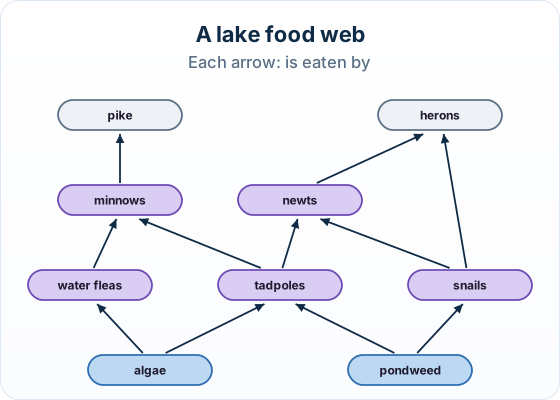
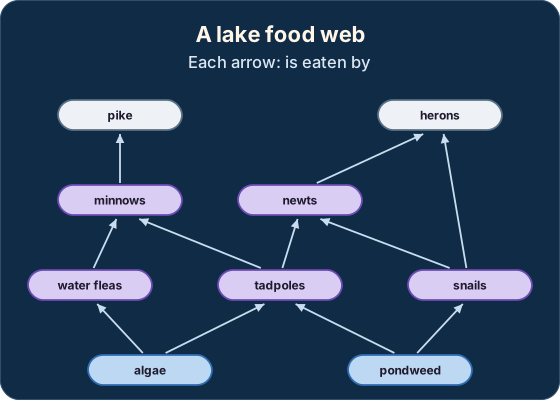
Herons in the lake. Follow pondweed → snails → herons: the herons are secondary consumers. Now follow pondweed → snails → newts → herons: the herons are tertiary consumers. Both are true.
Free preview
This is the free notes preview
You're reading the free notes. Aimnova Pro unlocks the full study experience — and you can try it with your first topic free to keep:
- FlashcardsLock in vocabulary and key terms with spaced repetition.
- Practice questionsAnswer exam-style questions and get instant AI marking.
- Mock exams & past-paper vaultSit full mocks and see exactly how examiners award marks.
- Personalised study planA daily plan built around your exam date and weak areas.
How it is asked: Paper 2 asks you to state the trophic level of one organism for 1 mark. Paper 1A shows a food web and asks how many species are only primary consumers, which organisms are tertiary consumers, or which organism feeds at two levels.
In a lake, herons eat snails, and the snails eat pondweed. The herons also eat newts, and the newts eat snails. State the two trophic levels of the herons.
Model answer plan
See the answer broken into clear points, with guidance on how each point earns marks.