The big idea: A quadrat is a square frame of known area. Quadrats placed at random positions are used to estimate the population size of sessile organisms: plants, and animals that stay fixed in one place.
See it drawn, step by step
In My Learning, handwritten diagrams build one step at a time. Play, pause and replay each explanation until it clicks. Create your free account to try it.
The points to remember
- Sessile = fixed in one place. Plants, barnacles, limpets, corals and sea anemones can be sampled with quadrats.
- Positions come from random numbers used as coordinates on two tape measures.
- Population estimate = mean per quadrat x total area divided by the area of one quadrat.
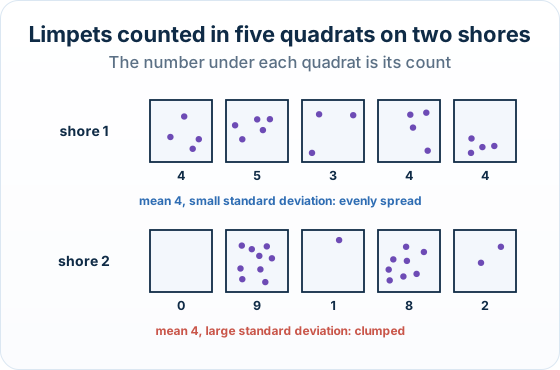
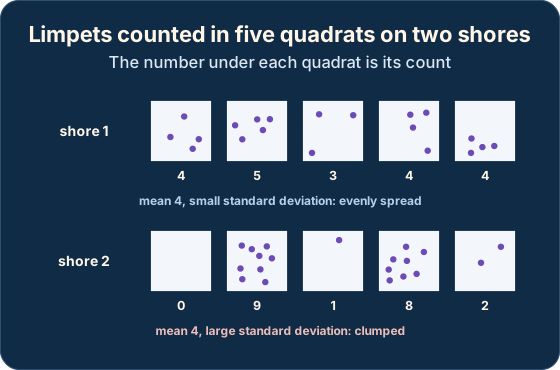
- The standard deviation of the mean shows how much the counts vary between quadrats.
Remember it as: Place at random, count, mean, scale up.
Example: the area in the drawing. Five quadrats of 1 square metre hold 20 plants, a mean of 4 per quadrat. The area is 50 square metres, so the estimate is 4 x 50 = 200 plants.
Trap: Quadrats do not work for animals that move: they leave the quadrat or are counted twice. The individuals must also be countable one by one.
The same method, in words:
Quadrat sampling in three moves: Place several quadrats at random positions in the habitat and count the organisms inside each one.
Find the mean number per quadrat, then scale up: multiply by how many quadrat-sized areas would fit in the whole habitat.
What the standard deviation tells you. A calculator gives the standard deviation of the mean number per quadrat. A small value means the counts are close to the mean: the population is evenly spread. A large value means the counts vary a lot: the population is unevenly spread (clumped), and the estimate is less reliable. You do not need to learn the formula.
Quadrat example: If a 1 m² quadrat holds a mean of 8 daisies and the field is 500 m², the estimate is 8 × 500 = 4000 daisies.
Free preview
This is the free notes preview
You're reading the free notes. Aimnova Pro unlocks the full study experience — and you can try it with your first topic free to keep:
- FlashcardsLock in vocabulary and key terms with spaced repetition.
- Practice questionsAnswer exam-style questions and get instant AI marking.
- Mock exams & past-paper vaultSit full mocks and see exactly how examiners award marks.
- Personalised study planA daily plan built around your exam date and weak areas.
How it is asked: Questions ask you to outline the method (random positions, count, mean, scale up), to calculate an estimate from quadrat counts, and to say what a standard deviation shows about the spread of a population.
Outline how random quadrat sampling could be used to estimate the number of sea anemones on a rocky shore.
Model answer plan
See the answer broken into clear points, with guidance on how each point earns marks.