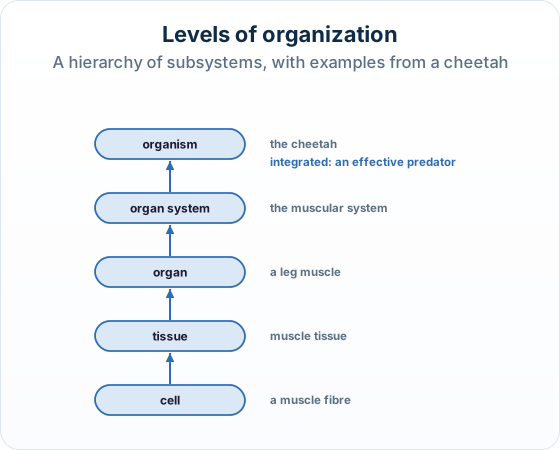
The big idea: A multicellular organism is built as a hierarchy: cells form tissues, tissues form organs, organs form organ systems, and the systems make up the organism. Each level is a subsystem of the one above. When the systems are integrated, the organism gains emergent properties that no single part has.
The points to remember
- Cells of one type working together form a tissue.
- Several tissues form an organ.
- Organs working together form an organ system.
- Integrated systems make up the organism.
- Integration gives emergent properties: more than the sum of the parts.
Remember it as: Cell, tissue, organ, system, organism.
Real example: the cheetah. A cheetah can sprint at around 100 km/h for a few seconds. That only works because its muscular, skeletal, nervous, circulatory and respiratory systems act together: integrated, they make it an effective predator, which no single system could be on its own.
Trap: An organ is made of several kinds of tissue (a muscle also has nerve, blood and connective tissue), not just one.
Free preview
This is the free notes preview
You're reading the free notes. Aimnova Pro unlocks the full study experience — and you can try it with your first topic free to keep:
- FlashcardsLock in vocabulary and key terms with spaced repetition.
- Practice questionsAnswer exam-style questions and get instant AI marking.
- Mock exams & past-paper vaultSit full mocks and see exactly how examiners award marks.
- Personalised study planA daily plan built around your exam date and weak areas.
Start Studying Free Full access to Aimnova Pro · cancel anytime
How it is asked: Expect a question that asks you to put the levels in order, or to explain how integration of systems gives an organism new properties.
IB-style questionOutline[3 marks]
Outline how a multicellular organism is organized as a hierarchy of subsystems.
Model answer plan
See the answer broken into clear points, with guidance on how each point earns marks.