The big idea: A nerve impulse travels along a neuron as an electrical signal — but neurons do not actually touch.
Crossing the gap
The gap
Where one neuron meets the next there is a tiny gap called a synapse.
A chemical carries it
The signal cannot jump the gap electrically, so it is carried across by a chemical instead.
The neurotransmitter
That chemical is a neurotransmitter: it is released by the first neuron, drifts across the gap, and triggers a brand-new impulse in the second neuron.
Electrical → chemical → electrical
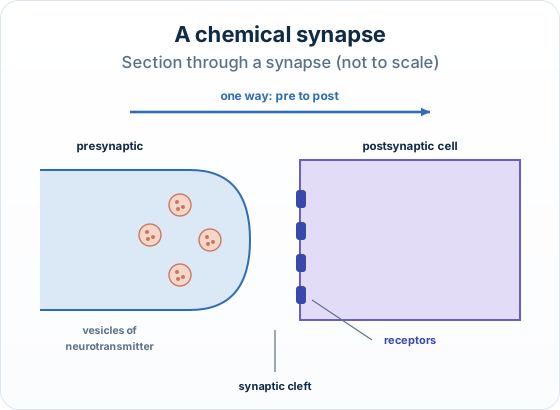
An impulse reaches the presynaptic neuron; vesicles release neurotransmitter (amber dots) into the synaptic cleft; it diffuses across, binds receptors on the postsynaptic neuron and triggers a new impulse.
Interactive diagram
Explore the labelled diagram, charts and maps for this topic in full study mode.
- Synapse
- The junction (a tiny gap) between two neurons, where a signal is passed from one to the next using a chemical.
- Synaptic cleft
- The narrow gap between the two neurons that the neurotransmitter diffuses across.
- Presynaptic neuron
- The neuron BEFORE the synapse — the one that releases the neurotransmitter (the sender).
- Postsynaptic neuron
- The neuron AFTER the synapse — the one that receives the neurotransmitter (the receiver).
- Neurotransmitter
- The chemical messenger released into the synaptic cleft; it carries the signal across the gap.
- Synaptic vesicle
- A small membrane-bound sac inside the presynaptic neuron that stores neurotransmitter ready for release.
- Receptor
- A protein on the postsynaptic membrane that the neurotransmitter binds to, passing the signal on.
Why a chemical, not just electricity: The impulse is electrical INSIDE each neuron, but the two neurons are separated by the synaptic cleft.
Electricity cannot cross that gap, so the signal is converted into a chemical (the neurotransmitter) to bridge it — then turned back into an electrical impulse on the other side.
Free preview
This is the free notes preview
You're reading the free notes. Aimnova Pro unlocks the full study experience — and you can try it with your first topic free to keep:
- FlashcardsLock in vocabulary and key terms with spaced repetition.
- Practice questionsAnswer exam-style questions and get instant AI marking.
- Mock exams & past-paper vaultSit full mocks and see exactly how examiners award marks.
- Personalised study planA daily plan built around your exam date and weak areas.
The big idea: A synapse is a junction between a neuron and the next cell: another neuron, or an effector such as a muscle fibre or a gland cell. At a chemical synapse a neurotransmitter carries the signal across a narrow gap, and the signal can only pass one way.
The points to remember
- Presynaptic terminal: vesicles of neurotransmitter.
- Synaptic cleft: a very narrow gap.
- Postsynaptic membrane: receptors.
- The next cell can be a neuron or an effector (muscle, gland).
- Vesicles on one side, receptors on the other: one way only.
Remember it as: Vesicles here, receptors there, so one way.
Real example: the neuromuscular junction. Where a motor neuron meets a skeletal muscle fibre there is a synapse; the fibre is the effector, and the neurotransmitter is acetylcholine.
Trap: The impulse does not jump across the gap as electricity: at a chemical synapse it is carried by a neurotransmitter.
Learn what examiners really want
See exactly what to write to score full marks. Our AI shows you model answers and the key phrases examiners look for.
How it is asked: Expect a diagram of a synapse (draw an arrow for the direction of the impulse, identify the region where chemical transmission happens, distinguish the two membranes) or a written question on why transmission is one way.
Explain why a nerve impulse can pass across a synapse in one direction only.
Model answer plan
See the answer broken into clear points, with guidance on how each point earns marks.