The big idea: A neuron sends a message as an action potential — a brief, fast change in the membrane potential that sweeps along the axon.
One spike, step by step
At rest
The inside of the axon is negative (about −70 mV).
Depolarisation
When a strong enough stimulus arrives, the membrane depolarises: sodium ions (Na⁺) rush in and the inside flips to about +40 mV.
Repolarisation
Straight away the membrane repolarises: potassium ions (K⁺) move out and the inside returns to about −70 mV.
That whole up-and-down spike is one action potential — the nerve impulse.
An action potential: the membrane rests at about −70 mV, depolarises to about +40 mV as Na⁺ ions rush in, then repolarises back down as K⁺ ions move out.
Interactive diagram
Explore the labelled diagram, charts and maps for this topic in full study mode.
- Membrane potential
- The voltage difference across the axon membrane (between the inside and the outside). It is measured in millivolts (mV).
- Resting potential
- The membrane potential of a neuron that is not firing — about −70 mV, with the inside negative compared with the outside.
- Action potential
- A rapid, temporary reversal of the membrane potential (from about −70 mV to +40 mV and back) that travels along the axon as a nerve impulse.
- Depolarisation
- The phase in which Na⁺ ions enter the axon, making the inside less negative and then positive — the membrane potential rises.
- Repolarisation
- The phase in which K⁺ ions leave the axon, returning the membrane potential back to the resting value.
- Threshold
- The membrane potential that a stimulus must reach to trigger an action potential. Below it, nothing fires; at or above it, a full action potential fires.
Why the names make sense: Depolarise = removing the polarity (the −70 mV difference) as the inside turns positive.
Repolarise = restoring the polarity, bringing the inside back to negative.
The ion that drives each phase is the giveaway: Na⁺ IN to go up, K⁺ OUT to come back down.
Free preview
This is the free notes preview
You're reading the free notes. Aimnova Pro unlocks the full study experience — and you can try it with your first topic free to keep:
- FlashcardsLock in vocabulary and key terms with spaced repetition.
- Practice questionsAnswer exam-style questions and get instant AI marking.
- Mock exams & past-paper vaultSit full mocks and see exactly how examiners award marks.
- Personalised study planA daily plan built around your exam date and weak areas.
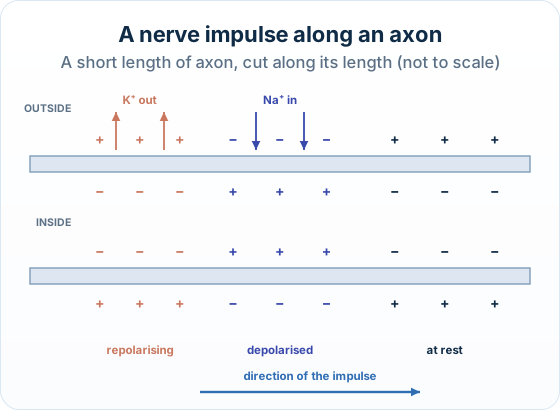
The big idea: A nerve impulse is an action potential that travels along a nerve fibre. It is electrical because it is a movement of positively charged ions: sodium ions flow in, then potassium ions flow out, region by region along the fibre.
The points to remember
- At rest: outside positive, inside negative.
- At the impulse: Na⁺ flows in, the inside becomes positive (depolarised).
- Just behind: K⁺ flows out, the inside is negative again.
- The impulse moves along the fibre, one way.
- It is electrical because positive ions move.
Remember it as: Sodium in, potassium out, and on to the next bit.
Real example: the squid giant axon. The movements of sodium and potassium ions in a nerve impulse were first measured in the giant axon of the squid, which is up to about 1 mm wide.
Trap: The impulse is not an electric current running down a wire: it is a wave of ion movement across the membrane, repeated along the fibre.
Study smarter, not longer
Most students waste 40% of study time on topics they already know. Our AI tracks your progress and optimizes every minute.
How it is asked: Expect a short Outline on why the impulse is electrical, a Label question on a diagram of an axon (resting and depolarised regions), or an MCQ on which ions move.
Outline why a nerve impulse is described as electrical.
Model answer plan
See the answer broken into clear points, with guidance on how each point earns marks.