The big idea: A neuron (nerve cell) is the cell that carries electrical signals, called nerve impulses, around the body.
Built for fast, one-way signalling
Dendrites
Dendrites receive a signal.
Cell body
The cell body holds the nucleus.
Axon
A long axon carries the impulse away.
Axon terminals
The impulse reaches the axon terminals at the far end.
Dendrites → cell body → axon → axon terminals
The myelin sheath: Many axons are wrapped in a fatty myelin sheath that insulates the fibre and makes the impulse travel faster.
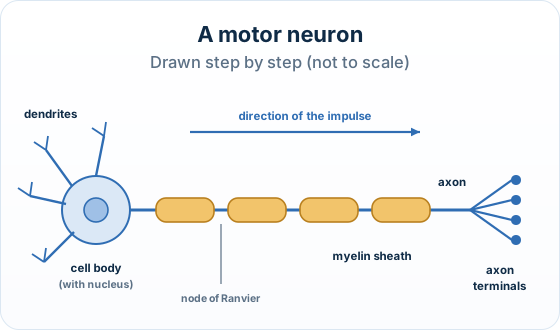
The structure of a motor neuron: dendrites receive the signal into the cell body (with its nucleus); the long, myelinated axon — insulated by the myelin sheath and broken by nodes of Ranvier — carries the impulse to the axon terminals.
Interactive diagram
Explore the labelled diagram, charts and maps for this topic in full study mode.
- Neuron
- A nerve cell — the cell specialised to carry electrical impulses around the body.
- Nerve impulse
- The electrical signal that travels along a neuron.
- Dendrites
- The short, branched extensions of a neuron that receive incoming signals and carry them towards the cell body.
- Cell body
- The main part of the neuron; it contains the nucleus and most of the organelles.
- Axon
- The long, thin fibre that carries the nerve impulse away from the cell body.
- Myelin sheath
- A fatty layer wrapped around an axon that insulates it and speeds up the impulse.
- Axon terminals
- The branched endings at the tip of the axon that pass the signal on to the next cell.
Follow the signal one way: A neuron always carries its impulse in one direction:
in through the dendrites → into the cell body → along the axon → out through the axon terminals.
Keeping this order straight is the key to labelling any neuron diagram.
Free preview
This is the free notes preview
You're reading the free notes. Aimnova Pro unlocks the full study experience — and you can try it with your first topic free to keep:
- FlashcardsLock in vocabulary and key terms with spaced repetition.
- Practice questionsAnswer exam-style questions and get instant AI marking.
- Mock exams & past-paper vaultSit full mocks and see exactly how examiners award marks.
- Personalised study planA daily plan built around your exam date and weak areas.
Not all neurons do the same job. They are grouped by the direction they carry information.
Sensory neurons
- Carry impulses inwards
- From sense receptors towards the central nervous system
Motor neurons
- Carry impulses outwards
- From the central nervous system to effectors (the muscles and glands that produce a response)
- Sensory neuron
- A neuron that carries impulses from receptors towards the central nervous system (CNS).
- Motor neuron
- A neuron that carries impulses from the central nervous system (CNS) to effectors (muscles and glands).
- Receptor
- A cell or structure that detects a stimulus (e.g. light, touch, temperature).
- Effector
- A muscle or gland that carries out a response — by contracting or by releasing a secretion.
- Central nervous system (CNS)
- The brain and the spinal cord — the body's processing and control centre.
- Peripheral nervous system (PNS)
- All the nerves outside the brain and spinal cord, connecting the CNS to the rest of the body.
Sensory vs motor — it's about direction: The difference between the two neuron types is simply which way the message travels.
Sensory = towards the CNS (the message comes IN from the senses).
Motor = away from the CNS (the message goes OUT to the muscles and glands).
| Feature | Sensory neuron | Motor neuron |
|---|---|---|
| Carries impulses… | FROM receptors TOWARDS the CNS | FROM the CNS TOWARDS effectors |
| Direction of information | Inwards (into the central nervous system) | Outwards (out to the body) |
| What it connects to | Sense receptors (e.g. in skin, eye) | Effectors — muscles and glands |
| Job in a response | Detects a stimulus and reports it | Triggers the response (movement or secretion) |
The two divisions of the nervous system: The nervous system is split into two parts.
The central nervous system (CNS) is the brain and the spinal cord — this is where information is processed and decisions are made.
The peripheral nervous system (PNS) is all the other nerves, which connect the CNS to the rest of the body and carry signals both ways.
| Division | What it is made of | Its role |
|---|---|---|
| Central nervous system (CNS) | The brain and the spinal cord | Processes information and decides on a response (the control centre) |
| Peripheral nervous system (PNS) | All the nerves outside the brain and spinal cord | Carries information between the CNS and the rest of the body |
Sensory neuron
- Carries impulses from receptors
- Carries impulses towards the CNS
- Brings information in (the senses)
- Lets the body detect a stimulus
Motor neuron
- Carries impulses from the CNS
- Carries impulses to effectors (muscles/glands)
- Sends information out to the body
- Lets the body respond to a stimulus
Remember it as: Sensory → Senses send signals in to the CNS.
Motor → Moves the body by sending signals out to the muscles.
And the CNS is just the Core: brain + spinal cord.
See how examiners mark answers
Answer exam-style questions with model answers. Learn exactly what earns marks and what doesn't.
The big idea: A neuron is a cell with a cell body (cytoplasm and nucleus) and long nerve fibres: many short dendrites and one long axon. Electrical impulses are conducted along these fibres.
The points to remember
- Cell body: cytoplasm and the nucleus.
- Dendrites: many short, branched fibres.
- Axon: one long fibre, carrying impulses away from the cell body.
- Myelin sheath with gaps, the nodes of Ranvier.
- Impulses run one way: dendrites, cell body, axon, terminals.
Remember it as: Body, branches, one long wire, the ends.
Real example: the longest cells in your body. The axons of motor neurons that run from the spinal cord to the muscles of the foot can be about a metre long in an adult.
Trap: When you draw a neuron, the axon is the single long fibre; the dendrites are the many short ones. Label the myelin as a sheath around the axon, not as part of it.
How this is tested: A common Label question gives you a diagram of a motor neuron and asks you to label its structures.
Structures you may have to label
- Dendrites
- Cell body
- Axon
- Myelin sheath
- Axon terminals
Other ways it is tested
- Identify: one labelled part is pointed to, and you name it and state its function
- Distinguish: contrast the functions of sensory and motor neurons
- State: give the two components of the central nervous system (the brain and the spinal cord)
Exam-style question — label a motor neuron
The diagram below shows a motor neuron. Label the dendrites, the axon and the myelin sheath. [3]
Step by step
- Find where the signal enters. The short, branched extensions at the cell-body end are the dendrites — they receive the incoming impulse.
- Find the long fibre. The single, long, thin fibre leading away from the cell body is the axon — it carries the impulse towards the axon terminals.
- Find the insulation. The fatty layer wrapped around the axon is the myelin sheath — it insulates the axon and speeds up the impulse.
Final answer
Dendrites = the branched extensions that receive the signal; axon = the long fibre carrying the impulse away; myelin sheath = the fatty layer insulating the axon.
A labelled motor neuron. Trace the impulse left to right: dendrites → cell body → axon → axon terminals. The myelin sheath wraps the axon, and the gaps between segments are the nodes of Ranvier.
Interactive diagram
Explore the labelled diagram, charts and maps for this topic in full study mode.
Why this works: Each label points to a distinct structure and the answer reads them in the natural order of the signal — dendrites in, axon along, myelin wrapping it.
The usual slip is confusing the axon with a dendrite: remember the dendrites are the branched receiving end, while the axon is the single long fibre that carries the impulse away.
| Part of the neuron | What it is | What it does |
|---|---|---|
| Dendrites | Short, branched extensions at one end of the cell | Receive incoming signals and carry them towards the cell body |
| Cell body | The main part of the cell, containing the nucleus | Holds the nucleus and organelles; controls the cell and integrates incoming signals |
| Axon | A long, thin fibre extending from the cell body | Carries the nerve impulse away from the cell body towards the next cell |
| Myelin sheath | A fatty insulating layer wrapped around the axon | Insulates the axon and speeds up the nerve impulse |
| Nodes of Ranvier | The gaps between segments of the myelin sheath | Bare points where the impulse 'jumps', so it travels faster |
| Axon terminals | Branched endings at the far tip of the axon | Pass the signal on to the next neuron or to an effector at a synapse |
Another question in the papers' style:
A diagram of a neuron labels the single long fibre leading from the cell body. Identify this structure and state its function.
Model answer plan
See the answer broken into clear points, with guidance on how each point earns marks.