The big idea: Atmospheric carbon dioxide is rising. To predict how photosynthesis and plant growth will change, scientists grow plants at higher carbon dioxide and compare them with plants at today's level.
The points to remember
- Enclosed experiments: greenhouses or growth chambers with added carbon dioxide.
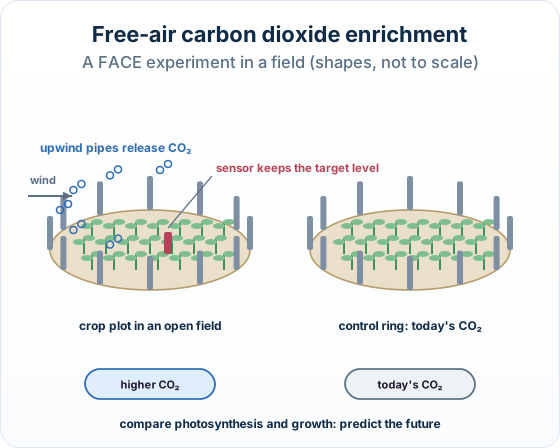
- FACE experiments: rings of pipes release carbon dioxide over plants growing in the open.
- Measure the rate of photosynthesis and growth (for example biomass or yield).
- Compare with a control at today's carbon dioxide concentration.
- Results help predict future crop yields and forest growth.
Remember it as: Grow the future today, then compare.
Real example: SoyFACE. At SoyFACE in Illinois, USA, rings of pipes release carbon dioxide over open fields of soybeans, so the crop can be studied in real weather at the concentrations expected in future.
Trap: Extra carbon dioxide raises the rate only while carbon dioxide is the limiting factor: in a real field, light, water, temperature or nutrients may limit growth instead.
Two ways to run the experiment:
| Enclosed greenhouse or chamber | FACE (free-air) experiment | |
|---|---|---|
| Conditions | Controlled: light, temperature and water can be fixed | Natural: real weather, soil and pests |
| Strength | Only carbon dioxide changes, so cause and effect is clear | Results are closer to how crops and forests will really respond |
| Weakness | Artificial: plants may respond differently outside | Expensive; other factors vary, so results are harder to interpret |
Free preview
This is the free notes preview
You're reading the free notes. Aimnova Pro unlocks the full study experience — and you can try it with your first topic free to keep:
- FlashcardsLock in vocabulary and key terms with spaced repetition.
- Practice questionsAnswer exam-style questions and get instant AI marking.
- Mock exams & past-paper vaultSit full mocks and see exactly how examiners award marks.
- Personalised study planA daily plan built around your exam date and weak areas.
Start Studying Free Full access to Aimnova Pro · cancel anytime
How it is asked: Expect a question on what these experiments can predict, or an advantage or limitation of enclosed or FACE experiments.
IB-style questionEvaluate[3 marks]
Evaluate the use of enclosed greenhouse experiments to predict how crops will respond to higher carbon dioxide in future.
Model answer plan
See the answer broken into clear points, with guidance on how each point earns marks.