The big idea: Every living cell needs a constant supply of energy to stay alive and do its work.
How cells get usable energy
- Cells cannot use the energy locked inside food (like glucose) directly.
- Instead they carry out cell respiration: glucose is broken down in controlled steps to release its energy a little at a time.
- That released energy is used to make ATP, the molecule the cell actually 'spends' to power everything it does.
- Cell respiration
- The controlled breakdown of glucose (and other carbon compounds) inside a cell to release energy and regenerate ATP.
- ATP (adenosine triphosphate)
- The molecule cells use as their immediate, usable energy supply — sometimes called the cell's 'energy currency'.
- ADP (adenosine diphosphate)
- ATP with one phosphate removed. Adding a phosphate back to ADP (using energy from respiration) regenerates ATP.
- Respiratory substrate
- The fuel molecule that is respired to release energy — most often glucose.
So why bother breaking glucose down step by step instead of all at once? Releasing all the energy in one burst would be wasteful and could damage the cell.
By releasing it in small, controlled steps, the cell can capture a useful share of the energy in ATP, ready to use exactly when and where it is needed.
What cells spend energy on: Cells need energy for active transport (pumping ions), building large molecules (proteins, DNA), movement (muscle contraction, beating cilia) and keeping the cell organised.
All of these are paid for by ATP — and ATP is supplied by respiration.
| Energy-using process | What the cell is doing | Why it needs ATP |
|---|---|---|
| Active transport | Pumping ions across a membrane against their gradient | Moving substances 'uphill' costs energy |
| Synthesis of macromolecules | Building proteins, DNA, polysaccharides from subunits | Joining monomers by condensation needs energy |
| Movement | Muscle contraction, beating cilia/flagella, cytoplasmic streaming | Mechanical work needs an energy supply |
| Maintaining the cell | Keeping concentrations, repairing structures, generating heat | Staying alive and organised is not free |
Free preview
This is the free notes preview
You're reading the free notes. Aimnova Pro unlocks the full study experience — and you can try it with your first topic free to keep:
- FlashcardsLock in vocabulary and key terms with spaced repetition.
- Practice questionsAnswer exam-style questions and get instant AI marking.
- Mock exams & past-paper vaultSit full mocks and see exactly how examiners award marks.
- Personalised study planA daily plan built around your exam date and weak areas.
ATP is not made from scratch each time. The cell keeps recycling between ATP and ADP, over and over.
The ATP–ADP cycle
- When a cell uses ATP, the molecule loses its third phosphate and becomes ADP.
- Respiration then recharges it: energy released from glucose is used to bond that phosphate back on, turning ADP back into ATP.
The ATP–ADP cycle: Using energy: ATP → ADP + phosphate (energy released to do work)
Regenerating ATP: ADP + phosphate → ATP (energy from respiration needed)
The energy needed to drive the second step — turning ADP back into ATP — comes from respiring glucose.
| Stage of the cycle | What happens to the phosphate | Energy |
|---|---|---|
| ADP → ATP (recharging) | A third phosphate is bonded onto ADP | Energy from respiration is needed |
| ATP → ADP (using) | The third phosphate is removed | Energy is released to power cell work |
| Where the energy comes from | Respiration of glucose regenerates the ATP | The cycle runs continuously, all day |
Where the energy comes from: Glucose is an energy-rich molecule: a lot of chemical energy is stored in its bonds.
During respiration the cell breaks those bonds in stages. The energy released at each stage is used to add a phosphate to ADP, regenerating ATP.
So the path is always: glucose → (respiration releases energy) → ADP + phosphate → ATP.
Glucose
- An energy-rich carbon compound (a 'fuel')
- Energy is stored in its chemical bonds
- Released slowly, in controlled steps
- Cannot be used by the cell directly
ATP
- The cell's immediate, usable energy supply
- Removing its third phosphate releases energy
- Released instantly when that phosphate is removed
- Used directly to power cell processes
An easy way to remember: Think of glucose as money in the bank and ATP as cash in your pocket.
Respiration is the cash machine: it draws on the glucose 'savings' to keep your ATP 'cash' topped up, so you can spend it the moment you need it.
Stop wasting time on topics you know
Our AI identifies your weak areas and focuses your study time where it matters. No more overstudying easy topics.
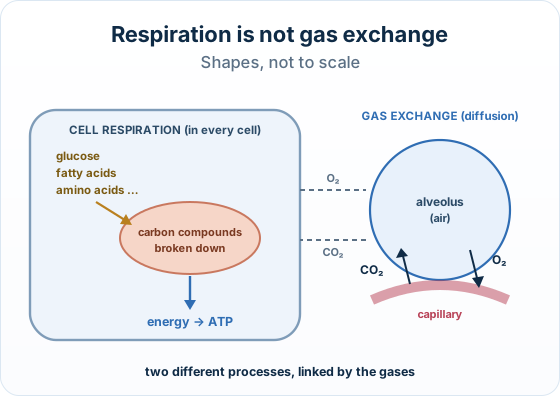
The big idea: Cell respiration is a system of reactions inside cells that releases energy from carbon compounds to make ATP. It is not the same as gas exchange.
The points to remember
- Glucose and fatty acids are the main respiratory substrates.
- Many other carbon compounds, such as amino acids, can be respired too.
- Gas exchange = diffusion of oxygen in and carbon dioxide out across a surface (alveoli, leaves).
- Gas exchange supplies respiration with oxygen and removes its carbon dioxide.
Remember it as: Respiration makes ATP inside cells; gas exchange just moves the gases.
Real example: marathon runners. Early in a marathon, muscles respire mostly glucose from their glycogen stores. As the stores run low, they respire more fatty acids from fat, which is why runners slow down when the glycogen runs out.
Trap: Breathing is ventilation, not respiration. Cell respiration is the chemistry inside cells.
How this is tested: Questions on making ATP are short written answers or data questions. Match your answer to the format below.
The common formats
- 3 marks (Outline): outline how cells generate ATP. Give the chain: respiration releases energy from glucose, and that energy is used to add a phosphate to ADP, regenerating ATP.
- Explain: why cells need energy and how respiration releases it. Score by listing several energy-using processes AND describing the controlled breakdown of glucose.
- Data question: a yeast experiment may ask the function of the sugar (sucrose/glucose) provided. It is the respiratory substrate the yeast respires to release energy.
Exam-style question — outline how cells generate ATP
Outline how a cell generates ATP. [3]
Step by step
- Start with the fuel. The cell carries out respiration, breaking down glucose (the respiratory substrate) to release the energy stored in it.
- Link energy to ADP. This released energy is used to bond a phosphate group onto ADP.
- Name the product. Adding the phosphate to ADP regenerates ATP, which the cell can then use.
Final answer
Respiration breaks down glucose to release energy; that energy is used to add a phosphate to ADP, regenerating ATP.
Why this works: It gives the full chain of cause and effect — glucose broken down, energy released, phosphate added to ADP, ATP regenerated.
An answer that just says 'respiration makes ATP' is not enough: give the mechanism: energy → ADP + phosphate → ATP.
| Stage of the cycle | What happens to the phosphate | Energy |
|---|---|---|
| ADP → ATP (recharging) | A third phosphate is bonded onto ADP | Energy from respiration is needed |
| ATP → ADP (using) | The third phosphate is removed | Energy is released to power cell work |
| Where the energy comes from | Respiration of glucose regenerates the ATP | The cycle runs continuously, all day |
Another question in the papers' style:
Distinguish between cell respiration and gas exchange in a mammal.
Model answer plan
See the answer broken into clear points, with guidance on how each point earns marks.