The big idea: An adaptation is a feature that helps an organism survive and reproduce in the place where it lives.
Every habitat sets challenges: Every habitat sets challenges — heat, cold, a shortage of water, finding food, or avoiding being eaten. An adaptation is the animal's 'answer' to one of these challenges.
Animal adaptations come in three types
- Structural — the body's parts
- Physiological — how the body works inside
- Behavioural — what the animal does
- Adaptation
- A feature that helps an organism survive and reproduce in its particular environment.
- Structural (anatomical) adaptation
- A physical feature of the body — its shape, size or parts (for example large ears or a thick coat of fur).
- Physiological (functional) adaptation
- A way the body works on the inside — its chemistry or internal processes (for example making very concentrated urine).
- Behavioural adaptation
- Something the animal does — an action or habit (for example resting in a burrow during the heat of the day).
- Environment (habitat)
- The surroundings an organism lives in, including its abiotic conditions such as temperature, water and light.
| Type of adaptation | What it is | Animal example |
|---|---|---|
| Structural (anatomical) | A feature of the body's shape, size or parts | A fennec fox's large ears that lose heat in the desert |
| Physiological (functional) | A way the body works on the inside (its chemistry or processes) | A camel producing very concentrated urine to save water |
| Behavioural | Something the animal DOES (an action or habit) | A desert lizard sheltering in a burrow during the hot midday |
Structure, function, behaviour: A quick way to keep the three types apart:
Structural = what the body has (a part you could point to).
Physiological = what the body does inside (a process you cannot see).
Behavioural = what the animal does (an action it chooses).
Free preview
This is the free notes preview
You're reading the free notes. Aimnova Pro unlocks the full study experience — and you can try it with your first topic free to keep:
- FlashcardsLock in vocabulary and key terms with spaced repetition.
- Practice questionsAnswer exam-style questions and get instant AI marking.
- Mock exams & past-paper vaultSit full mocks and see exactly how examiners award marks.
- Personalised study planA daily plan built around your exam date and weak areas.
An adaptation only makes sense once you link it to the challenge it solves.
The exam reward is for a clear cause → effect chain: name the feature, then say how it helps the animal survive in its particular environment.
Coping with heat and water shortage (deserts): Desert animals face two linked problems: too much heat and too little water.
Desert adaptations
- Structural: large, thin ears with many blood vessels lose heat to the air; thin fur lets heat escape.
- Physiological: the kidneys make very concentrated urine, so little water is lost.
- Behavioural: the animal is active at night and shelters in a cool burrow by day, avoiding the hottest hours.
Coping with cold: Cold-climate animals must keep heat in.
Structural: thick fur and a layer of fat (blubber) insulate the body; small ears reduce heat loss.
Physiological: shivering muscles release heat; the body raises its metabolic rate.
Behavioural: animals huddle together to share warmth, or migrate to warmer places for the winter.
| Challenge | Structural example | Physiological example | Behavioural example |
|---|---|---|---|
| Coping with heat (hot desert) | Large ears / thin fur to lose heat | Concentrated urine to save water | Active at night, resting in a burrow by day |
| Coping with cold | Thick fur and a layer of fat (blubber); small ears | Shivering to release heat from respiration | Huddling together; migrating to warmer areas |
| Water shortage | Few sweat glands; a water-storing body | Producing very little, concentrated urine | Getting water from food instead of drinking |
| Finding food | Teeth or mouthparts shaped for the diet | Gut microbes that digest tough plant material | Foraging where the right food is found |
| Avoiding predators | Camouflage colours; a protective shell | Releasing a foul taste or toxin | Staying alert (vigilance); feeding in a group |
Finding food and avoiding predators: Two more challenges drive many adaptations.
Feeding: teeth, beaks and mouthparts are shaped for the diet — sharp teeth for meat, flat grinding teeth for plants; gut microbes help digest tough food.
Predator avoidance: camouflage, a hard shell, a warning toxin, staying alert (vigilant), or feeding in a group all lower the chance of being eaten.
Predator adaptations (catching food)
- Sharp teeth, claws or a hooked beak
- Forward-facing eyes to judge distance
- Speed or stealth to catch prey
- Camouflage to ambush prey unseen
Prey adaptations (avoiding being food)
- Camouflage colours to blend in
- Side-facing eyes for a wide field of view
- Vigilance and feeding in a group
- A shell, spines or a foul-tasting toxin
Always finish the 'because': An adaptation answer is only complete when you say why it helps.
'Large ears' scores little; 'large ears, which lose heat and keep the animal cool in the desert' scores the mark. Name the feature, then give the survival benefit.
Know your predicted grade
Take timed mock exams and get detailed feedback on every answer. See exactly where you're losing marks.
The big idea: Desert plants must get water when it rains, store it, and lose as little as possible.
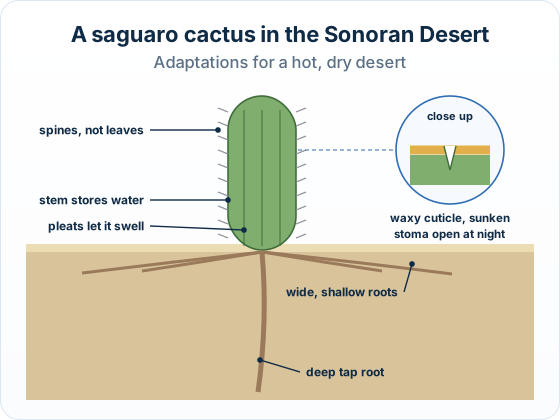
The points to remember
- Wide, shallow roots take up rain quickly; deep roots reach water far underground.
- Water storage in a thick stem or leaves (succulents) lasts through drought.
- Spines or tiny leaves give a small surface area, so less transpiration.
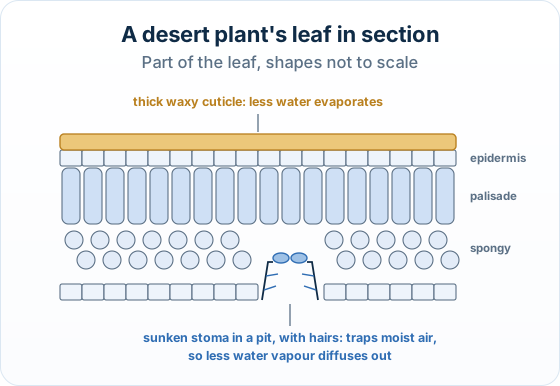
- A thick waxy cuticle cuts evaporation; few, sunken stomata keep moist air close.
- Some open their stomata only at night, when it is cooler, so less water is lost.
Remember it as: Get it, store it, keep it.
Real example: the saguaro. A large saguaro in the Sonoran Desert can soak up hundreds of litres of water after a storm, and its pleated stem visibly swells; it then lives on that store through the dry months.
Trap: Spines also deter animals, but in a question about dry conditions link them to less surface for water loss.
Drawing a desert leaf in section. Draw the leaf, then add and label two features that save water:
The big idea: Desert animals face heat by day, cold at night and little water: their adaptations lose heat, save water and avoid the hottest hours.
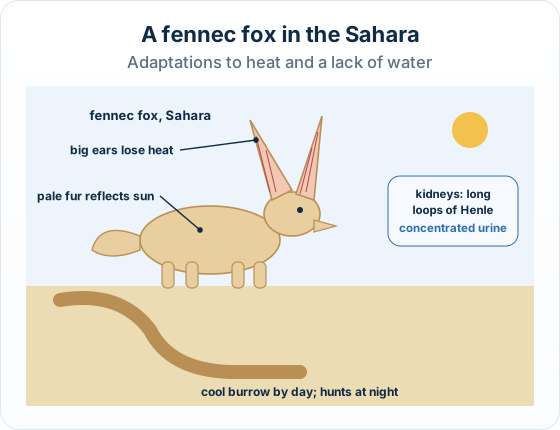
The points to remember
- Large ears with many blood vessels lose heat (fennec fox).
- Pale fur reflects sunlight; fur on the feet protects from hot sand.
- Kidneys with long loops of Henle make very concentrated urine, saving water.
- Nocturnal habits and burrows avoid the daytime heat.
Real example: the kangaroo rat. Kangaroo rats of North American deserts may never drink: they get water from the seeds they eat and from respiration, make very concentrated urine, and stay in sealed burrows by day.
Get feedback like a real examiner
Submit your answers and get instant feedback — what you did well, what's missing, and exactly what to write to score full marks.
The big idea: In a tropical rainforest water is plentiful; the challenges are heavy rain, deep shade under tall trees, and thin, poor soil.
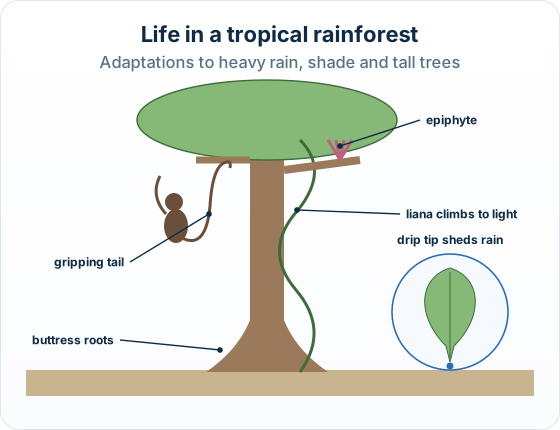
The points to remember
- Buttress roots (kapok tree) support very tall trees in shallow soil.
- Drip tips on leaves shed heavy rain quickly.
- Lianas climb other trees to reach the light; epiphytes grow high on branches.
- Spider monkeys grip branches with a long tail as they move through the canopy.
Tropical rainforests grow in the Amazon, the Congo Basin and South-East Asia: kapok trees and spider monkeys are found in the Amazon rainforest.
How this is tested: Questions here use Suggest, Describe or Explain: you are given a named plant or animal, or a new scenario, and asked how it is adapted.
| Question | What it asks | How to score |
|---|---|---|
| 4-mark Suggest | Herbivore adaptations for feeding on plants | Give four distinct, reasoned features (grinding teeth, a long gut, gut microbes, hours spent feeding) |
| Shorter 1-mark Suggest | A desert mammal, a predator's prey choice, or a feeding animal | Give one adaptation or behaviour, each with its benefit |
Exam-style question — suggest herbivore feeding adaptations
Grazing mammals such as antelope feed only on tough grasses and leaves. Suggest four adaptations that help a herbivore feed on and digest a plant diet. [4]
How to score all four marks
- Teeth shaped for plants. Broad, flat grinding teeth (molars) that grind the tough leaves and stems into a paste, making them easier to digest.
- A long gut. A long digestive system (often with extra stomach chambers) holds the plant food for longer, giving more time to break down the hard cell walls.
- Gut microbes. Microbes living in the gut digest cellulose in plant cell walls, which the animal's own enzymes cannot break down.
- Lots of feeding time. The animal spends many hours feeding, because plant material is low in energy and a large amount must be eaten.
Final answer
Grinding molar teeth to break up tough plants; a long gut to allow slow digestion; gut microbes to digest cellulose; and long feeding times to gather enough energy from low-energy food.
Why this works: Each line is a separate feature with its benefit — teeth (grind), long gut (more digestion time), microbes (digest cellulose), feeding time (enough energy).
A 4-mark Suggest needs four distinct, reasoned points, not one idea repeated. Naming a feature without its benefit is not enough.
| Herbivore feeding adaptation | Type | Why it helps with a plant diet |
|---|---|---|
| Broad, flat grinding teeth (molars) | Structural | Grinds tough leaves and stems into a paste so they can be digested |
| A long gut / extra stomach chambers | Structural | Holds plant food longer, giving more time to break down hard cell walls |
| Microbes living in the gut | Physiological | These microbes digest cellulose, which the animal's own enzymes cannot |
| Spending many hours feeding | Behavioural | Plants are low in energy, so a lot must be eaten to get enough |
Another question in the papers' style:
Describe adaptations of plants that allow them to survive in hot deserts.
Model answer plan
See the answer broken into clear points, with guidance on how each point earns marks.