The big idea: A biome is a large region of the Earth that has a particular climate and a characteristic community of plants and animals.
Biomes you should know
- Hot desert
- Tropical rainforest
- Temperate forest
- Grassland
- Taiga
- Tundra
What decides the biome: What decides which biome forms in a place is mostly two abiotic (non-living) factors: temperature and precipitation (rainfall). Together these set the conditions that plants — and the animals that depend on them — must live in.
- Biome
- A large geographical region with a particular climate and a characteristic community of organisms (for example tropical rainforest or tundra).
- Climate
- The typical pattern of temperature and precipitation in a region, averaged over many years.
- Abiotic factor
- A non-living physical or chemical feature of the environment, such as temperature, rainfall, light or soil.
- Precipitation
- Water that falls onto the land, mainly as rain (also snow). It determines how much water is available to organisms.
- Temperature
- How hot or cold a region is. It affects which organisms can survive and how fast biological processes happen.
Why temperature and rainfall matter most: Plants are the base of almost every community, and plants are limited above all by how warm it is and how much water there is.
So if you know a region's temperature and its precipitation, you can predict which biome — and therefore which kind of vegetation — it will have.
Free preview
This is the free notes preview
You're reading the free notes. Aimnova Pro unlocks the full study experience — and you can try it with your first topic free to keep:
- FlashcardsLock in vocabulary and key terms with spaced repetition.
- Practice questionsAnswer exam-style questions and get instant AI marking.
- Mock exams & past-paper vaultSit full mocks and see exactly how examiners award marks.
- Personalised study planA daily plan built around your exam date and weak areas.
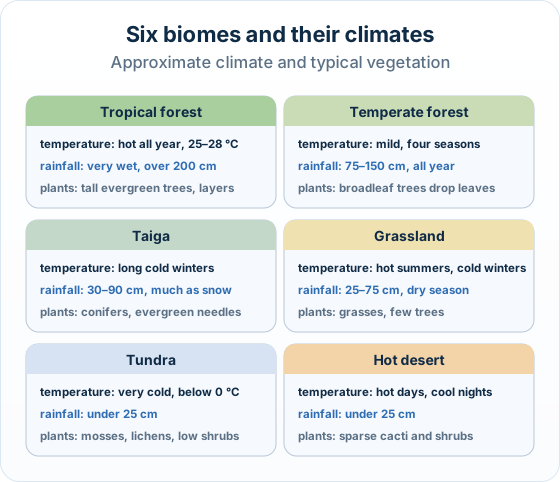
The big idea: Each biome has its own pattern of temperature and rainfall, and that climate decides its typical vegetation.
The points to remember
- Tropical forest: hot and wet all year; tall evergreen trees; nutrient-poor soil; very high biodiversity.
- Temperate forest: mild with four seasons and rain all year; broadleaf trees that drop their leaves.
- Taiga: long, cold winters; moderate precipitation, much as snow; conifers.
- Grassland: hot summers, cold winters and a dry season; grasses with few trees.
- Tundra: very cold and dry, with frozen ground; mosses, lichens and low shrubs.
- Hot desert: very little rain, hot days and cool nights; sparse cacti and shrubs.
Remember it as: Name the biome, then its temperature, its rainfall and its plants.
Questions often give two or three clues, such as climate, soil and biodiversity, and ask for the biome: match every clue, not just one.
Trap: Tundra and hot desert both get under 25 cm of rain a year: only the temperature tells them apart.
Stop wasting time on topics you know
Our AI identifies your weak areas and focuses your study time where it matters. No more overstudying easy topics.
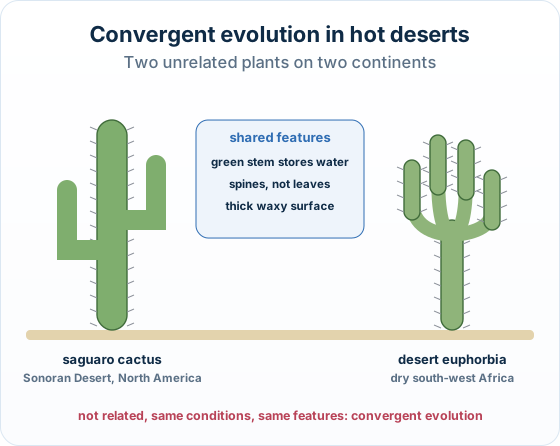
The big idea: A biome is a group of ecosystems with similar communities. They look alike because similar abiotic conditions select similar adaptations: convergent evolution.
The points to remember
- Convergent evolution: unrelated species evolve similar features because they live in similar conditions.
- Ecosystems of one biome can be on different continents, with different species.
- Their communities are still similar in structure: the same kinds of plants and the same adaptations.
Remember it as: Same conditions, same solutions, different ancestors.
Real example: three rainforests, one biome. The rainforests of the Amazon, the Congo Basin and South-East Asia are far apart and share few species, but all are hot and wet all year with tall evergreen trees in layers, so they are one biome.
How it is asked: Expect 'state what a biome is', a choice of climate conditions for a named biome, or a biome to name from its climate, soil and biodiversity.
Explain why the tropical rainforests of South America and South-East Asia are classed as the same biome, although they share few species.
Model answer plan
See the answer broken into clear points, with guidance on how each point earns marks.