The big idea: A coral reef is a marine ecosystem built by tiny animals, coral polyps, that lay down skeletons of calcium carbonate.
The points to remember
- Each polyp is a small animal related to jellyfish; thousands live together as a colony.
- Single-celled algae live inside the polyps' tissue and photosynthesise, passing sugars to the coral.
- The coral uses this energy to build a calcium carbonate skeleton; layers of skeleton build up into a reef.
- The reef gives food and shelter to fish, crabs, molluscs and many other species.
Because the algae need light and the skeleton needs the right water chemistry, reefs form only where the abiotic conditions suit both partners.
Free preview
This is the free notes preview
You're reading the free notes. Aimnova Pro unlocks the full study experience — and you can try it with your first topic free to keep:
- FlashcardsLock in vocabulary and key terms with spaced repetition.
- Practice questionsAnswer exam-style questions and get instant AI marking.
- Mock exams & past-paper vaultSit full mocks and see exactly how examiners award marks.
- Personalised study planA daily plan built around your exam date and weak areas.
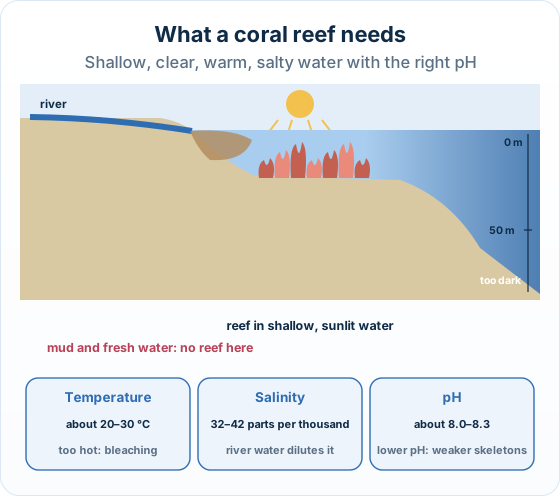
The big idea: Reef-building corals need water that is shallow, clear, warm, salty and slightly alkaline: every one of these must be inside their range of tolerance.
The points to remember
- Depth: shallow, less than about 50 m, so light reaches the algae.
- Clarity: clear water; mud from rivers blocks the light.
- Temperature: about 20 to 30 °C; too hot and the corals lose their algae (bleaching).
- Salinity: full-strength seawater, about 32 to 42 parts per thousand.
- pH: about 8.0 to 8.3; a lower pH makes it harder to build calcium carbonate skeletons.
Remember it as: Shallow, clear, warm, salty, alkaline.
Real example: the Great Barrier Reef. In 2016 a marine heatwave pushed the water above the corals' range of tolerance along the northern Great Barrier Reef in Australia: large areas bleached, and many of the bleached corals died.
Trap: More dissolved carbon dioxide does not help corals: it lowers the pH of seawater, so they build their skeletons more slowly.
Practice with exam-style questions
Answer exam-style questions and get AI feedback that shows you exactly what examiners want to see in a full-marks response.
How it is asked: Expect a choice of conditions, a list of changes to judge, or 'explain why reefs form only in...'. Name the condition and say how it acts on the coral or its algae.
Explain why coral reefs grow only in shallow, clear water.
Model answer plan
See the answer broken into clear points, with guidance on how each point earns marks.