For any abiotic factor, a species does best at some best (optimum) value in the middle.
As the factor moves away from that optimum, the species is put under more and more stress. In the end it reaches a limit beyond which it can no longer survive — so it is absent from places where the factor is too high or too low.
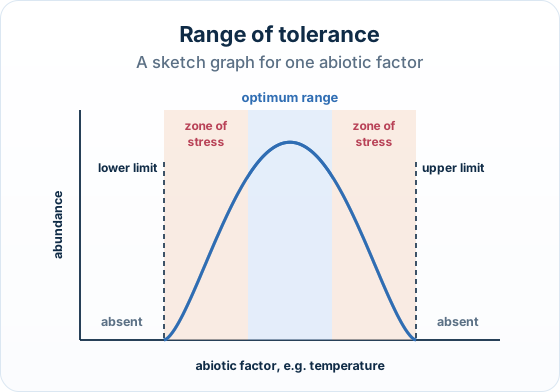
Optimum, stress, and limits: Plot how well a species does against an abiotic factor and you get a range of tolerance.
The range of tolerance
- An optimum range in the middle where the species is most abundant
- A zone of stress on each side where it survives but struggles
- A lower limit and an upper limit — beyond these, the species is absent
The band decides distribution: So an abiotic factor sets a band of conditions in which the species can live — and that band decides its distribution.
An organism thrives in its optimum range, struggles in the zones of stress, and is absent beyond its lower and upper limits of tolerance — so each abiotic factor sets a band of conditions in which the species can live.
Interactive diagram
Explore the labelled diagram, charts and maps for this topic in full study mode.
Each factor works through the organism's biology: An abiotic factor never affects distribution by magic — it works through the organism's biology. When you explain a distribution, always name the factor and the biological reason.
Temperature
- Sets the rate of enzyme-controlled reactions
- Extremes denature proteins
Water
- Needed for cell processes
- Too little dehydrates the organism; too much can drown roots
Light
- Drives photosynthesis in plants
- Deep shade or deep water limits where they grow
| Abiotic factor | Why it affects where a species lives | Example effect on distribution |
|---|---|---|
| Temperature | Sets the rate of enzyme-controlled reactions; extremes denature proteins or freeze tissues | Tropical species are absent from cold mountain tops or polar regions |
| Water / moisture | Needed for cell processes; too little causes dehydration, too much can drown roots or reduce oxygen | Cacti live in dry deserts; rushes live in waterlogged marshes |
| Light | Drives photosynthesis in plants and algae; sets activity in animals | Shade-loving ferns live on a forest floor; few plants grow in deep, dark water |
| pH (acidity) | Affects enzyme activity and the availability of mineral ions in soil or water | Some plants only grow in acidic peat; some fish cannot survive in acidified lakes |
| Salinity (salt) | Affects water movement into and out of cells by osmosis | Only salt-tolerant plants live in estuaries and on coastal mudflats |
Inside the range of tolerance
- Conditions suit the species
- Near the optimum it is most abundant
- Enzymes and cell processes work well
- The species is present here
Outside the range of tolerance
- The factor is too high or too low
- The species is stressed, then cannot survive
- It passes a limiting value
- The species is absent here
An easy way to remember: Think 'Goldilocks': not too hot, not too cold — just right.
A species lives where every abiotic factor is within its range of tolerance. Push any one factor past a limit and the species disappears from that spot.
Free preview
This is the free notes preview
You're reading the free notes. Aimnova Pro unlocks the full study experience — and you can try it with your first topic free to keep:
- FlashcardsLock in vocabulary and key terms with spaced repetition.
- Practice questionsAnswer exam-style questions and get instant AI marking.
- Mock exams & past-paper vaultSit full mocks and see exactly how examiners award marks.
- Personalised study planA daily plan built around your exam date and weak areas.
Every species can only survive within a certain range of each abiotic factor. Too little or too much, and the organism cannot function.
Biologists describe this as the range of tolerance: the organism does best in an optimum range, struggles in a zone of stress on each side, and dies (is absent) beyond the limits of tolerance.
The range of tolerance: For any one abiotic factor — say temperature — an organism's performance follows a bell shape.
Optimum range
- Most abundant and active
Zone of stress
- Either side of the optimum
- Survives but is stressed
Beyond the limits
- Beyond the lower and upper limits of tolerance
- Cannot survive at all
Every factor counts: An organism can only live where every abiotic factor stays within its tolerable range.
An organism's range of tolerance for one abiotic factor: it does best in the optimum range, struggles in a zone of stress on each side, and is absent beyond the lower and upper limits of tolerance.
Interactive diagram
Explore the labelled diagram, charts and maps for this topic in full study mode.
Oxygen — a condition many organisms cannot do without: Dissolved oxygen is one of the most important conditions for survival for aquatic organisms.
Obligate aerobe
- For example many seaweeds and fish
- Must have oxygen to respire
- Without it, it cannot release enough energy and it dies
Obligate anaerobe
- Oxygen is toxic to it
- It can only survive where oxygen is absent
- For example deep in waterlogged mud
Obligate aerobe
- Must have oxygen to survive
- Uses oxygen for aerobic respiration
- Found where oxygen is available (e.g. well-aerated water)
- Dies if oxygen runs out
Obligate anaerobe
- Oxygen is toxic to it
- Releases energy without oxygen
- Found only where oxygen is absent (e.g. waterlogged mud)
- Dies if oxygen is present
| Part of an organism's niche | What it describes | Example for a rock-pool seaweed |
|---|---|---|
| Abiotic conditions it tolerates | The range of physical/chemical conditions it can survive in | It needs dissolved oxygen, a suitable temperature and salinity |
| How it obtains energy / food | Whether it makes or takes its food, and from where | It is a producer — it photosynthesises using light |
| Interactions with other species | Its relationships with other living organisms | It competes for light and space; it is grazed by snails |
Why this matters for distribution: Because each species can only tolerate a certain range of conditions, the niche helps explain where an organism is found.
If a place lacks even one required condition (too cold, too acidic, no oxygen), the organism is absent there — no matter how good the other conditions are.
Sketching the range of tolerance. Label the curve in three steps:
Know your predicted grade
Take timed mock exams and get detailed feedback on every answer. See exactly where you're losing marks.
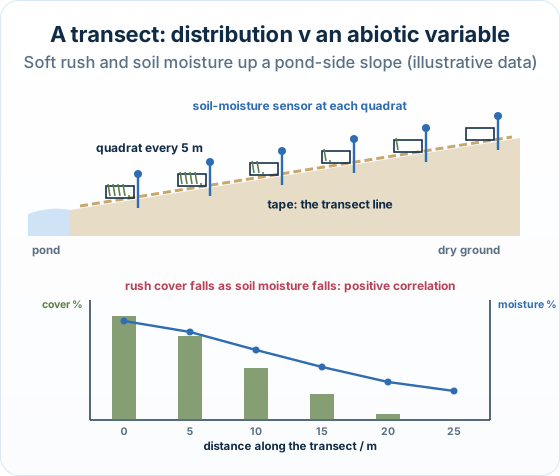
The big idea: A transect tests a range of tolerance in the field: where an abiotic variable changes across a habitat, the species' abundance changes with it.
The points to remember
- Lay a tape across a habitat where an abiotic variable changes: the transect.
- Place quadrats at regular intervals and record the abundance (such as percentage cover).
- Measure the abiotic variable at each quadrat, often with a sensor (light, temperature, moisture, pH).
- Plot both against distance, or one against the other, and look for a correlation.
- A correlation shows the variable may limit the species: it does not prove cause.
Remember it as: Tape, quadrats, sensor, plot, correlate.
Real example: a school transect. Students running a transect up a slope from a pond can record the cover of soft rush in quadrats and soil moisture with a probe: the rush thins out where the soil dries.
Trap: A narrow range of tolerance between the optimum and the upper limit means a species is hit hard by even a small rise in that variable, such as warming.
How it is asked: Expect data: a tolerance curve, germination against temperature, or a transect. Predict or discuss from the optimum and the limits, and quote values.
Seeds of a shrub germinate best at 15 °C (optimum) and not above 20 °C (maximum). After a fire in early summer the soil is at 28 °C and dry; it cools to 18 °C and gets wetter in autumn. Predict, with reasons, when the seeds will germinate.
Model answer plan
See the answer broken into clear points, with guidance on how each point earns marks.