aımnova
DashboardMy LearningCrash CoursesStudy Plan

Aimnova site navigation

Stay in the loop

Get the latest study resources and updates

New features, study tips and exam insights — straight to your inbox.

IB Diploma

  • IB Past Papers
  • IB Study Notes
  • IB Question Bank
  • IB Mock Exams
  • IB Revision

IB Subjects

  • IB Math AA
  • IB Math AI
  • IB Economics
  • IB Business Management
  • IB Physics
  • IB Biology
  • View all IB subjects→

IB Past Papers

  • IB Math AA HL Past Papers
  • IB Math AA SL Past Papers
  • IB Math AI HL Past Papers
  • IB Math AI SL Past Papers
  • IB Economics HL Past Papers
  • IB Economics SL Past Papers
  • IB ESS Past Papers
  • View all past papers→

Study Resources

  • Study Notes
  • Question Bank
  • Mock Exams
  • Crash Courses
  • Flashcards
  • Revision Guide
  • Exam Skills
  • Command Terms
  • Grade Calculator
  • Exam Timetable 2026

Aimnova

  • Features
  • Pricing
  • For Teachers
  • For Schools
  • For Parents
  • About Us
  • Blog
  • Contact
aımnova

IB study, practice and feedback built around the real exam.

TermsPrivacyCookies·© 2026 Aimnova. All rights reserved.06bfe1b

Aimnova is not affiliated with or endorsed by the International Baccalaureate Organization (IB).

NotesBiologyTopic 2.7Adaptations of capillaries for exchange of materials between blood and the internal or external environment
Back to Biology Topics
2.7.14 min read

Adaptations of capillaries for exchange of materials between blood and the internal or external environment

IB Biology · Unit 2

AI-powered feedback

Stop guessing — know where you lost marks

Get instant, examiner-style feedback on every answer. See exactly how to improve and what the markscheme expects.

Try It Free

Contents

  1. 1Built for exchange
  2. 2Fenestrations and the direction of exchange
  3. 3Exam-style question (step by step)
The big idea: Capillaries are where the blood exchanges materials with the cells. Every feature of them makes that exchange faster.

The points to remember

  • Capillaries branch into huge networks: a large surface area for exchange.
  • Their diameter is narrow, about one red blood cell, so they reach close to every cell.
  • The wall is one cell thick (flat endothelial cells): a short diffusion distance.
  • Oxygen and glucose leave the blood; carbon dioxide and wastes enter it.
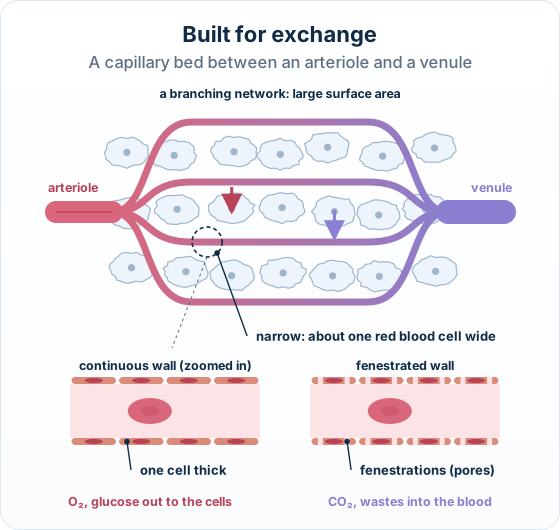
A capillary bed drawn step by step: an arteriole branching into many narrow capillaries between tissue cells and joining a venule, a zoom on the wall one cell thick, a fenestrated wall, and arrows for oxygen out and carbon dioxide in
A capillary bed, one adaptation at a time.
Remember it as: Branched, narrow, thin: area, closeness, short distance.

Real example: skeletal muscle. Muscle is packed with capillaries: a working muscle fibre always has several running beside it, so oxygen and glucose only have a few micrometres to travel.

Free preview

This is the free notes preview

You're reading the free notes. Aimnova Pro unlocks the full study experience — and you can try it with your first topic free to keep:

  • FlashcardsLock in vocabulary and key terms with spaced repetition.
  • Practice questionsAnswer exam-style questions and get instant AI marking.
  • Mock exams & past-paper vaultSit full mocks and see exactly how examiners award marks.
  • Personalised study planA daily plan built around your exam date and weak areas.
Start Studying Free Full access to Aimnova Pro · cancel anytime
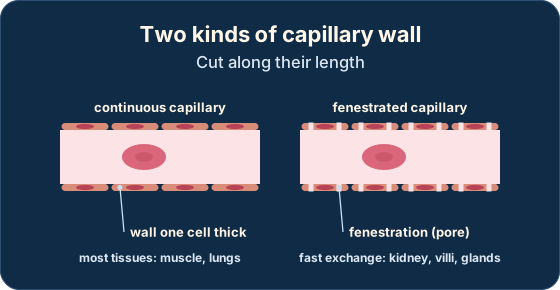
Where exchange must be fastest: Some capillaries have fenestrations: small pores in the wall that let fluid and dissolved substances out and in very quickly.
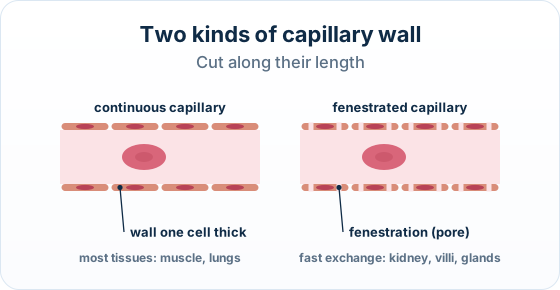
Two capillaries cut along their length: a continuous wall one cell thick, and a fenestrated wall with small pores between and through the endothelial cellsTwo capillaries cut along their length: a continuous wall one cell thick, and a fenestrated wall with small pores between and through the endothelial cells
Continuous and fenestrated capillary walls.
WhereWhy fenestrated capillaries are needed
Kidney (glomerulus)Huge volumes of plasma are filtered every minute
Villi of the small intestineDigested food is absorbed into the blood fast
Glands that release hormonesHormones pass into the blood quickly

The points to remember

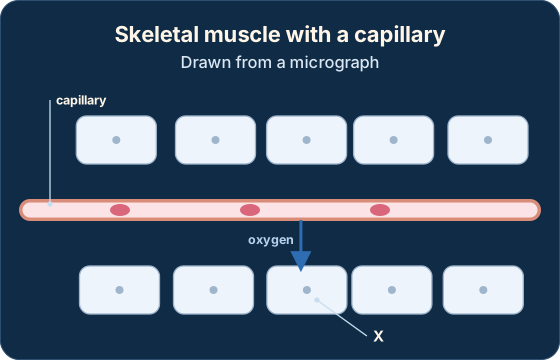
  • On a drawing, an arrow for oxygen or glucose goes from the capillary into the cell.
  • An arrow for carbon dioxide or wastes goes from the cell into the capillary.
  • Capillaries are too small to see at low power: a red blood cell barely fits inside one.
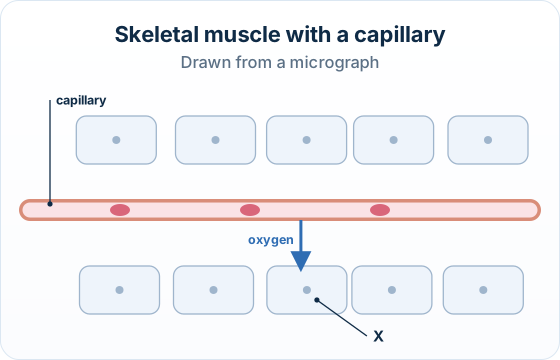
A capillary running between muscle cells, with an arrow drawn from the capillary into cell X labelled oxygenA capillary running between muscle cells, with an arrow drawn from the capillary into cell X labelled oxygen
Drawing the direction of exchange: oxygen from the capillary into cell X.
Two traps: Write that the wall is one cell thick, not that it is 'a thin membrane': the wall is made of cells.

An arrow must go through the capillary wall to or from the cell, never straight from an artery to the cell.

Feeling unprepared for exams?

Get a clear study plan, practice with real questions, and know exactly where you stand before exam day. No more guessing.

Get Exam Ready FreeYour first topic is free to keep • No credit card required
How it is asked: Expect 'describe or outline how capillaries are adapted for exchange', a one-mark 'state the adaptation', or an arrow to draw on a tissue diagram.
IB-style questionDescribe[2 marks]

Describe how capillaries in a working muscle are adapted for the exchange of glucose.

Model answer plan

See the answer broken into clear points, with guidance on how each point earns marks.

Claim your free topic

Try an IB Exam Question — Free AI Feedback

Test yourself on Adaptations of capillaries for exchange of materials between blood and the internal or external environment. Write your answer and get instant AI feedback — just like a real IB examiner.

A sprinter's leg muscles take up glucose rapidly from the blood.

how capillaries are adapted for the exchange of glucose with muscle cells.
[2 marks]

Related Biology Topics

Continue learning with these related topics from the same unit:

2.1.1Chemical properties of carbon that allow diverse compounds2.1.2Production of macromolecules by condensation reactions2.1.3Digestion of polymers into monomers by hydrolysis reactions2.1.4Form and function of monosaccharides
View all Biology topics
Improve your exam techniqueCommand terms, paper structure, and mark-scheme tips for Biology
Previous2.6.99Archived: emphysema and lung disease (withdrawn, not in the 2025 guide)NextStructure of arteries and veins2.7.2

19 practice questions on Adaptations of capillaries for exchange of materials between blood and the internal or external environment

Students who practiced this topic on Aimnova scored 82% on average. Try free practice questions and get instant AI feedback.

Try 3 Free QuestionsView All Biology Topics