The big idea: Facilitated diffusion carries particles that cannot cross the bilayer through a transport protein, still down the concentration gradient.
How it works
Some particles are blocked
Ions (like sodium and potassium) and large polar molecules (like glucose) are charged or water-loving, so the oily, water-hating core of the bilayer blocks them. They cannot slip straight through.
A protein gives a route
They pass through a transport protein embedded in the membrane — a channel protein or a carrier protein.
Still down the gradient
They are still moving down the concentration gradient.
Passive
No ATP (cell energy) is used. The protein only provides a route.
Blocked → protein route → down the gradient → no ATP
The membrane contains both a channel protein (an open hydrophilic pore) and a carrier protein (which changes shape to ferry a molecule across) — these are the proteins that make facilitated diffusion possible.
Interactive diagram
Explore the labelled diagram, charts and maps for this topic in full study mode.
- Facilitated diffusion
- The passive movement of ions and large polar molecules across a membrane, through a channel or carrier protein, down the concentration gradient (no ATP used).
- Channel protein
- A membrane protein with a water-filled pore (tunnel). It lets specific ions or polar molecules pass straight through.
- Carrier protein
- A membrane protein that binds a specific molecule and changes shape to move it from one side of the membrane to the other.
- Concentration gradient
- The difference in concentration of a substance between two areas. Particles diffuse down the gradient — from high to low concentration.
- Passive transport
- Movement that does NOT use the cell's energy (ATP), because particles move down their concentration gradient.
Why a protein is needed at all: The middle of the membrane is made of hydrophobic (water-hating) fatty-acid tails.
Charged ions and water-loving molecules are repelled by this oily core, so they cannot diffuse straight through like oxygen can.
A transport protein gives them a hydrophilic (water-loving) path across — that is the whole point of facilitated diffusion.
Free preview
This is the free notes preview
You're reading the free notes. Aimnova Pro unlocks the full study experience — and you can try it with your first topic free to keep:
- FlashcardsLock in vocabulary and key terms with spaced repetition.
- Practice questionsAnswer exam-style questions and get instant AI marking.
- Mock exams & past-paper vaultSit full mocks and see exactly how examiners award marks.
- Personalised study planA daily plan built around your exam date and weak areas.
There are two kinds of transport protein used in facilitated diffusion, and they work in different ways.
**Channel protein**
- Like an open doorway
- Forms a water-filled pore that lets the particle slip straight through
**Carrier protein**
- More like a revolving door
- The molecule binds to it, and the protein changes shape to carry the molecule from one side to the other
Channel proteins — an open pore: A channel protein has a hydrophilic pore running right through the membrane.
Specific ions (such as sodium, Na⁺, or potassium, K⁺) and small polar molecules pass straight through the pore, down the gradient.
Because the route is open, channels are fast. (Aquaporins, the water channels from 2.3.2, are a special type of channel protein.)
Carrier proteins — bind and change shape: A carrier protein binds the specific molecule it transports (for example glucose or fructose) on one side of the membrane.
It then changes shape to move the molecule across and release it on the other side.
Because it must change shape each time, a carrier is slower than a channel — but it can handle larger molecules.
| Feature | Channel protein | Carrier protein |
|---|---|---|
| What it is | A protein with a water-filled pore through the membrane | A protein that binds the molecule on one side |
| How it works | Opens a hydrophilic tunnel; the molecule passes straight through | Changes shape to move the molecule from one side to the other |
| Speed | Faster (an open route) | Slower (must change shape each time) |
| Typical passengers | Ions (e.g. sodium, potassium) and water (aquaporins) | Larger molecules such as glucose and fructose |
| Direction | Down the concentration gradient | Down the concentration gradient |
| ATP used? | No — passive | No — passive |
Still passive — no ATP: This is the point checked most. Facilitated diffusion moves particles down the concentration gradient (from high to low).
Why it is passive
- The particles move the way they would naturally go anyway, so no ATP is used — it is passive, exactly like simple diffusion
- The only difference from simple diffusion is the route
- Facilitated diffusion goes through a protein, while simple diffusion goes straight through the bilayer
Facilitated diffusion (second panel): ions and large polar molecules pass through a channel or carrier protein, still moving DOWN the concentration gradient and using no ATP — it is passive, just like simple diffusion.
Interactive diagram
Explore the labelled diagram, charts and maps for this topic in full study mode.
Channel protein
- An open water-filled pore through the membrane
- The molecule passes straight through
- Fast — the route is open
- Carries ions (Na⁺, K⁺) and water (aquaporins)
Carrier protein
- Binds the molecule, then changes shape
- Ferries the molecule from one side to the other
- Slower — must change shape each time
- Carries larger molecules (glucose, fructose)
An easy way to remember: Channel = an open channel/tunnel the particle slips through.
Carrier = it carries the molecule by changing shape.
And for both: down the gradient, no ATP — facilitated diffusion is passive.
Stop wasting time on topics you know
Our AI identifies your weak areas and focuses your study time where it matters. No more overstudying easy topics.
The big idea: The shape of a channel protein decides which ion can pass and when. That is what makes a membrane selectively permeable.
The points to remember
- A channel protein is an integral protein with a pore right through the membrane.
- The pore is lined with hydrophilic parts of the protein, so ions can pass through it.
- Each channel is specific: the size and charges of its pore let only one kind of ion through.
- Many channels are gated: ions pass only when the channel is open, not when it is closed.
- Ions move down their concentration gradient: facilitated diffusion is passive, with no ATP.
Name a channel: For facilitated diffusion, name a channel protein. A pump uses ATP, so it is active transport, and answers naming a carrier protein were not accepted on the 2025 papers.
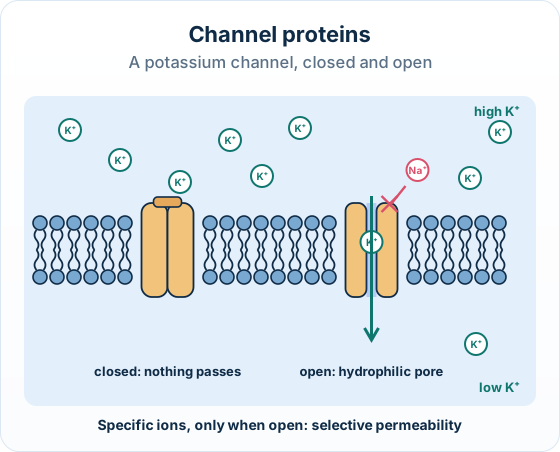
Real example: potassium channels in nerve cells: Nerve cells have potassium channels that open for a moment during each nerve impulse, letting K⁺ ions diffuse out of the cell.
The big idea: Simple diffusion gets faster and faster as the gradient grows. Facilitated diffusion levels off, because there are only so many channels.
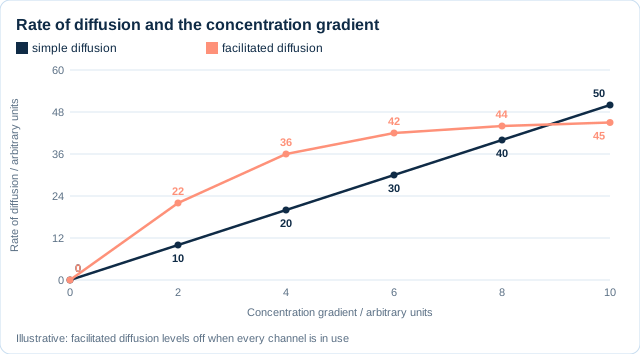
How to read it
- Simple diffusion: the rate rises in step with the concentration gradient.
- Facilitated diffusion: the rate rises, then levels off.
- On the flat part, every channel is in use (saturated), so a steeper gradient cannot make it faster.
- More channels in the membrane would raise the level where the curve flattens.
Not a lack of energy: The curve does not level off because the cell runs out of ATP: facilitated diffusion uses none. The channels are simply all in use.
See how examiners mark answers
Answer exam-style questions with model answers. Learn exactly what earns marks and what doesn't.
How this is tested: Facilitated diffusion is tested as a 4-mark Describe, a 1-mark explain and a short Outline.
| Question | What you are asked | What scores |
|---|---|---|
| Paper 2, 4-mark Describe | How substances move across the membrane by facilitated diffusion | Separate points: the particle is polar / an ion, it passes through a channel or carrier protein, it moves down the concentration gradient, and no ATP is used |
| 1-mark explain | Why a polar molecule like glucose still crosses down its gradient even though it needs a protein | The protein only gives a route; the molecule still moves high → low |
| Short Outline (2 marks) | A sugar such as fructose moving by facilitated diffusion | It binds a carrier protein and moves down the gradient, passively |
Exam-style question — describe facilitated diffusion
Describe how a polar molecule such as glucose crosses the cell membrane by facilitated diffusion. [4]
How to score all four marks
- Say why a protein is needed. Glucose is large and polar (water-loving), so it cannot pass straight through the hydrophobic core of the phospholipid bilayer.
- Name the route. It crosses through a transport protein in the membrane — a carrier protein (or channel protein) specific to that molecule.
- State the direction. It moves down the concentration gradient, from where glucose is at higher concentration to where it is lower.
- State that it is passive. No ATP is used, so it is passive transport. (The carrier binds glucose and changes shape to move it across.) Award 1 mark each for: needs a protein because polar/large; through a channel/carrier protein; down the gradient; passive / no ATP.
Final answer
Glucose is too large and polar to cross the bilayer, so it passes through a channel/carrier protein, moving down its concentration gradient without using ATP — facilitated diffusion is passive.
Why this scores full marks: Each sentence is a separate, distinct point — why a protein is needed, the protein route, the direction, and 'no ATP'.
The mark most students lose is forgetting to say down the gradient and passive / no ATP — without those, a reader cannot tell facilitated diffusion from active transport.
| Feature | Simple diffusion | Facilitated diffusion |
|---|---|---|
| Route across the membrane | Straight through the phospholipid bilayer | Through a channel or carrier protein |
| What can cross | Small, non-polar molecules (e.g. O₂, CO₂) | Ions and large polar molecules (e.g. glucose, Na⁺) |
| Direction | High → low (down the gradient) | High → low (down the gradient) |
| Energy (ATP) | None — passive | None — passive |
| At high solute concentration | Rate keeps rising (straight line) | Rate levels off — proteins become saturated |
A two-mark Outline, in the Paper 2 style:
Outline how potassium ions leave a nerve cell by facilitated diffusion.
Model answer plan
See the answer broken into clear points, with guidance on how each point earns marks.